Retirement / Contributions
How Salary Growth Changes Retirement Contributions and Projections
Compare flat salary with 3% raises while saving 6% of pay. Separate contributions from investment growth, matching assumptions, and future purchasing power.
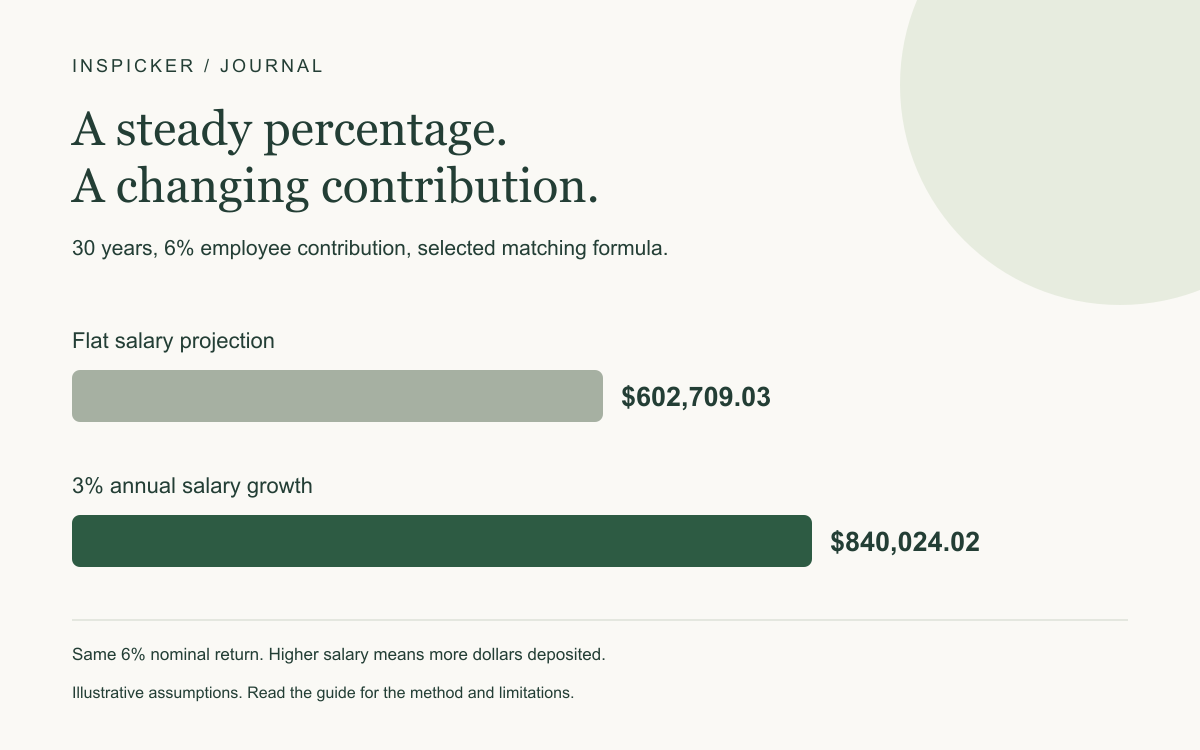
When you contribute a fixed percentage of pay, a salary increase can raise the dollar contribution even if the percentage stays unchanged. A retirement calculator’s salary-growth input changes those future deposits; it is not an extra investment return.
In this hypothetical example, saving 6% of an $80,000 starting salary with a selected employer match produces approximately $602,709.03 after 30 years with flat salary, or $840,024.02 with 3% annual salary growth. Both paths use the same selected 6% nominal annual investment return.
Use the retirement calculator to compare the assumptions separately. Neither the raises nor the investment results in this example are guaranteed.
Salary growth changes deposits; investment return changes balances
A contribution rate answers how much of eligible pay is saved. A salary-growth assumption changes that pay over time. An investment-return assumption changes what happens to money already in the account.
| Input | Meaning in this example |
|---|---|
| Employee contribution: 6% | Six cents of each modeled salary dollar is contributed |
| Salary growth: 3% | Salary rises by the selected percentage between modeled years |
| Investment return: 6% nominal annually | Account balances compound monthly at 6% divided by twelve |
Do not add 3% salary growth to 6% investment return and enter a 9% return. That would change the investment assumption rather than correctly increasing future contributions.
The SEC’s first-job retirement resource discusses saving through workplace plans and increasing contributions as earnings grow. This article isolates the arithmetic of an unchanged contribution percentage applied to changing salary.
A fixed dollar election behaves differently. If you contribute $400 monthly regardless of pay, a raise does not automatically increase that amount. Confirm how your own payroll election operates.
A constant 6% contribution becomes more dollars after a raise
Assume the employee starts at $80,000 and the employer matches 50% of contributions up to 6% of salary. Under that selected single-tier formula, the employer contributes 3% of salary when the employee contributes 6%.
| Modeled year | Salary | Employee annual contribution | Employer annual contribution | Combined deposits |
|---|---|---|---|---|
| First year | $80,000 | $4,800 | $2,400 | $7,200 |
| Second year after a 3% raise | $82,400 | $4,944 | $2,472 | $7,416 |
The employee contribution rises by $144 and the employer contribution by $72. The selected contribution rate remains 6%, and the matching formula remains unchanged.
This is different from raising the employee rate from 6% to 7%. That changes the fraction of salary saved. Read the one-percentage-point contribution guide for that separate comparison.
For the match formula itself, see what a 50% match up to 6% means. Actual plans can use different compensation definitions, multiple matching tiers, eligibility conditions, and timing rules.
Compare the same 30-year horizon with different salaries
Both paths start at age 35, end at 65, and begin with zero invested balance. The employee rate is 6%; the employer match is 50% up to a 6% contribution cap. The nominal investment return is 6% annually, compounded monthly, with deposits at month-end.
Only annual salary growth changes: 0% in one path and 3% in the other.
| Over 30 years | Flat salary | 3% annual salary growth |
|---|---|---|
| Employee deposits | $144,000.00 | $228,362.00 |
| Employer deposits | $72,000.00 | $114,181.00 |
| Modeled investment growth | $386,709.03 | $497,481.02 |
| Projected ending balance | $602,709.03 | $840,024.02 |
The projected ending difference is approximately $237,314.99. That is not all extra investment profit: approximately $126,542.99 comes from additional employee and employer deposits, with approximately $110,772.00 of additional modeled growth.
The rising-salary path requires larger dollar deposits. It does not create the higher balance for the same dollar contribution commitment. Keeping the percentage constant changes the contribution amount as pay changes.
These are hypothetical future-dollar projections without fees or taxes. The model assumes the selected match continues and all employer contributions are retained. Actual employment and market outcomes can differ.
Check when the raise applies and what the model leaves out
InsPicker applies the starting salary during the first modeled year and increases it between years. In a 30-year projection, the final contribution year therefore uses 29 salary increases, not 30.
At 3% annual growth, that final-year salary is approximately $188,525.24, with an employee contribution of approximately $11,311.51. Applying a thirtieth raise before the final year would overstate that year’s deposits relative to this model.
A real raise may occur midyear, payroll deductions may use different eligible-pay rules, and employment can change. Equal annual raises are a simplifying assumption rather than a career forecast.
Contribution limits do not disappear when salary rises
The calculator does not enforce annual tax-law limits or plan-specific restrictions. At sufficiently high pay or contribution rates, a percentage-based projection could imply deposits that require adjustment.
Review the IRS contribution-limit guidance for the relevant year and plan. This article does not assume today’s dollar limits remain unchanged for 30 years or independently project future limits.
Matching eligibility, vesting, annual adjustments, and compensation caps also need plan-specific review. A smooth model should not be treated as a promise that every displayed employer dollar will be received and retained.
A raise can change both saving and spending needs
A 3% salary increase does not necessarily create 3% more take-home cash. Taxes, deductions, benefit costs, and other payroll factors can change. The retirement tool does not calculate the paycheck impact.
Check the actual net amount available after the contribution. Update the budget planner using that take-home figure, without subtracting payroll retirement saving again if it has already been withheld.
Also distinguish nominal pay growth from improved purchasing power. If living costs rise too, the higher future salary may not buy proportionately more. Similarly, the projected $840,024.02 balance is not expressed in today’s dollars.
Read the retirement inflation guide before comparing a future-dollar projection with a spending target written at current prices.
Test a flat-salary scenario even if regular raises seem plausible. If the retirement plan depends on uninterrupted raises, employment, and favorable returns, those dependencies should remain visible rather than being buried in one final number.
Reproduce the comparison with one input change
Enter age 35, retirement age 65, starting balance zero, salary $80,000, contribution 6%, employer match 50%, match cap 6%, return 6%, and salary growth 0%. Then change only salary growth to 3%.
The separate withdrawal-rate field does not alter the projected account balance. It multiplies the result to produce an initial arithmetic income estimate; it does not test a complete withdrawal strategy.
If your actual contribution is a fixed dollar amount, this salary-percentage model is not an automatic representation of that arrangement. Use a suitable fixed-deposit comparison, such as the compound-interest calculator, while recognizing that it does not independently apply the retirement tool’s match formula.
Common questions about salary growth and retirement saving
Does 3% salary growth mean an extra 3% investment return?
No. It changes future contribution dollars. The account return remains the separately selected investment assumption.
Will a 6% election rise in dollars after a raise?
Under a salary-percentage election applied to the higher eligible pay, yes. A fixed-dollar deduction is different; check your payroll setting.
Is the extra $237,314.99 all investment growth?
No. In this example, a substantial part comes from higher deposits. The article separates contributions from growth so the comparison is not mistaken for a free return increase.
Does the calculator guarantee contribution-limit compliance?
No. It does not enforce all annual legal or plan-specific limits. Review actual rules and payroll circumstances separately.
Method: hypothetical constant annual salary growth applied between years, single-tier employer match, month-end contributions, and monthly compounding. No fees, taxes, contribution limits, vesting losses, or changing employment are modeled.
For education and planning. Check assumptions and product terms before making a financial decision.
Put the numbers to work ↗