Retirement / Inflation
Retirement Savings: Future Dollars vs. Today's Buying Power
Convert a retirement projection into today's purchasing power. Includes checked growth assumptions, inflation scenarios, and withdrawal-rate limitations.
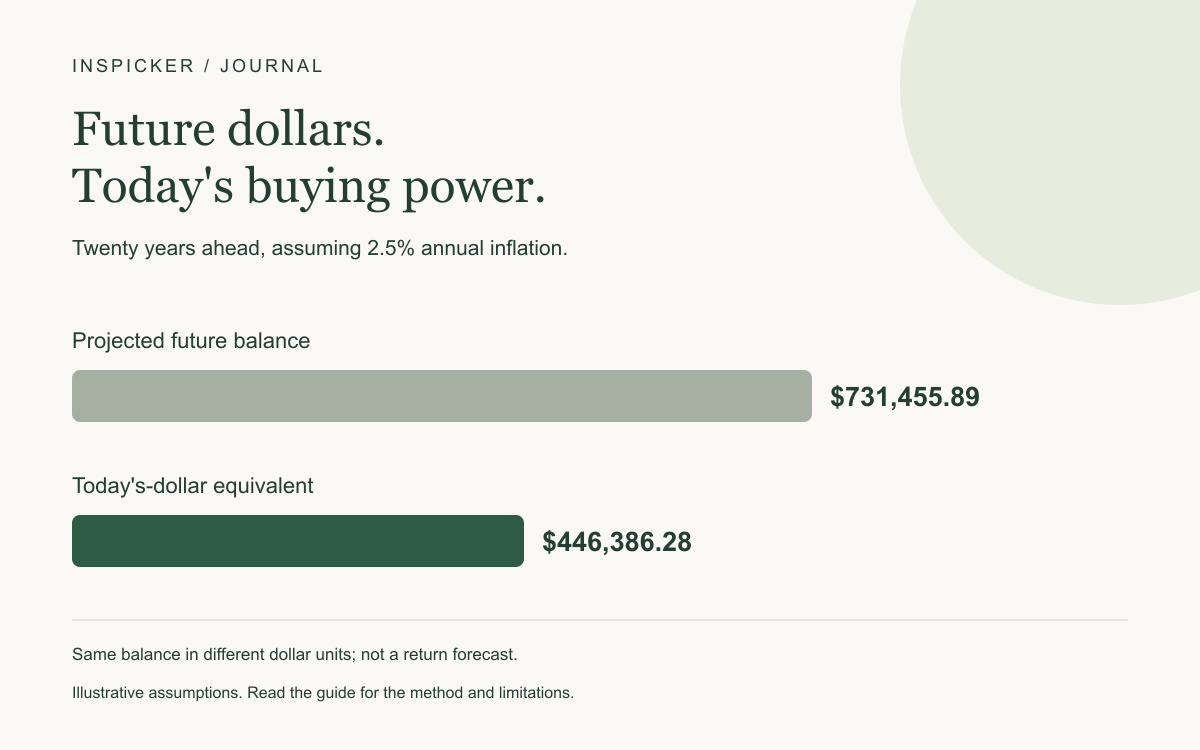
A retirement projection in future dollars is not the same as its buying power today. Convert the projected amount into today’s dollars by dividing it by the accumulated inflation factor for the years until retirement.
For example, $731,455.89 received 20 years from now has approximately $446,386.28 of today’s purchasing power if inflation averages 2.5% annually. Those are two ways of expressing the same projected balance, not two different accounts or an extra loss to subtract afterward.
Start with the retirement calculator, then use the conversion below to interpret the result. The calculator’s retirement projection does not automatically apply this article’s inflation adjustment.
Future dollars and today’s dollars answer different questions
A future-dollar, or nominal, balance describes the projected number shown in the account at a later date. A today’s-dollar, or real, balance describes what that number could buy relative to current prices.
The SEC’s investor education guide to investment risk identifies inflation as a risk to purchasing power. A larger account balance can still feel less substantial if the goods and services it must fund also cost more.
Neither unit is inherently wrong. The mistake is comparing a future-dollar asset or income estimate directly with a budget written in today’s prices. Put both sides in the same units before deciding whether the projection appears sufficient.
Inflation is also an assumption, not a known future rate. Your personal spending mix can change differently from a broad inflation measure, especially if housing, healthcare, or other large expenses change during retirement.
A retirement projection with explicit contribution assumptions
Consider this hypothetical household input set:
| Input | Assumption |
|---|---|
| Current age | 45 |
| Retirement age | 65 |
| Current retirement balance | $100,000 |
| Annual salary | $80,000 |
| Employee contribution | 10% of salary, or $8,000 annually |
| Employer match | 50% of contributions up to 6% of salary |
| Annual employer contribution | $2,400 |
| Annual salary growth | 0% |
| Nominal annual investment return | 6% |
| Projection period | 20 years |
The employee contributes more than the 6% of salary eligible for matching. The modeled employer contribution is therefore $80,000 × 6% × 50% = $2,400 per year. This is a selected plan formula, not a statement about every employer’s benefits.
The model compounds monthly at 6% divided by 12 and adds contributions at the end of each month. Salary stays fixed, so the employee’s and employer’s nominal contributions also stay fixed. The combined contribution is approximately $866.67 monthly, with unrounded values retained internally.
| Component over 20 years | Amount |
|---|---|
| Starting balance | $100,000.00 |
| Employee contributions | $160,000.00 |
| Employer contributions | $48,000.00 |
| Modeled investment growth | $423,455.89 |
| Projected future balance | $731,455.89 |
The return is a constant scenario input. Actual returns fluctuate, and fees or taxes may reduce what you retain. This is not a forecast or a promised outcome. Employer vesting, plan limits, and your eligibility also need separate attention.
For the mechanics of adding regular deposits, see compound interest with monthly contributions. That simpler example does not automatically include this retirement model’s employer-match rules.
Divide by the accumulated inflation factor
The conversion is:
Today’s-dollar value = future-dollar value ÷ [(1 + annual inflation rate) raised to the number of years].
At 2.5% inflation for 20 years, the accumulated price factor is approximately 1.6386. Apply it to the projected balance:
$731,455.89 ÷ 1.025²⁰ = approximately $446,386.28 in today’s dollars.
Keeping all the unrounded inputs gives the displayed result; rounded intermediate factors can produce a slightly different number. You do not subtract 2.5% just once, because the assumption applies repeatedly for 20 years.
Also avoid subtracting 2.5% multiplied by 20 directly from the balance. Inflation compounds. The division accounts for that compounding and puts the final balance into a consistent price unit.
The conversion does not mean $285,069.61 will be withdrawn from the account as an inflation fee. It describes a difference in purchasing-power units. The nominal balance in this scenario remains $731,455.89.
Test more than one inflation assumption
Keep the nominal projection fixed and vary only the inflation assumption:
| Average annual inflation over 20 years | Projected balance in today’s dollars |
|---|---|
| 2.0% | $492,248.85 |
| 2.5% | $446,386.28 |
| 4.0% | $333,826.92 |
These are scenarios, not probabilities or inflation predictions. Higher assumed inflation reduces the purchasing power assigned to the same future-dollar balance.
This table deliberately isolates inflation. In reality, investment returns, salary, contributions, and prices can change together. If you increase contributions over time or change the return assumption, first recalculate the nominal projection, then convert that revised result consistently.
Do not assume that subtracting inflation from the return input and leaving every contribution unchanged will always reproduce the same today’s-dollar result. A contribution of $800 in a later year has a different real value from $800 today. A model working entirely in real dollars must handle its cash flows consistently too.
Treat a withdrawal rate as an assumption, not a guarantee
Suppose you multiply the projected balance by a selected 4% initial withdrawal rate:
$731,455.89 × 4% = $29,258.24 for the first year, in future dollars.
At the same 2.5% inflation assumption, that amount is approximately $17,855.45 annually in today’s purchasing power, or about $1,487.95 monthly before any applicable taxes.
The 4% number here is an illustration. Multiplying a balance by a percentage does not prove that withdrawals can last through a particular retirement. The projection does not simulate varying returns, the order of those returns, longevity, tax treatment, or a detailed spending policy.
It also does not establish how later withdrawals change. Taking 4% of the current balance each year and taking an initial dollar amount followed by inflation increases are different withdrawal strategies. This article’s calculation is only an initial-year estimate.
The SEC’s managing lifetime income resource provides a starting point for reviewing retirement income sources and planning risks. A household plan needs more than a single account projection.
Compare income and expenses in the same dollar units
Write a retirement spending estimate using current prices. Separate recurring essentials, discretionary expenses, and irregular costs that may not appear in a normal month. Account for changes you reasonably expect, rather than assuming today’s work-related budget stays identical.
Then express projected retirement income in today’s dollars too. The illustrative $17,855.45 above should be compared with a current-price annual budget, not a future-price budget that has already been inflated.
Other income sources need their own assumptions. A pension with no inflation increases behaves differently from an income source with adjustments. For Social Security, use an estimate based on your earnings record and check which dollar convention it uses. Our Social Security claiming comparison explains a separate timing question; it does not turn this account projection into a complete retirement plan.
Use the budget planner to organize current spending, and revisit the projection when your contribution rate, employer match, retirement date, or balances change. Small input updates can be more useful than adding false precision to a decades-long forecast.
Common questions about inflation-adjusted retirement savings
Does the retirement calculator already adjust its result for inflation?
The retirement projection used here is nominal. This article applies the inflation conversion separately. Check the labels of any calculator you use so you do not adjust a result that is already expressed in today’s dollars.
Is a $1 million future balance the same as $1 million today?
Only if the relevant price level does not change. With positive cumulative inflation, the future balance has less purchasing power than the same number of dollars today. The amount of the difference depends on time and the inflation assumption.
Can I just subtract inflation from the expected return?
That can be a rough shortcut for a rate comparison, but it does not by itself convert every future contribution correctly. This article first projects nominal balances and then divides the final amount by an accumulated inflation factor.
Does a 4% withdrawal guarantee I will not run out of money?
No. The percentage produces an initial arithmetic estimate. It does not model a retirement’s full sequence of returns, spending, taxes, or lifespan, and is not a personalized withdrawal recommendation.
Method: hypothetical monthly compounding with month-end contributions, constant nominal salary and return, and the stated employer-match formula. Inflation conversion uses annual compounded price growth for 20 years. Rounded figures are illustrative; investment returns and retirement income are not guaranteed.
For education and planning. Check assumptions and product terms before making a financial decision.
Put the numbers to work ↗