Retirement / Employer match
What Does a 50% Employer Match Up to 6% of Salary Mean?
Understand a 50% match up to 6% with an $80,000 salary example. Compare employee contribution levels, match caps, projections, and plan limitations.
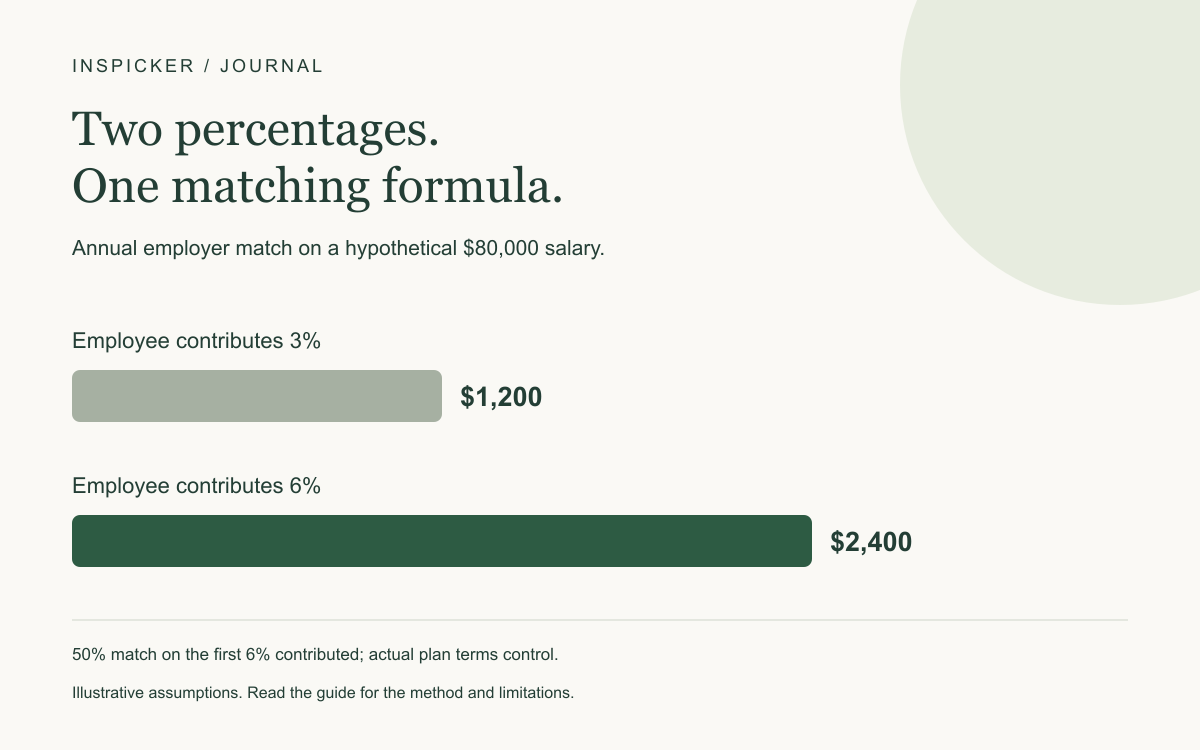
A 50% employer match on contributions up to 6% of salary means the maximum employer contribution is 3% of salary. You contribute the eligible 6%; the employer contributes half that amount. It does not mean the employer contributes 6% or matches half your entire salary.
At an assumed $80,000 annual salary, contributing $4,800 a year earns a $2,400 annual match under this specific formula. Contributing more than $4,800 still adds to your own retirement savings, but it does not increase this formula’s match.
Use the retirement calculator to test the contribution rate, match rate, and matching cap separately. Your plan’s written terms control eligibility, compensation definitions, matching dates, and vesting.
The match rate and matching cap do different jobs
The formula used here is:
Employer contribution = annual salary × smaller of employee contribution rate or matching cap × match rate.
For a 50% match up to 6% of salary, the match rate is 50% and the cap is 6%. If the employee contributes 6% or more, the maximum employer amount is:
$80,000 × 6% × 50% = $2,400.
The employee’s contribution is a separate $4,800 at a 6% contribution rate. Together, $7,200 enters the modeled account during the year.
This is a hypothetical single-tier formula. Some plans use multiple matching tiers, fixed contributions, different compensation definitions, or other conditions. Do not force those arrangements into this formula simply because the plan summary mentions a percentage.
The Department of Labor’s retirement-plan FAQs explain that plan features and requirements vary and direct participants to their Summary Plan Description. Ask the administrator to explain any wording you cannot translate into an actual dollar example.
Compare contributions below, at, and above the cap
Hold the salary and employer formula constant:
| Employee contribution rate | Employee annual contribution | Employer annual match | Combined annual contribution |
|---|---|---|---|
| 3% | $2,400 | $1,200 | $3,600 |
| 6% | $4,800 | $2,400 | $7,200 |
| 10% | $8,000 | $2,400 | $10,400 |
Moving from 3% to 6% adds $2,400 of employee contributions and $1,200 of employer contributions annually. Under these assumptions, that is $3,600 more entering the account each year.
Moving from 6% to 10% adds $3,200 of employee contributions but no extra match. That does not make the additional saving useless. It means the matching formula stops increasing the employer amount after the 6% threshold.
The employee’s annual contributions correspond to $200, $400, or about $666.67 monthly when averaged over twelve months. The real payroll deduction depends on pay frequency and eligible pay. These are contribution amounts, not exact changes in take-home pay.
A different formula can have the same maximum
A dollar-for-dollar match up to 3% also tops out at 3% of salary, but it reaches that maximum when the employee contributes 3%. The 50%-up-to-6% formula requires a 6% employee contribution to reach the same maximum employer percentage.
At a 3% employee contribution on $80,000, those two formulas would produce $2,400 and $1,200 of employer money respectively. A headline such as “3% employer match” is therefore less useful than the full formula.
A long-term example with the match separated
The following projection uses the same $80,000 salary for 20 years, starts with a zero balance, and assumes a constant 6% nominal annual return compounded monthly. Contributions arrive at the end of each month. Salary growth is zero, and all modeled employer contributions are retained.
| Employee contribution rate | Employee deposits over 20 years | Employer deposits over 20 years | Projected balance with match |
|---|---|---|---|
| 3% | $48,000 | $24,000 | $138,612.27 |
| 6% | $96,000 | $48,000 | $277,224.54 |
| 10% | $160,000 | $48,000 | $400,435.44 |
At the 6% employee rate, the no-match projection is approximately $184,816.36. Including the assumed match raises it to approximately $277,224.54, a difference of $92,408.18. That difference includes both the $48,000 of employer deposits and their hypothetical growth.
The figures are not promised balances. Returns can vary, fees can reduce growth, salary can change, and the amount you keep may depend on plan terms. The model does not enforce annual contribution limits or calculate taxes.
All balances are in future dollars. See how to interpret a retirement projection after inflation before comparing one with a spending budget written in today’s prices.
Check matching dates, eligibility, and vesting
The calculator distributes contributions evenly through each modeled year. A real plan may calculate its match per paycheck, annually, or under another arrangement. Do not assume the model answers what happens when you front-load contributions or join partway through the year.
Before changing deductions, ask the plan administrator:
- Which pay counts for matching: base pay, bonuses, or another defined amount?
- When do you become eligible, and are there employment conditions for a contribution?
- Is matching calculated each payroll period, and is there a year-end adjustment?
- What happens if contributions stop after reaching an annual limit?
- When do employer contributions become fully yours under the vesting terms?
An annual adjustment is sometimes described as a true-up, but you should not assume your plan provides one. The answer belongs in the plan documents or the administrator’s explanation.
The projection also assumes all employer contributions shown remain available to you. If you leave before satisfying applicable vesting requirements, the amount retained can differ. A contribution displayed in an account and the amount you can keep are not always the same measure.
Match the contribution decision to actual cash flow
Going from 3% to 6% of $80,000 increases gross employee deferrals by $2,400 annually, or $200 monthly on average. The change in take-home pay depends on the type of contribution and applicable payroll tax treatment; this calculator does not calculate it.
Use a payroll estimate or an actual paystub after the change. Then update the budget planner using the new net amount available. Do not subtract a retirement deduction a second time if it has already been withheld from the take-home pay entered in the budget.
Also consider near-term bills, required debt payments, and an accessible reserve. This article explains the arithmetic of a matching formula; it does not establish an individually suitable contribution rate or rank every competing household priority.
Enter each percentage in its proper field
To reproduce the 6% projection, enter current age 45, retirement age 65, starting balance zero, salary $80,000, employee contribution 6%, match 50%, matching cap 6%, return 6%, and salary growth 0%.
The separate withdrawal-rate field does not change the accumulated balance. It multiplies that balance to create an initial income estimate; it does not prove a withdrawal plan is sustainable.
Try 3% and 10% employee contributions while keeping the match and cap unchanged. The employer total should rise from the first scenario to the second, then remain the same above the cap. If it does not match the logic of your actual plan, use the plan’s formula rather than this simplified example.
Common questions about a 50%-up-to-6% match
Does the employer put in 6% of salary?
Under this formula, no. The employer contributes half the eligible employee amount, with eligibility capped at 6% of salary. Its maximum is therefore 3% of salary.
Does contributing 10% earn a 5% match?
Not with the selected 6% cap. Only the first 6% is matched at 50%, so the maximum remains 3% of salary.
Does the calculator handle my plan’s two-tier match?
It uses one match rate and one cap. A multi-tier formula needs a separate calculation; do not assume one headline percentage reproduces it at every employee contribution level.
Are the projected employer contributions all vested?
The model assumes they are retained. Your actual vesting and eligibility terms control the amount you can keep.
Method: hypothetical single-tier match, constant salary, equal month-end contributions, and monthly compounding. No fees, taxes, contribution-limit enforcement, forfeitures, or payroll timing adjustments are modeled.
For education and planning. Check assumptions and product terms before making a financial decision.
Put the numbers to work ↗