Retirement / Contributions
What Does One Percentage Point More in Retirement Contributions Add?
See what increasing contributions from 6% to 7% adds on an $80,000 salary. Compare deposits, projected growth, matching caps, and budget effects.
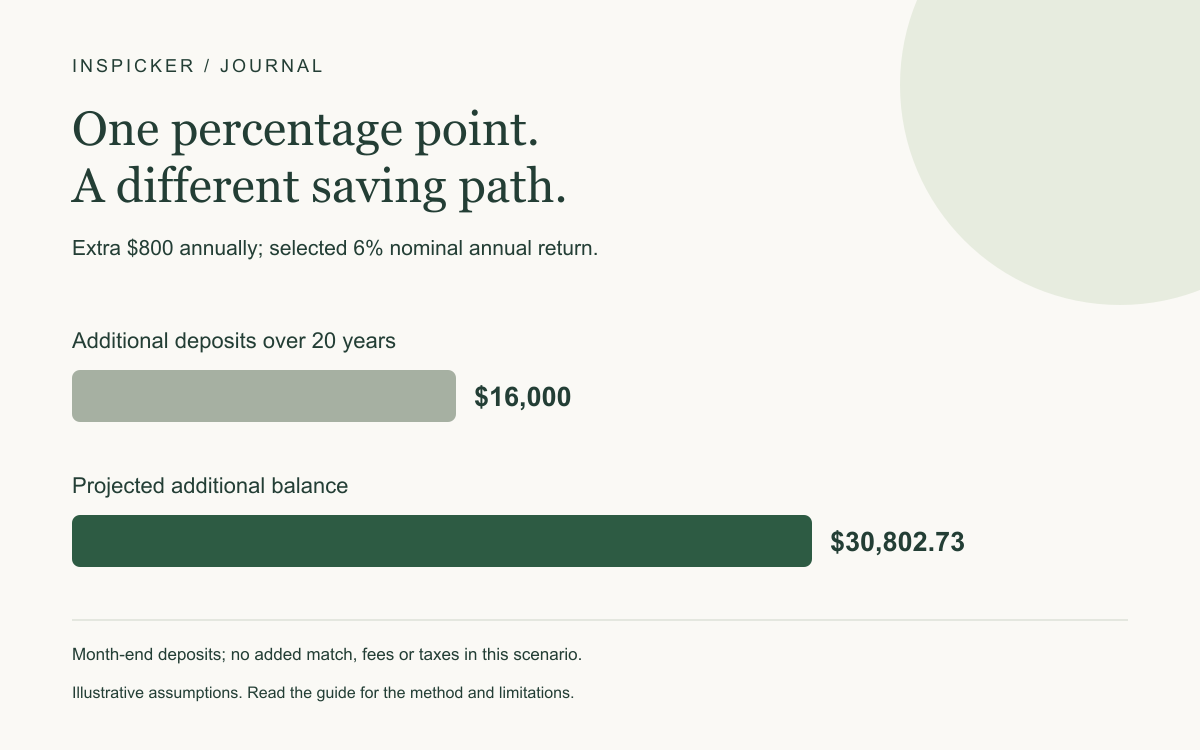
Increasing a retirement contribution from 6% to 7% of an $80,000 salary adds $800 a year, or about $66.67 monthly on average. That is a one-percentage-point increase in the salary contribution rate. It is not the same as increasing the existing contribution amount by 1%.
In a hypothetical 20-year projection at a constant 6% nominal annual return, that extra $800 annually grows to approximately $30,802.73 with month-end deposits. Actual returns, salary changes, fees, taxes, and plan terms can change the outcome.
Use the retirement calculator to compare two contribution rates while keeping the other inputs identical. The useful figure is the difference between the two scenarios, not a balance taken out of context.
A percentage point is a change in the contribution rate
At a 6% contribution rate on $80,000, the annual employee contribution is $4,800. Raising the rate to 7% makes it $5,600. The difference is $800.
By contrast, increasing the existing $4,800 amount by 1% would add only $48 annually, producing $4,848. That corresponds to 6.06% of an unchanged $80,000 salary, not 7%.
| Instruction | New annual employee amount | Increase |
|---|---|---|
| Raise salary contribution rate from 6% to 7% | $5,600 | $800 |
| Raise the existing $4,800 contribution by 1% | $4,848 | $48 |
Payroll election screens and automatic-escalation settings can use different wording. Confirm the resulting contribution rate or dollar deduction rather than relying on the phrase “one percent more.”
Convert the change into the pay schedule you use
The extra annual amount is:
$80,000 × (7% − 6%) = $800.
That averages about $66.67 monthly, $33.33 per twice-monthly paycheck, or $30.77 per paycheck across 26 biweekly paydays. Rounded paycheck amounts may require a small final adjustment, and actual payroll uses eligible compensation and the plan’s calculation rules.
These are gross contribution differences. They do not establish the exact reduction in take-home pay. Contribution type and tax treatment matter, and the calculator does not provide a payroll tax calculation.
If the change applies only for the rest of the year, it will not necessarily produce a full extra $800 that year. The selected rate acts on eligible pay after the election becomes effective. Use remaining payroll dates and compensation to estimate the first year separately.
A 20-year example holding everything else constant
Both paths below start at age 45, end at 65, and begin with a zero balance. Salary is fixed at $80,000. The employer matches 50% of employee contributions up to 6% of salary, and the selected return is 6% nominal annually with monthly compounding.
Contributions are added at month-end. Fees, taxes, annual limits, and forfeitures are excluded.
| Over 20 years | 6% employee contribution | 7% employee contribution |
|---|---|---|
| Annual employee contribution | $4,800 | $5,600 |
| Employee deposits over the horizon | $96,000 | $112,000 |
| Employer deposits over the horizon | $48,000 | $48,000 |
| Projected ending balance | $277,224.54 | $308,027.26 |
The additional employee deposits total $16,000. Under the selected constant-return scenario, they produce approximately $14,802.73 of additional growth, for a total ending difference of $30,802.73.
Small differences from subtracting displayed rounded balances are possible because calculations retain precision internally. The result is a conditional projection, not a promised reward for changing payroll settings.
All balances are future-dollar amounts. Read the inflation-adjusted retirement guide before comparing the projected increase with a current-price spending target.
An extra contribution does not always earn an extra match
In this example, both 6% and 7% employee rates already reach the employer’s 6% matching cap. The annual employer contribution remains $80,000 × 6% × 50% = $2,400 in either path.
The additional $800 employee contribution earns no additional match under that formula. Its projected benefit comes from the extra contribution and its growth.
If the original rate were below the cap, the result could be different. Moving from 3% to 4% under the same selected formula would add $800 of employee money and $400 of employer money annually, assuming the full year is eligible and all terms are satisfied.
For a fuller explanation of the formula, see what a 50% match up to 6% means. The Department of Labor’s retirement-plan FAQs direct participants to their plan documents for actual features and requirements.
Do not assume annual matching arithmetic handles per-paycheck rules, year-end adjustments, eligibility changes, or vesting. Those conditions can affect what is deposited and retained.
Check the real paystub rather than subtracting twice
Before making the change, estimate the paycheck effect using your employer’s payroll tools or benefit information. After it takes effect, compare the new deduction and net pay with the estimate.
Then update the budget planner with the take-home amount actually available. If the deduction has already reduced that figure, do not subtract the $66.67 average again as a checking-account transfer.
Also account for required bills and an accessible reserve. A contribution change is easier to maintain when it is incorporated into an ordinary spending plan rather than funded by repeatedly creating new card debt.
This article calculates the effect of a selected rate change. It does not establish that 7% is a sufficient retirement rate or the right priority for every household. The broader question includes savings already held, expected retirement age, other income, spending, and competing commitments.
Test time and returns instead of relying on one outcome
Keeping the extra $800 annual contribution and month-end deposit pattern:
| Scenario | Additional deposits | Additional projected balance |
|---|---|---|
| 10 years at a constant 6% nominal return | $8,000 | $10,925.29 |
| 20 years at a constant 6% nominal return | $16,000 | $30,802.73 |
| 20 years at 0% return | $16,000 | $16,000.00 |
The 0% row separates the saving effort from assumed growth. Negative returns could leave the value below the deposits. A longer horizon adds more contributions and more time for earlier deposits to grow, but it does not make the selected return certain.
The SEC’s investment-risk guide explains why investment outcomes and purchasing power carry uncertainty. Review appropriate investments and fees rather than treating a contribution election as an investment guarantee.
If salary increases, a fixed percentage produces larger dollar contributions. This article holds salary constant to isolate the one-point change. Adding salary growth creates a new scenario that should be labeled separately.
Common questions about contributing one percentage point more
Is moving from 6% to 7% a 1% increase in dollars?
No. It is a one-percentage-point rate increase. At an unchanged salary, the employee contribution amount rises by about 16.67%, from $4,800 to $5,600 in this example.
Will my paycheck fall by exactly $66.67 monthly?
Not necessarily. That is the average gross contribution increase. Net-pay changes depend on payroll timing and tax treatment, which this calculator does not compute.
Does contributing more always increase employer contributions?
No. In this example, the employer match is already capped at the 6% employee rate. Moving to 7% adds employee saving but no additional match.
Is the extra $30,802.73 guaranteed?
No. It depends on 20 years of selected deposits and a constant 6% nominal return, without fees or taxes. Actual results can be lower or higher.
Method: hypothetical constant salary, one-tier matching formula, and equal month-end deposits with monthly compounding. Comparisons change only the employee contribution rate unless explicitly stated. Tax, payroll, plan-limit, and vesting calculations are excluded.
For education and planning. Check assumptions and product terms before making a financial decision.
Put the numbers to work ↗