Debt / Credit card
How to Pay Off a $5,000 Credit Card in 12 Months: Calculate the Payment
Calculate a fixed payment for a $5,000 card balance at 24%. Compare 12-, 18-, and 24-payment schedules, interest, affordability, and calculator limits.
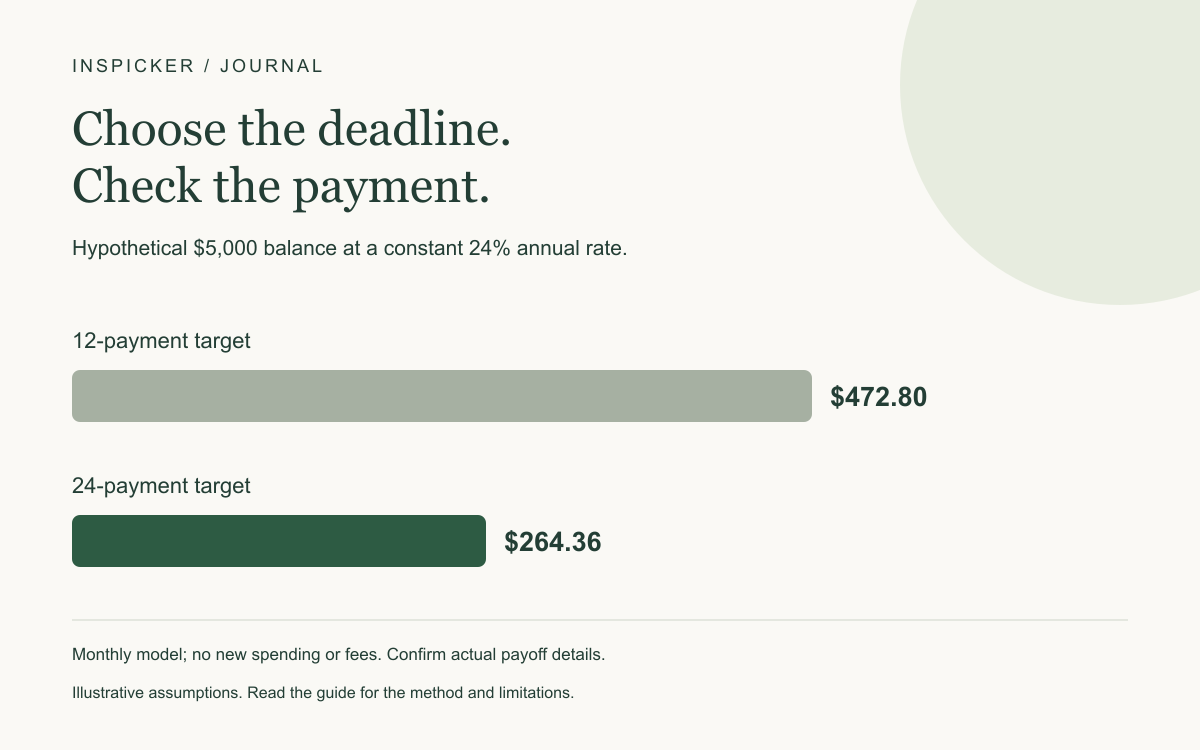
To clear a $5,000 credit-card balance in twelve equal monthly periods at a constant 24% annual rate, the simplified model requires about $472.80 per month. Dividing $5,000 by twelve is not enough because the balance accrues interest while it is being repaid.
The example assumes no purchases, fees, or rate changes. Actual daily-interest methods and payment dates can change the payoff amount. Treat the result as a planning target, then reconcile it with your statements and the issuer’s final payoff information.
Use the credit card payoff calculator to test a proposed fixed payment. The tool simulates a payment you enter; it does not have a dedicated input that automatically solves for a chosen payoff deadline.
A twelve-month target needs more than principal divided by twelve
Ignoring interest, $5,000 divided by twelve is approximately $416.67. At the selected interest rate, that amount does not account for the charges added before the balance is cleared.
The example uses a monthly rate of 24% ÷ 12 = 2%. First-month interest is $5,000 × 2% = $100. A $472.80 payment therefore reduces principal by $372.80 in that modeled month, leaving $4,627.20.
The next month’s interest is calculated from the smaller remaining balance. That makes a fixed-payment amortization calculation more appropriate than simply adding a full year’s interest on the original $5,000.
For a positive monthly rate, the mathematical target is:
Payment = balance × monthly rate ÷ [1 − (1 + monthly rate) raised to the negative number of payments].
Using $5,000, 2%, and twelve payments gives approximately $472.798 before rounding. Rounding upward to cents gives $472.80.
The CFPB explains that many card issuers calculate interest daily. The monthly convention here keeps the example reproducible; it is not a prediction of every statement’s exact interest.
Shorter deadlines require larger payments but less interest
Keep the same $5,000 opening balance and 24% annual rate. Calculate a target for each selected number of monthly periods, round upward to cents, then simulate that payment through payoff:
| Selected payoff schedule | Fixed payment target | Modeled total interest | Principal plus interest |
|---|---|---|---|
| 12 payments | $472.80 | $673.57 | $5,673.57 |
| 18 payments | $333.52 | $1,003.16 | $6,003.16 |
| 24 payments | $264.36 | $1,344.50 | $6,344.50 |
The final payment is adjusted to the remaining amount. Calculations keep unrounded balances internally, so multiplying the displayed target by the full payment count can slightly overstate the final total.
Compared with the 24-payment path, the 12-payment path requires $208.44 more per month and avoids about $670.93 of interest in this scenario. Neither schedule is automatically affordable for a particular household.
The table is not an offer for a new loan or a statement about your card’s minimum. It compares selected fixed-payment schedules on the same hypothetical balance.
What happens if $400 is the amount available?
At $400 monthly under the same assumptions, the model clears the balance in 15 payments, with approximately $811.97 of interest.
After the twelfth $400 payment, approximately $976.37 remains. That is the difference between a schedule that makes progress and one that meets the selected twelve-payment deadline.
| Fixed monthly amount | Result in the model |
|---|---|
| $472.80 | Clears in 12 payments |
| $400.00 | Clears in 15 payments; about $976.37 remains after payment 12 |
The gap between the two monthly commitments is $72.80. Across the complete schedules, the $400 path costs approximately $138.40 more interest.
If $472.80 does not fit actual cash flow, entering it into a calculator does not solve that constraint. Use the budget planner to review a contribution you can maintain alongside essential bills and required payments on other debts.
A longer realistic schedule is more informative than an aggressive target repeatedly missed. If obligations are unaffordable, contact the issuer about available options rather than assuming an unapproved smaller payment changes the agreement.
A fixed target does not replace the statement’s requirements
The modeled minimum in this example is interest plus 1% of balance, subject to a $25 floor. The opening modeled minimum is $150. Every target in the twelve-, eighteen-, and twenty-four-payment table exceeds that initial amount.
Your actual minimum can use a different formula. Always follow the statement’s required amount and due date; the selected target is a separate planning calculation.
InsPicker’s simulator also applies its configured minimum if an entered fixed amount is lower. The interest-versus-principal guide explains that behavior.
Some statements provide a three-year repayment comparison. The CFPB explains that estimate and its no-new-purchases assumption. It is not automatically the amount needed for a different deadline such as twelve months.
For the broader difference between shrinking minimums and constant payments, see the minimum-versus-fixed comparison.
Recalculate from the current balance and remaining time
A fixed target assumes the original inputs remain relevant. New spending, a fee, a rate change, or a different payment date can shift the result.
Do not keep using the old $472.80 figure after the balance or deadline changes and assume it will correct itself. Review the current statement balance, applicable rates, and payment opportunities left.
Also avoid counting a payment before it posts. A planned transfer and a processed account payment are different events. Keep confirmation and check that the payment was applied as expected.
If the card has several balances at different rates, a single-rate calculation will not reproduce all allocation rules. Obtain the account breakdown rather than replacing every rate with whichever number produces a preferred result.
A promotional rate requires another model. The balance-transfer deadline guide includes fees and expiration assumptions; the deferred-interest guide explains why some conditional promotions need additional review.
Enter the fixed amount and inspect the resulting schedule
Enter a $5,000 balance, 24% APR, 1% principal in the modeled minimum, a $25 floor, and $472.80 fixed monthly payment. The selected model should show twelve payments and approximately $673.57 interest.
Change only the fixed amount to $400 to reproduce the fifteen-payment comparison. Restore the original assumptions before testing $333.52 or $264.36.
The calculator does not model every daily billing detail, additional transactions, penalties, or changing rates. Its result should help organize a plan, not replace the issuer’s payoff quote or contractual requirements.
At the end of the schedule, confirm what is actually needed to clear the account. Do not assume a rounded calculator balance guarantees there can be no remaining interest or other account activity.
Common questions about a twelve-month card payoff
Is $416.67 enough to clear $5,000 in twelve payments?
Only in a zero-interest, no-additional-charge calculation. The selected 24% monthly model needs approximately $472.80.
Does $400 a month make no progress?
It makes substantial progress in this example, but misses the twelve-payment target. It clears in fifteen payments instead.
Does the tool automatically solve for my deadline?
It simulates a fixed amount you enter. This article calculates deadline-based starting targets separately and then checks them in the model.
Will the final payoff match the table exactly?
Not necessarily. Actual daily interest, rounding, transaction timing, and account activity can differ. Confirm the final amount with the issuer.
Method: hypothetical constant 24% annual rate divided by twelve, equal monthly payment periods, no new spending or fees, and the stated modeled minimum. Payment targets are rounded upward; the final installment is capped at the amount owed.
For education and planning. Check assumptions and product terms before making a financial decision.
Put the numbers to work ↗