Debt / Credit card
Why Your Credit Card Payment Barely Reduces the Balance
See how a $5,000 card balance at 24% divides payments between interest and principal. Understand the modeled minimum and a checked $200 payoff schedule.
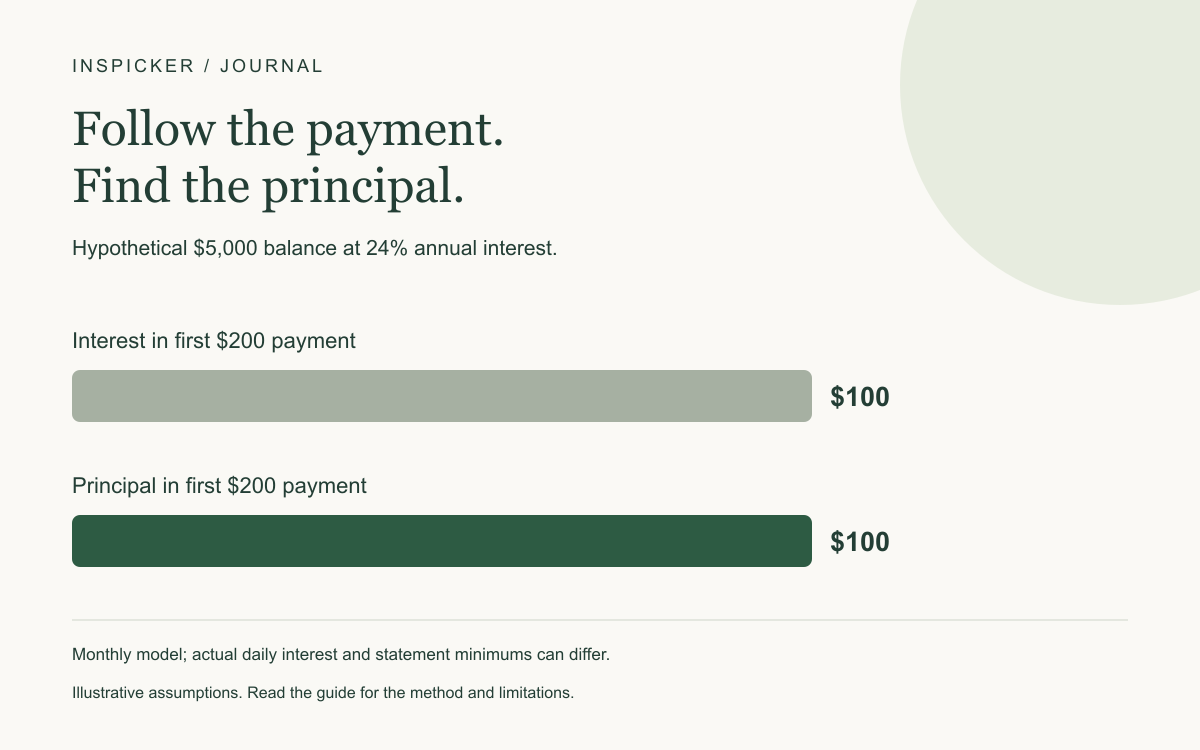
A credit-card payment reduces principal only after covering the period’s interest and other applicable charges. A payment that barely exceeds interest can produce slow progress even when it looks substantial in the monthly budget.
In a simplified monthly example, $5,000 at 24% annual interest accrues $100 in the first month. A $120 payment leaves only $20 to reduce principal before considering fees or other activity. That arithmetic does not mean $120 satisfies the issuer’s actual minimum.
Use the credit card payoff calculator to compare repayment schedules. Its minimum-payment settings matter: the tool does not assume that entering a low fixed amount permits paying less than its modeled minimum.
The whole payment does not reduce the balance
For the selected balance and rate, the model’s monthly interest is:
$5,000 × 24% ÷ 12 = $100.
Ignoring fees and new spending, the next balance is the old balance plus interest minus the payment.
| Hypothetical first payment | Interest covered | Change in principal | Next balance |
|---|---|---|---|
| $80 | Less than the $100 accrued | Balance grows by $20 | $5,020 |
| $100 | $100 | $0 | $5,000 |
| $120 | $100 | Balance falls by $20 | $4,980 |
| $200 | $100 | Balance falls by $100 | $4,900 |
This table illustrates arithmetic only. It is not a list of permitted payment choices, and it does not model the consequences of failing to pay an actual minimum.
The CFPB explains that many issuers calculate interest daily, commonly using average daily balances. Actual billing periods and transaction dates can therefore produce a different charge from the simplified annual-rate-divided-by-twelve example.
The calculator applies its modeled minimum even with a fixed amount
Suppose the tool’s minimum settings are 1% of balance as principal plus interest, subject to a $25 floor. At the opening $5,000 balance and 24% rate:
Modeled minimum = greater of $25 or ($50 principal + $100 interest) = $150.
If you enter a fixed payment of $120, the simulation uses at least the modeled $150 minimum at that point. It does not reproduce the $120 arithmetic row above. That is deliberate behavior: the fixed amount is subject to the minimum configured in the tool.
Read your own statement to determine the required amount and due date. The example’s 1%-plus-interest formula is a selected modeling convention, not a claim that every issuer uses the same minimum.
This also explains why changing only the fixed-payment box may not create the scenario you expected. Check the minimum principal percentage and floor, and understand how they interact before comparing results.
At $200, principal reduction increases as interest declines
With a fixed $200 payment, the opening balance falls to $4,900 after the first modeled month. The next month’s interest is $4,900 × 2% = $98, leaving $102 of the next payment to reduce principal.
The fixed payment stays the same while the interest portion generally falls as the balance shrinks. That releases more of each payment for principal. The pattern is different from a minimum payment that declines with the balance.
Using the $5,000 balance, 24% rate, 1% minimum-principal setting, $25 floor, and fixed $200 payment gives:
| Modeled result | Amount |
|---|---|
| First payment | $200.00 |
| Number of monthly payments | 36 |
| Total interest | $2,000.56 |
| Principal plus interest paid | $7,000.56 |
The final payment is smaller than $200. Calculations retain unrounded balances internally, so actual statement rounding can differ.
The minimum-versus-fixed-payment guide compares the two full schedules. This article focuses on why a payment can make less principal progress than the dollar amount initially suggests.
A stalled model result is not a literal forecast of all future statements
If a modeled payment cannot cover the accrued interest, it cannot clear principal under those assumptions. Likewise, a schedule that fails to finish within the tool’s simulation limit should not be presented as a completed payoff.
InsPicker labels unfinished schedules rather than claiming a finite full-repayment cost. A stalled result does not calculate every consequence of missing contractual payments, such as fees, changed terms, collection activity, or credit reporting.
With a positive modeled minimum-principal percentage, the calculator may raise a low entered fixed amount above the interest charge. That can prevent the exact below-interest scenario from appearing even when the fixed-payment field alone looks too small.
Do not adjust the minimum settings merely to produce an attractive payoff date. Use them to represent the relevant agreement as closely as the simplified model permits.
New charges and timing can undo modeled progress
The payoff example assumes no purchases, cash advances, fees, or additional transfers. If you pay $200 but add $150 of new purchases, the account is no longer following the no-new-spending path shown here.
Different types of balances may also have different interest rates. A single-rate calculator does not replicate every payment-allocation rule across purchases, transfers, and cash advances.
Review the statement’s opening balance, interest, fees, new activity, payments, and closing balance. That reconciliation can reveal whether slow progress comes from interest, ongoing spending, or another charge rather than from the payment amount alone.
If the required payment is unaffordable, contact the issuer to discuss available options rather than treating a calculator’s smaller hypothetical payment as an approved arrangement. The budget planner can help identify a sustainable amount alongside other obligations.
For a promotional transfer, use the deadline-based transfer payment guide. A 0% period changes the interest calculation, but its fee, expiration date, and actual minimum still need attention.
Common questions about interest and principal
Does paying $200 lower a $5,000 balance by $200?
Not in the selected interest-bearing example. The first modeled interest charge is $100, so only $100 of the $200 payment reduces principal before other activity.
Why does a $120 fixed input produce a higher first payment?
The tool applies its modeled minimum. With 1% principal plus interest and a $25 floor, the opening minimum is $150 in this example.
Is monthly interest always APR divided by twelve?
That is the approximation used here. Many real issuers calculate interest daily, so your statement can differ with billing dates and activity.
Does a stalled result mean I can ignore the minimum?
No. It describes a modeled schedule that does not complete; your actual payment obligations remain governed by the agreement and statement.
Method: hypothetical single-rate monthly interest, no fees or new charges, and the stated minimum-payment formula. The low-payment table is standalone arithmetic; the calculator enforces its modeled minimum when simulating fixed payments.
For education and planning. Check assumptions and product terms before making a financial decision.
Put the numbers to work ↗