Debt / Credit card payoff
Minimum vs. Fixed Credit Card Payments: Build a Faster Payoff Plan
Compare minimum and fixed credit card payments with a checked $5,000 example. See payoff times, interest costs, and how to choose a sustainable payment.
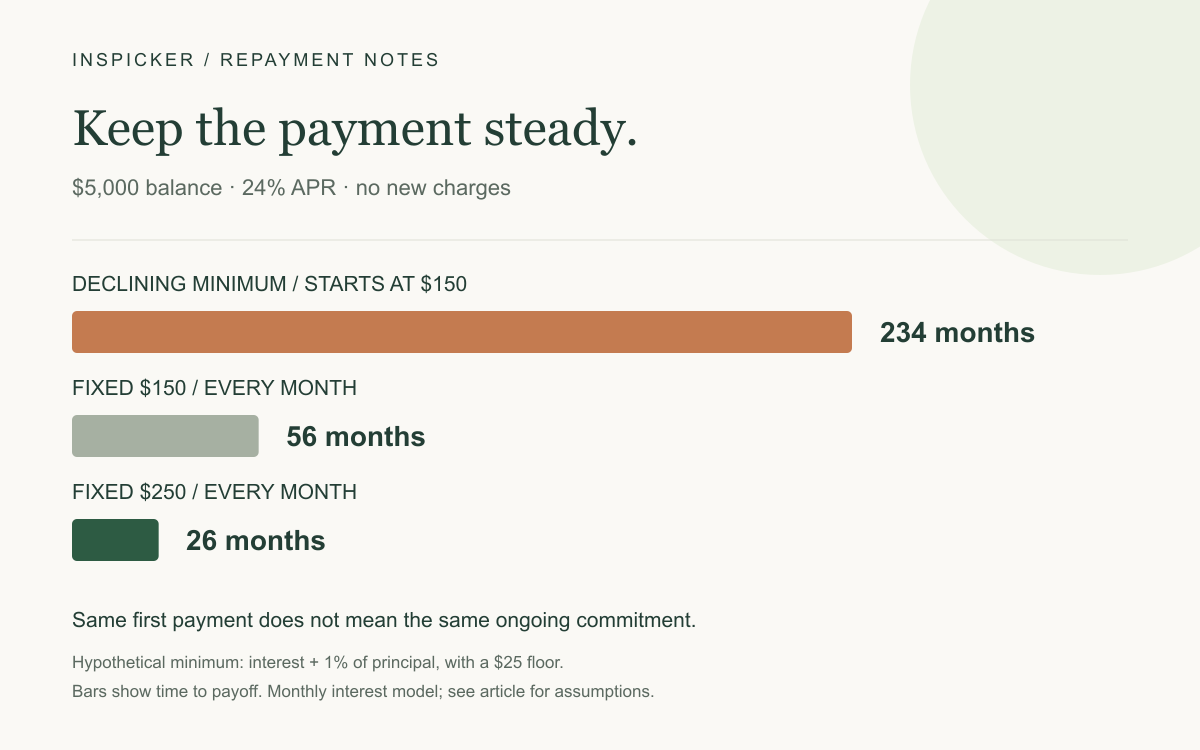
A fixed credit card payment can clear debt much sooner than following a minimum that falls with the balance. The benefit comes from keeping your payment steady as interest declines, so more of each later payment reduces what you owe.
The fixed amount must remain at least as large as the required minimum and fit your budget. This is a repayment plan for an existing balance, not a way to avoid interest entirely.
In the hypothetical example below, both plans start with a $150 payment on a $5,000 balance at 24% APR. Following the declining minimum takes 234 months. Continuing to pay $150 takes 56 months, saving approximately $5,564.86 in modeled interest.
Use the credit card payoff calculator to compare the payment you make today with a sustainable fixed amount.
Minimum, fixed, and full payments do different jobs
Your statement's minimum payment due is the amount required for that billing period. Paying it on time does not mean you have cleared the balance or avoided interest.
A fixed payment is an amount you choose to keep paying each month while working down the debt. For example, you might keep paying $200 even after the required minimum falls below that. If the issuer's minimum later rises above $200, you still need to meet the larger requirement.
Paying the full statement balance is a different approach. When the purchase grace period applies, paying that balance in full by the due date can avoid purchase interest. If you already carry debt, residual interest and the card's grace-period conditions can complicate the final payoff. Check your account's terms and latest balance. See the CFPB's explanation of credit card grace periods.
The comparisons below assume an existing interest-bearing balance. None of the fixed-payment examples promises to eliminate all interest.
Why a shrinking minimum keeps debt around
Issuers use different minimum-payment formulas. For this article, we use a hypothetical formula:
Monthly minimum = the greater of $25 or monthly interest plus 1% of the starting principal balance.
The final payment is limited to what remains owed. This is the example's formula, not a description of every card agreement.
At a $5,000 balance and 24% APR, our monthly model calculates:
- Interest: $5,000 × 24% ÷ 12 = $100.
- Principal portion: $5,000 × 1% = $50.
- First minimum: $100 + $50 = $150.
- Balance after paying: $5,000 + $100 − $150 = $4,950.
In the next modeled month, interest is $99 and the principal portion is $49.50. The minimum falls to $148.50. The required payment is smaller, but so is the amount of principal removed.
If you keep paying $150 instead, that second payment removes $51 of principal. The difference is initially small. It grows as the fixed payment keeps releasing more money from interest toward principal.
This comparison does not assume that you pay the same amount over the entire period. The fixed plan starts at the same payment, then commits more than the declining minimum in subsequent months.
Worked example: compare four payment plans
Assume a hypothetical $5,000 balance, a constant 24% APR, the minimum formula above, and no additional purchases or fees. Interest accrues monthly at APR ÷ 12 before each payment. Actual issuers may calculate interest daily; statement timing and rounding can change the figures.
| Payment plan | First payment | Payoff time | Total interest | Total repayment |
|---|---|---|---|---|
| Follow the declining minimum | $150 | 234 months, or 19 years 6 months | $8,886.95 | $13,886.95 |
| Keep paying $150 | $150 | 56 months, or 4 years 8 months | $3,322.09 | $8,322.09 |
| Keep paying $200 | $200 | 36 months, or 3 years | $2,000.56 | $7,000.56 |
| Keep paying $250 | $250 | 26 months, or 2 years 2 months | $1,449.36 | $6,449.36 |
Final payments are smaller than the chosen monthly amount where appropriate. Total repayment includes the original $5,000 debt and all modeled interest.
Keeping the starting $150 payment steady instead of following the declining minimum:
- Removes 178 months, or 14 years 10 months, from the modeled payoff.
- Reduces interest by $5,564.86.
- Requires maintaining the payment even when the statement asks for less.
Increasing the fixed payment from $150 to $200 is a separate decision. It requires another $50 of monthly cash, shortens the modeled payoff by 20 months, and saves $1,321.52 in interest, calculated from unrounded model outputs.
The largest payment in this table is not automatically the right amount for your household. A payment that repeatedly forces you to borrow for essentials can undermine the plan.
Why the first year's results may look modest
The long-term difference can be much larger than the early change. After 12 modeled payments:
| Plan | Remaining balance |
|---|---|
| Declining minimum | $4,431.92 |
| Fixed $150 | $4,329.40 |
| Fixed $200 | $3,658.79 |
| Fixed $250 | $2,988.19 |
The gap between the first two plans is only about $103 after a year. Yet their eventual payoff times differ dramatically because the minimum-payment plan continues reducing its payment as the debt falls.
A realistic repayment plan needs both a long-term target and short-term milestones. Monitor the balance, the payment you actually made, and new charges. Do not judge the plan only by whether the latest minimum is smaller.
For the mechanics of a minimum-only schedule, our minimum-payment guide provides a separate introductory example. Here, the focus is choosing and maintaining a payment rule.
Use your statement's repayment estimate as a reference
Many statements include a minimum-payment warning and an estimate of the payment needed to repay the current balance in three years. The CFPB explains what that estimate means.
Use the disclosure to understand the current balance's repayment path. It does not mean future purchases disappear within the same deadline. It also does not replace the contractual minimum payment.
If the statement and calculator differ, inspect the assumptions: APR, minimum formula, fees, interest method, balance categories, and calculation date. The issuer's actual payment requirement takes priority over a simplified estimate.
Choose a fixed amount your budget can support
Start with required payments and essential bills
Work out the money available after essentials and all required debt payments. Use ordinary income you can reasonably expect, rather than relying entirely on a bonus or unusually strong month.
The monthly budget planner can help you compare payment amounts. Keep account balances and bill dates in view; an apparently affordable monthly total can still create a shortfall if the payment comes before income arrives.
Test a base payment and an optional extra payment
If $250 is affordable only in some months, a smaller sustainable base payment with occasional extras may be more realistic. The calculator's fixed-payment result assumes the selected amount arrives every modeled month. It does not predict an irregular payment schedule.
For income that varies, revisit the amount regularly. Continue meeting at least the actual minimum in each billing period. Contact the issuer promptly if you expect difficulty meeting it.
Set up payment instructions carefully
Check whether automatic payments are configured for the minimum, the statement balance, or a selected amount. A minimum-payment setting will normally follow the amount due, rather than maintain the fixed amount you intended.
Before adding a manual payment, confirm how it interacts with an already scheduled automatic debit. Payment services differ. Keep enough money available and verify that payments post on time.
Plan what happens when the balance is cleared
Check the remaining payoff amount and any residual interest before treating the account as settled. Once repayment is complete, the freed monthly cash can support another debt or a savings goal.
If you have several balances, the debt payoff calculator compares avalanche and snowball methods. Those methods determine where extra payments go across debts; a fixed payment determines how much cash you commit.
What can change the payoff date?
New purchases. The examples assume none. If you keep adding charges, part of your payment finances new spending rather than reducing the original debt. A nominally fixed payment may then fail to produce the expected payoff.
APR changes. A variable rate or the end of a promotion changes interest costs. Recalculate if the applicable rate changes.
Fees or missed payments. Additional charges can increase the balance and contractual payment requirement. Include known fees and address payment problems early.
Multiple balance categories. Purchases, cash advances, and transfers may carry different APRs and payment-allocation rules. One average-rate estimate may not reproduce their repayment schedules.
Payment timing. Many issuers calculate interest using daily balances, as the CFPB describes. An earlier payment can change actual interest, while this article's model uses one payment after monthly accrual.
If you are considering moving the debt to reduce its APR, read when a balance transfer fee is worth paying. Compare fees and the promotional deadline as well as the advertised rate.
How to compare your minimum and fixed payments
- Enter the balance and APR applicable to the debt you are modeling.
- Check the card's minimum-payment formula. Use the matching principal percentage and floor where the model applies.
- Enter the fixed amount you can sustain.
- Compare the payoff time, interest, and remaining-balance chart.
- Rerun with a smaller affordable amount and a larger amount to understand the tradeoff.
- Revisit the inputs when the balance, APR, or available monthly cash changes.
To reproduce the article, use a $5,000 balance, 24% APR, 1% minimum principal portion, and a $25 minimum floor. Compare fixed payments of $150, $200, and $250.
The tool keeps payments at least as high as its modeled minimum and reduces the final payment to the amount owed. It does not verify your issuer's agreement or model new charges, changing APRs, fees, or separate balance categories.
Common questions
Is paying a fixed amount the same as paying extra?
A fixed amount may equal the minimum initially and exceed it later as the minimum falls. It is the ongoing commitment that matters. Always check the actual minimum each month.
Can I keep paying today's minimum instead of letting it fall?
You can choose to keep that amount as a target, provided it remains affordable and meets future required minimums. The fixed $150 example demonstrates this approach under the stated assumptions.
Does paying more than the minimum stop interest?
Usually it reduces future interest by reducing the balance faster; it does not automatically eliminate interest on carried debt. Purchase grace-period and full-payment conditions are a separate issue.
Why does the fixed $200 example take 36 months?
That is the result for these specific inputs. A different balance, APR, minimum formula, or payment schedule changes the result. It is not a universal three-year payment amount.
Should I put every spare dollar toward the card?
Compare the interest cost with essential obligations and the need for accessible cash. A payment plan that leaves you unable to cover a necessary expense may lead to fresh borrowing. Our emergency savings article explains how to assess a cash cushion.
Editorial note: These hypothetical examples use InsPicker's monthly card-payoff method. Results are rounded for display and assume no new charges or fees. Your statement and card agreement determine actual amounts due.
For education and planning. Check assumptions and product terms before making a financial decision.
Put the numbers to work ↗