Debt / Balance transfers
Deferred Interest vs. 0% APR: What Happens If You Miss the Deadline?
Understand deferred interest versus a true 0% APR promotion. Includes a $2,000 payoff plan, deadline checks, payment allocation, and calculator limitations.
Deferred interest and a true 0% introductory APR are different offers. With deferred interest, failing to meet the payoff condition can make interest accrued during the promotional period payable. With a true 0% APR period, interest attributable to that period is not retroactively charged simply because a balance remains at expiration.
The remaining balance can still accrue interest after a 0% period ends, and fees or other contract conditions can apply. Read the offer rather than treating every “no interest” headline as the same arrangement.
The balance transfer calculator models an introductory rate followed by a later rate. It does not calculate retroactive deferred-interest charges. This guide explains when that limitation matters and how to build a deadline-based payment plan.
Look for the condition attached to “no interest”
The CFPB’s explanation of promotional financing distinguishes a zero-interest promotion from deferred interest. Wording such as “no interest if paid in full” should prompt you to inspect the full disclosure and its payoff condition.
Do not decide from a single advertising phrase. Find the promotional rate, the regular rate, the applicable balance, the exact expiration date, any fees, and what happens if the condition is not met.
| Question | True 0% introductory APR | Deferred-interest arrangement |
|---|---|---|
| What does the selected promotion do? | Applies a 0% rate for the stated period | Defers interest subject to a condition such as full payment by the deadline |
| What if a balance remains at expiration? | Later interest can apply to the remaining balance | Accrued promotional-period interest may become payable under the agreement |
| Does InsPicker estimate the full missed-deadline charge? | It models the selected later rate prospectively | No; the deferred-interest charge is not modeled |
This comparison isolates the promotional-interest structure. It does not describe every fee, penalty, purchase-grace-period rule, or consequence of late payment in an actual agreement.
The same remaining principal can create different costs
Suppose a hypothetical $2,000 promotional balance receives twelve payments of $150, all applied to principal during the selected period. Ignore fees and other activity for this illustration.
$2,000 − (12 × $150) = $200 remaining.
The remaining principal is the same arithmetic result whether you intended to finish a true 0% balance or satisfy a deferred-interest payoff condition. The consequence of leaving it unpaid can be different.
For a true 0% period, the example does not create interest for those twelve zero-rate periods simply because $200 remains. Interest after expiration depends on the later rate, balance, billing dates, and payment timing.
For deferred interest, the amount due may include interest accrued during the promotion rather than only interest on that last $200 after expiration. This article does not estimate the accumulated charge: the rate, balance history, calculation method, and actual agreement are needed.
That is why “I nearly paid it all off” is not enough to assess a conditional promotion. Check whether the condition requires the relevant balance to be fully paid and whether your payment will post before its deadline.
Work backward from usable payment dates
For a simple $2,000 balance with no additional charges, divide by the number of payments that can be completed before expiration:
| Usable payments before the deadline | Rounded-up payment target |
|---|---|
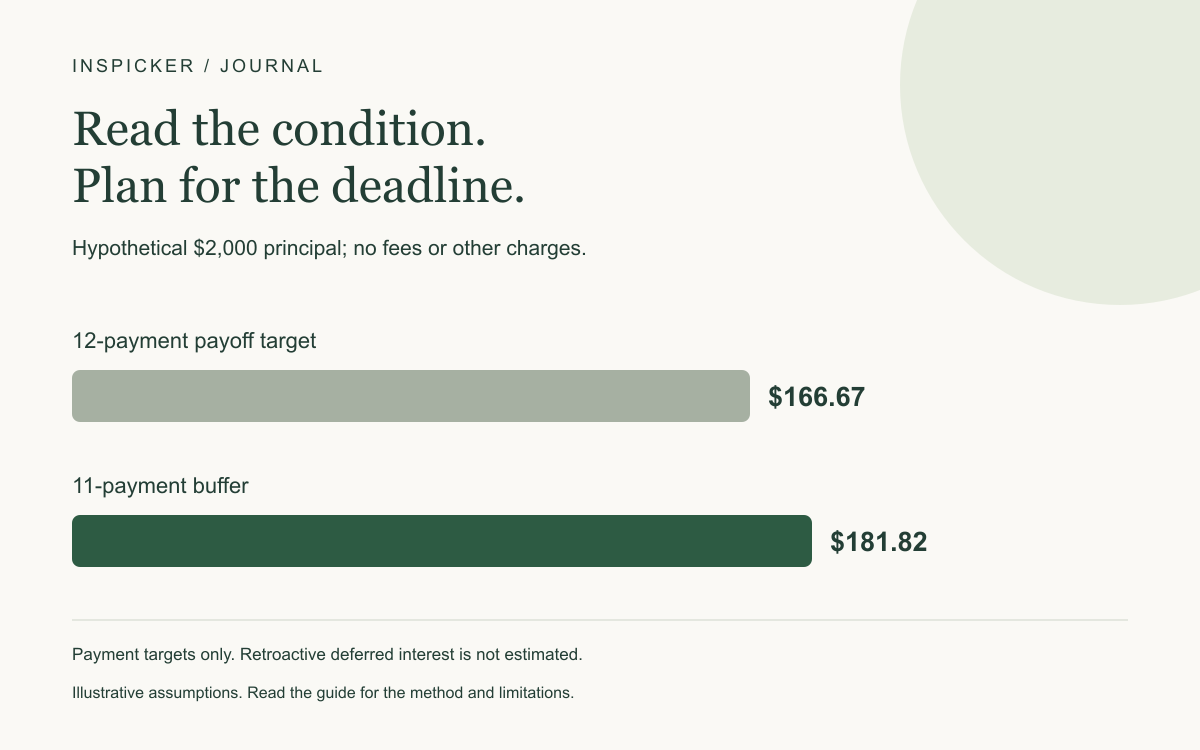
| 12 | $166.67 |
| 11 | $181.82 |
| 10 | $200.00 |
The 11-payment row is a voluntary one-payment buffer compared with the 12-payment example. It is not an issuer requirement. Count actual dates rather than assuming an advertised number of months provides that many convenient statement payments.
Amounts are rounded upward to avoid a small cent shortfall. Adjust the last payment to the actual remaining amount and confirm that the relevant promotional balance is zero.
The table assumes no fee. If a fee is added to the balance and must be repaid, include it in the target instead of dividing only the original purchase or transfer amount. The worked $5,000 transfer schedule shows how an added fee changes a payoff target.
Recalculate if the plan falls behind
After six $150 payments on the hypothetical $2,000 balance, principal remaining is $1,100. With six usable payments left, the revised no-additional-interest target is $183.34 per payment, rounded upward.
Continuing the original $150 schedule does not recover the earlier underpayment. Recalculate using the actual current promotional balance and the remaining payment opportunities.
If that new amount is unaffordable, review options with the issuer before the deadline. Do not assume a future transfer approval or a payment-extension request will be available.
A required minimum is not a deadline payoff plan
The statement minimum tells you the required payment for that statement. It does not necessarily clear a promotional balance by the expiration date.
The CFPB’s deferred-interest FAQ specifically warns that minimum payments may be insufficient for full payoff during the period. Make a separate deadline calculation and still satisfy each statement’s actual requirements.
Setting an average monthly target does not permit skipping an installment and catching up later. Nor does a promotional rate mean no payments are required. Check both the payment obligation and the payoff condition.
Use the budget planner to check whether the target is supported by ordinary cash flow. A mathematically correct $181.82 plan is not useful if repeated cash shortages prevent the payments from happening.
Other balances can change where your payments go
If an account also carries purchases, cash advances, or other promotions, do not assume the entire payment reduces the promotional balance you intend to clear.
Payment allocation has specific rules, including provisions relevant to deferred-interest balances near expiration. The CFPB’s payment-allocation regulation is the primary reference. Ask the issuer how payments and any allocation request will apply to your actual account, then check the statement breakdown.
Keep a record of the exact promotional payoff amount, expiration date, intended payment date, and confirmation that the payment posted. A normal monthly due date and a promotional expiration date are not interchangeable just because they occur in the same month.
If you make the final payment electronically, allow for the issuer’s stated processing requirements rather than relying on a last-minute assumption. Confirm the balance afterward instead of treating the transfer instruction alone as proof of payoff.
Use the balance-transfer tool for the structure it actually models
InsPicker starts with a transferred balance and an added transfer fee, applies the promotional APR for the selected number of monthly periods, then applies the later APR prospectively. It assumes a fixed payment and no new spending.
It does not accumulate hidden interest during the promotion and add it later if a deferred-interest condition fails. Entering 0% during the promotion and a high later rate does not reproduce that structure.
The calculator also does not model daily billing, every payment-allocation rule, or issuer-specific late-payment consequences. Its monthly period count is an approximation of timing, not an exact promotional-expiration calendar.
Use the tool for a true introductory-rate scenario and the arithmetic schedule here for initial deadline planning. For a deferred-interest payoff quote or accrued charge, obtain the account-specific figure from the issuer.
Common questions about deferred interest
Is “no interest if paid in full” automatically the same as 0% APR?
No. Inspect whether interest is deferred subject to a condition or the applicable rate is truly zero for the period. The full disclosure controls.
Does leaving $200 on a deferred-interest promotion limit interest to $200?
Not necessarily. Missing the payoff condition can make previously accrued interest payable. The remaining principal alone is not enough to calculate the charge.
Will making every minimum payment avoid deferred interest?
Not necessarily. Minimum-payment compliance and full payoff by the promotional deadline are different requirements.
Can the balance-transfer calculator estimate retroactive interest?
No. It applies a later rate prospectively after the modeled promotion. It does not calculate a deferred-interest charge accumulated during that promotion.
Method: hypothetical fee-free $2,000 principal and equal payments, with no other account activity in the arithmetic examples. No deferred-interest dollar charge is estimated. Actual promotional terms, daily interest, allocation rules, and payment dates require account-specific review.
For education and planning. Check assumptions and product terms before making a financial decision.
Put the numbers to work ↗