Debt / Balance transfers
How Much Should You Pay Monthly on a $5,000 Balance Transfer?
Calculate a $5,000 balance transfer payment including its fee. Compare 18-month and buffered schedules, and see the cost of a $250 payment shortfall.
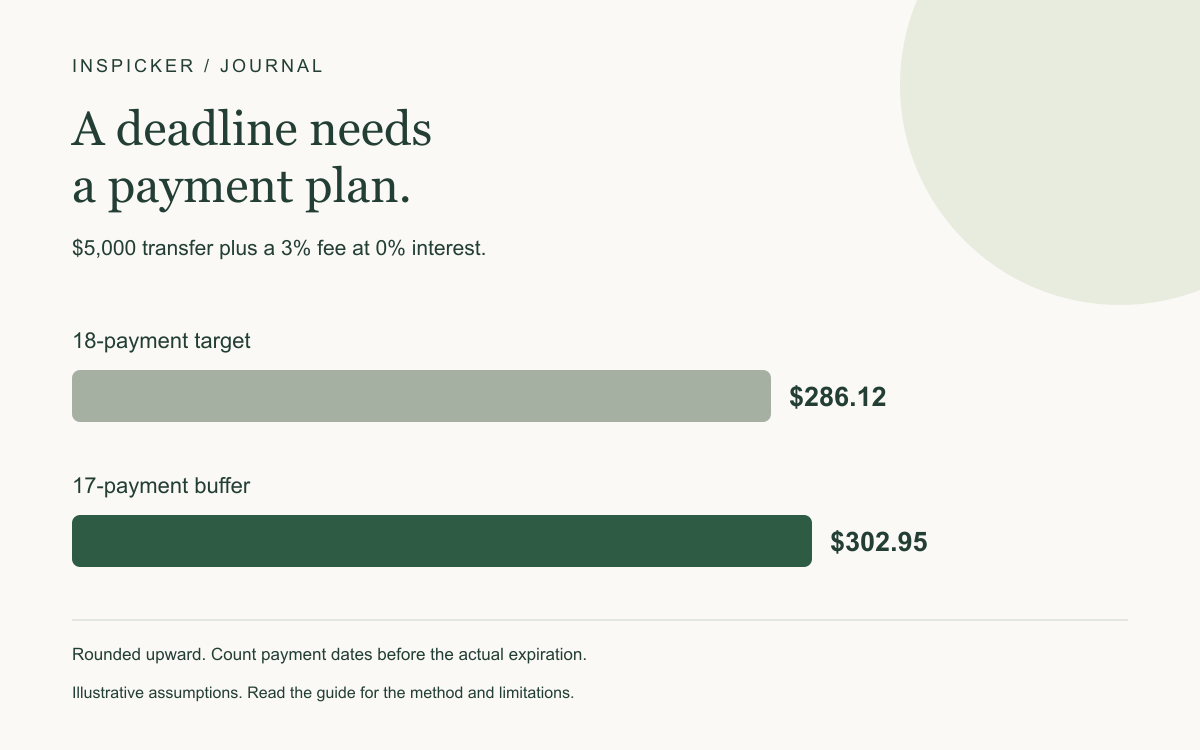
A $5,000 balance transfer with a 3% fee needs approximately $286.12 a month to clear in 18 payments at 0% interest. The fee adds $150 to the balance, so the payment target is based on $5,150, not $5,000.
That amount assumes 18 usable payment dates, no new charges, and the fee receiving the same 0% treatment. Your offer’s exact expiration date and billing terms determine the real schedule. A buffer can help when payment dates and promotional dates do not line up.
Use the balance transfer calculator to compare a fixed payment with the promotion’s length. This guide focuses on clearing the balance by a deadline; the transfer-fee comparison addresses whether moving the debt saves money in the first place.
Start with the amount that will actually need repaying
In the hypothetical offer used throughout this article:
| Input | Assumption |
|---|---|
| Existing balance transferred | $5,000 |
| Transfer fee | 3%, or $150 |
| Opening transferred balance including fee | $5,150 |
| Promotional interest | 0% |
| Promotional payment periods modeled | 18 |
| Interest after the promotion | 29% annually |
These are selected inputs, not a current credit-card recommendation. We assume the fee is added to the transferred balance and receives the promotional rate. Check whether your actual agreement treats the fee differently or imposes a minimum dollar fee.
Also confirm whether the available credit can accommodate the transfer and its fee. A request for $5,000 is not necessarily approved for that full amount. Keep making required payments on the old account until you confirm the transfer and any remaining amount owed there.
An offer can involve more than one date: a deadline for requesting transfers, a promotion expiration date, statement dates, and payment due dates. The number “18” in an advertisement is not a substitute for mapping the actual dates available to you.
Divide by the payments available before expiration
At 0% interest, with no other activity:
Required payment = opening balance including fee ÷ remaining payments.
For 18 payments, that is $5,150 ÷ 18 = $286.111…. Rounding upward gives $286.12. The final payment can be adjusted to the actual remaining cents.
| Payments available | Rounded-up payment for $5,150 |
|---|---|
| 18 | $286.12 |
| 17 | $302.95 |
| 15 | $343.34 |
| 12 | $429.17 |
The 17-payment row is useful if you deliberately aim to finish one payment earlier. It is not a special issuer rule. The right buffer depends on your actual dates and the way payments are processed.
Dividing only $5,000 by 18 produces about $277.78. That leaves the fee unfunded. The difference looks small per month, but the balance still exists when the promotional rate ends.
These targets also do not replace the statement’s required minimum. Pay at least the amount actually due, on time. A planned average payment is not permission to skip a monthly obligation and catch up later.
A $250 payment saves interest but misses this deadline
Suppose the budget supports only $250 per month. After 18 zero-interest payments:
$5,150 − (18 × $250) = $650 still owed.
That is a deadline shortfall, even though the transfer might still be cheaper than leaving the debt on its old rate.
In InsPicker’s simplified monthly model, applying 29% nominal annual interest after the eighteenth payment produces:
| Result with $250 monthly payments | Modeled outcome |
|---|---|
| Balance after the promotion | $650.00 |
| First post-promotion month’s interest | $15.71 |
| Total time to clear | 21 payments |
| Interest after the promotion | $30.00 |
| Fee plus transfer interest | $180.00 |
The final installment is smaller than $250. Calculations use unrounded balances internally, with cents rounded for this table.
An actual card can calculate interest using daily balances and different billing dates, so its statement may differ. This example is a planning approximation, not a payoff quote. It assumes the promotional terms remain in effect for the full modeled period and no late fees or other charges occur.
The result answers two separate questions: the transfer remains inexpensive in this selected scenario, but the $250 schedule does not clear it during the promotion. Do not treat the calculator’s estimated dollar saving as proof that the deadline is met.
Use a buffer you can actually fund
Finishing in 17 payments requires about $302.95 monthly. That is $16.83 more than the rounded 18-payment target. It can create room for date mismatches, but only if the payment fits the budget.
An alternative is an earlier extra deposit. For example, paying $300 at the start as an additional principal reduction leaves $4,850 to spread over the remaining schedule. The timing and number of subsequent installments must still be explicit; do not count the extra payment as both an additional deposit and one of the scheduled payments.
Avoid depending on a future transfer offer or an unconfirmed bonus. Those options may not be available when the balance needs repaying. If the target is unaffordable, compare a longer repayment plan using a realistic post-promotion rate rather than assuming another 0% period will appear.
The budget planner can show whether the contribution is supported by ordinary cash flow. If you already have several obligations, compare them in the debt payoff calculator.
New purchases can complicate the payoff plan
The example assumes no new purchases, cash advances, additional transfers, or annual fees. Adding another balance changes what needs repayment and may change how payments are allocated.
The CFPB explains that new purchases can incur interest after a promotional balance transfer, including when carrying the transferred balance affects the purchase grace period. Review the agreement before using the same card for spending.
A dedicated repayment plan is easier to monitor when its opening balance is stable. If you do use the account for other activity, reconcile each type of balance and its interest terms rather than continuing to divide the original $5,150 by an outdated number of months.
Recalculate from the current statement balance
Set a reminder several statements before expiration. Record the actual remaining promotional balance and the payments you can make before the exact end date.
For example, if $1,800 remains and only five usable payments are left, the new zero-interest target is $360 per payment. The original $286.12 schedule no longer answers the current question.
After sending the final payment, confirm that it posted and the relevant balance is cleared. The amount you intended to pay and the balance the issuer reports are different pieces of information. Retain confirmation and check whether another fee or separate balance remains.
Common questions about a $5,000 transfer payoff
Is $277.78 enough to clear $5,000 in 18 months?
Only if the amount to repay is exactly $5,000 at 0% with no additional charges. With a 3% fee added, the modeled balance is $5,150 and the rounded-up 18-payment target is $286.12.
Will the minimum payment clear it before the promotion ends?
Not necessarily. The minimum is the issuer’s required payment, not a promise that the balance will be zero by your chosen date. Calculate a deadline-based amount separately.
Should I use 18 months or 18 payment dates?
Count usable payment dates before the exact expiration. This article models 18 equal monthly payment periods; your real calendar can require an earlier finish.
Does a missed promotional deadline mean the transfer was worthless?
No. It means some balance remains exposed to the later terms. Compare the full cost and repayment schedule, including that remaining balance, rather than assuming either zero cost or automatic failure.
Method: hypothetical fee financed into a 0% balance, equal monthly payments, and monthly interest at the selected post-promotion annual rate divided by twelve. Actual agreements, daily-interest methods, and payment dates can produce different results.
For education and planning. Check assumptions and product terms before making a financial decision.
Put the numbers to work ↗