Savings / Budgeting
Missed a Monthly Savings Goal? Recalculate Your Catch-Up Plan
Recalculate savings after a missed deposit. Compare higher monthly transfers, a one-time catch-up payment, and a later deadline using a checked $12,000 example.
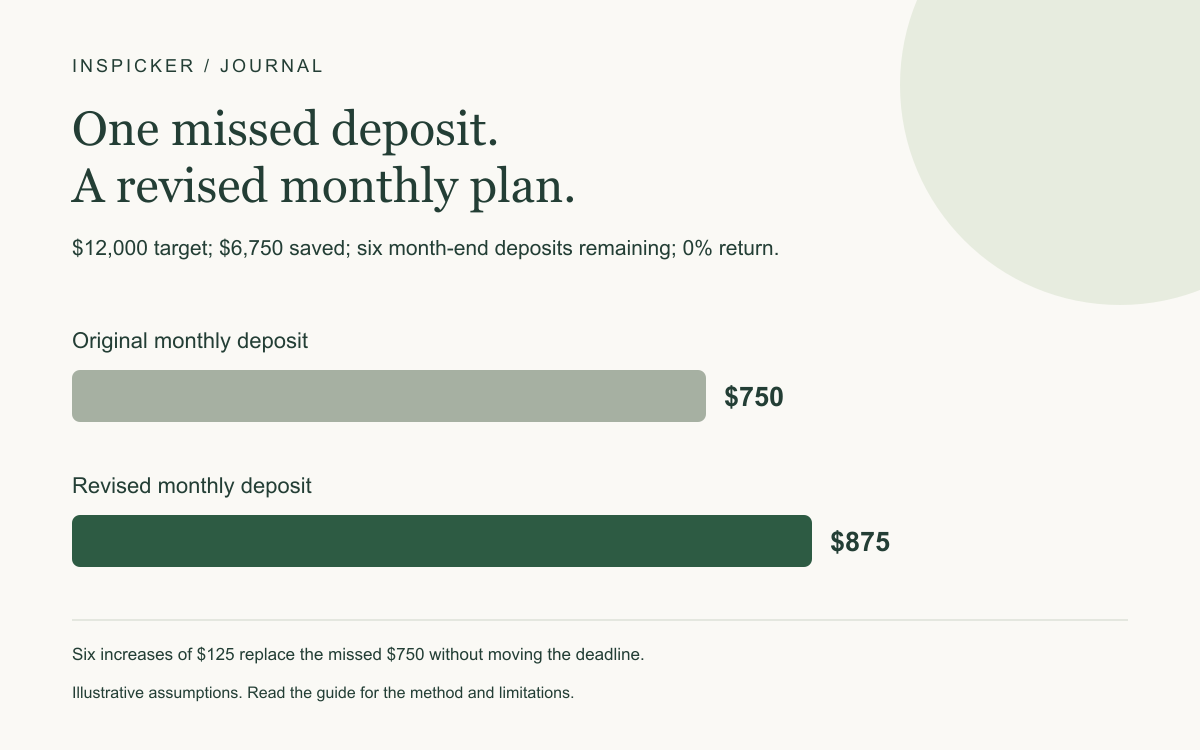
If you miss a monthly savings deposit, recalculate from your actual balance and the deposits still available before the deadline. Restarting the original plan from today can hide the shortfall, because some of the saving time has already passed.
For example, a household targeting $12,000 starts with $3,000 and plans twelve monthly deposits of $750, ignoring interest. After making five deposits and missing the sixth, it has $6,750. Reaching the original deadline now requires six deposits of $875.
Use the savings goal calculator with the amount currently assigned to the goal and the time remaining. Then decide whether the revised payment fits your budget.
Start with the balance you actually have
A savings target needs three basic inputs: the amount needed, cash already assigned to it, and a deadline. The original hypothetical plan is:
| Original input | Amount |
|---|---|
| Target balance | $12,000 |
| Starting savings assigned to this goal | $3,000 |
| Remaining amount to contribute | $9,000 |
| Planned month-end deposits | 12 |
| Deposit per month at 0% return | $750 |
The calculation is ($12,000 − $3,000) ÷ 12 = $750. The target includes the starting balance; it is not $12,000 of additional deposits on top of that balance.
Suppose five full deposits arrive, then the sixth deposit is skipped. Review the plan immediately after that sixth scheduled deposit date. Five deposits total $3,750, so the actual balance is $3,000 + $3,750 = $6,750. There are six scheduled month-end deposits left before the original deadline.
With all six deposits made on time, the balance would have been $7,500. The household is therefore $750 behind the original schedule. Use the actual $6,750 when updating the calculation; entering the scheduled $7,500 would count money that never arrived.
If the account contains several savings goals, use only the balance assigned to this one. Cash earmarked for an emergency reserve or another bill is not automatically available for this deadline. Our sinking fund guide explains how to separate known future costs.
Divide the current gap by the remaining deposits
At a selected 0% return, the new calculation is:
($12,000 − $6,750) ÷ 6 = $875 per month.
The remaining gap is $5,250. Dividing that gap across six deposits raises the monthly amount by $125, from $750 to $875. Six increases of $125 replace the missed $750.
| Revised checkpoint | Amount |
|---|---|
| Actual savings after the missed sixth deposit | $6,750 |
| Remaining target gap | $5,250 |
| Deposits left before the original deadline | 6 |
| Revised monthly deposit | $875 |
| Increase over the original deposit | $125 |
| Final balance after six revised deposits | $12,000 |
This is a cash-flow requirement, not evidence that $875 is affordable. Check income, essential expenses, required debt payments, and other commitments in your monthly budget. If the missed deposit happened because the original budget was already too tight, a higher transfer may repeat the same problem.
Compare three ways to recover the plan
You can change the deposit, add cash now, or change the deadline. Holding the target and selected 0% return constant makes their differences clear.
| Recovery option | Cash added now | Future deposits | Completion |
|---|---|---|---|
| Raise the monthly deposit | $0 | 6 × $875 | Original deadline |
| Replace the missed deposit now | $750 | 6 × $750 | Original deadline |
| Keep the old deposit and extend | $0 | 7 × $750 | One month later |
For the second option, the one-time $750 brings current savings to $7,500. Six further deposits of $750 then add $4,500, reaching $12,000. That catch-up payment needs an actual funding source. An expected bonus or an item listed for sale should not enter the current balance before the money is available.
For the third option, seven deposits of $750 add the required $5,250. It works mathematically only if the deadline can move. A bill with a fixed due date cannot simply be shifted in the spreadsheet without changing the underlying obligation.
If neither a higher deposit nor a later deadline is workable, revisit the target itself where possible. Reducing the cost of a discretionary purchase is another way to close the gap. Borrowing the missing amount creates a separate debt commitment; it does not turn the original saving plan into a completed cash-funded goal.
Treat interest as an assumption, and round deposits upward
This example uses 0% to isolate the missed-deposit arithmetic. Actual savings may earn interest, but the future rate, credited amount, and timing can differ from a projection. Taxes or account fees can also reduce the money available.
With a positive estimated return, the calculator grows current savings and equal month-end contributions over the selected period. Its input is a nominal annual rate divided by twelve for monthly compounding. It does not treat an entered rate as APY; see our APY versus interest-rate guide before using an advertised account yield.
Recalculate using the updated account balance and current assumptions after a missed deposit. Do not calculate interest on the original projected balance if the actual deposit history differs.
When a required deposit includes a fraction of a cent, rounding down can leave a small shortfall. Round the recurring amount upward to cents, then confirm the actual remaining balance near the deadline. This example happens to produce exact whole-dollar deposits, so no rounding adjustment is needed.
Reset the transfer without creating another cash shortage
The CFPB’s savings-plan guidance recommends reviewing real results against the plan and making adjustments. A missed month is a useful point to do that review rather than carrying an outdated deposit amount forward.
Check why the transfer was missed. An unusual expense may call for a temporary adjustment. A recurring shortfall may require a smaller goal, a longer deadline, or a broader budget change.
When updating automatic transfers, align them with income and scheduled bills. The CFPB’s automatic-saving guidance discusses transfer timing and monitoring checking balances to avoid overdrafts. Automation should execute an affordable plan, not substitute for checking whether the money will be there.
If paid every two weeks, count actual remaining paydays before the deadline. Six months is not automatically twelve or thirteen available paychecks. You can split a monthly saving commitment across paychecks for budgeting, but deposit timing and interest may differ from the calculator’s month-end model. Our biweekly-pay budget guide covers this distinction.
Enter the remaining time rather than the original term
To reproduce the main catch-up example:
- Set the target to $12,000.
- Enter $6,750 as already saved.
- Set time to save to 0.5 years, representing six months.
- Use 0% estimated annual return for the no-interest comparison.
- Confirm a monthly target of $875 and test it against your budget.
For the one-time catch-up option, enter $7,500 as already saved only after the additional $750 is assigned to the goal; six months at 0% gives $750 monthly. The seven-deposit extension is shown by the table’s direct arithmetic, rather than a half-year step on the time control.
The calculator rounds its time input to a whole number of months and assumes equal deposits at each month-end. It does not import your account history, schedule transfers, or automatically detect a missed payment. Taxes, fees, changing rates, withdrawals, and inflation are excluded. If the price of the planned purchase changes, update the target as well as the balance.
Common questions
Should I double my next savings deposit after missing a month?
You can replace the missed deposit at once if that fits your cash flow. It is not the only option. In this example, spreading the missing $750 over six future deposits adds $125 to each, while a one-time $750 payment preserves the original monthly amount.
What if I keep saving the original $750 for the remaining six months?
The $6,750 balance plus six deposits of $750 reaches $11,250 at 0%. That leaves a $750 shortfall against the $12,000 target. One additional $750 deposit reaches the goal one month after the original deadline.
Does missing a month mean I need to restart the whole savings plan?
No. Existing savings still count. Recalculate from the actual balance, remaining target, and remaining time. Restarting a twelve-month clock would change the completion date, so make that change explicit if you choose it.
Should I use emergency savings to catch up?
Consider what reserve would remain and whether this goal is an urgent obligation or a flexible purchase. Moving cash between purposes does not create new savings. Review emergency-fund coverage before treating that reserve as available for another goal.
Method: original hypothetical example at a selected 0% return, checked against InsPicker’s savings-goal calculation. Sources reviewed October 16, 2026. Amounts illustrate planning choices, not a product offer or personalized recommendation.
For education and planning. Check assumptions and product terms before making a financial decision.
Put the numbers to work ↗