Savings / Compound interest
APY vs. Interest Rate: What to Enter in a Savings Calculator
Compare 5% APY with a 5% nominal rate using a $10,000 deposit. Learn the monthly-rate conversion and avoid counting compounding twice.
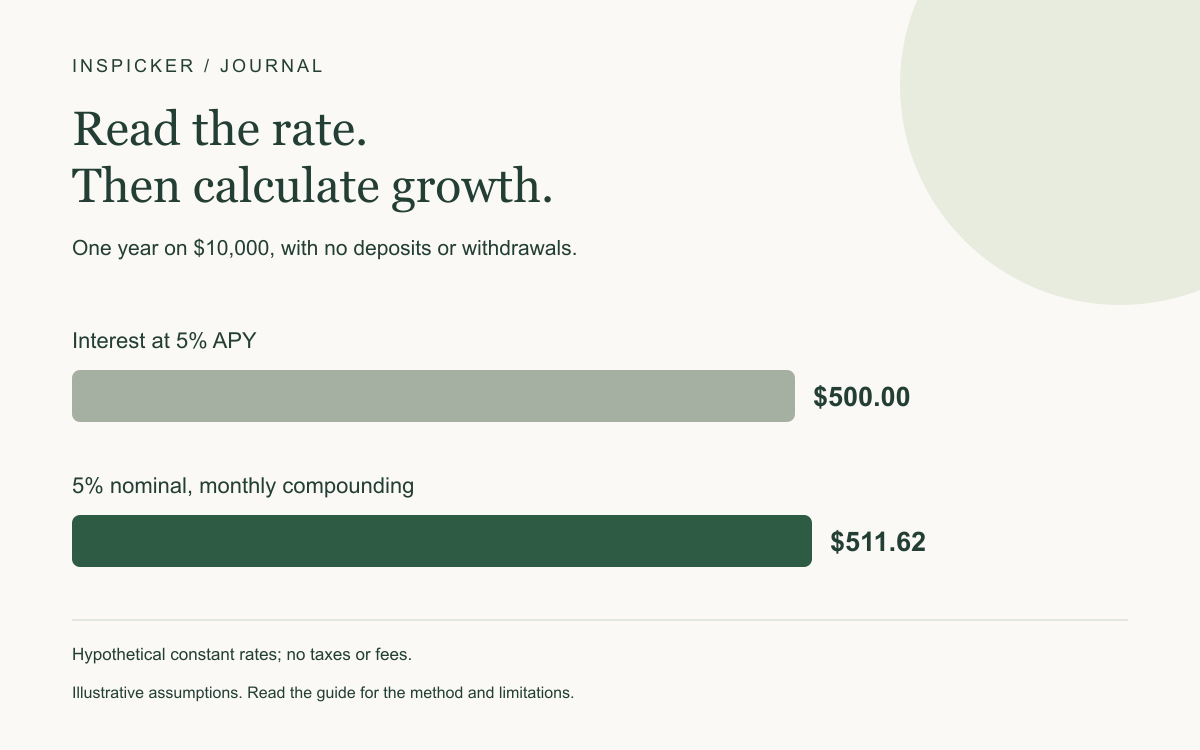
APY already includes the effect of compounding; a nominal annual interest rate does not. Entering an advertised APY into a calculator that divides a nominal rate by twelve can slightly overstate the result.
For example, $10,000 at 5% APY becomes $10,500 after one full year under a constant-rate, no-transaction assumption. At a 5% nominal annual rate compounded monthly, the same deposit becomes approximately $10,511.62. Both calculations can be correct because the two 5% figures mean different things.
The compound interest calculator uses a nominal annual return divided by twelve. This guide explains how to interpret that input before comparing it with a savings-account advertisement.
Read the rate label before doing the calculation
A nominal annual rate needs a compounding convention to describe the annual growth of money left in the account. In a monthly-compounding model, a 5% nominal rate becomes a monthly rate of 0.05 ÷ 12, or about 0.416667%.
APY expresses an annualized yield that already accounts for compounding. The CFPB’s APY calculation guidance explains the relationship between interest, principal, time, and compounding assumptions. Actual account disclosures can also involve rules for tiers or changing rates.
For the simple constant-rate examples here, the distinction is between a rate applied in monthly pieces and the annual outcome after those pieces compound. It is not a bonus that must be added a second time.
Do not confuse APY on a deposit with APR on a loan. A loan comparison may involve borrowing fees and repayment cash flows. This article concerns savings growth, not a method for converting loan APR into a deposit yield.
What happens to $10,000 over twelve months?
Assume no fees, taxes, additional deposits, or withdrawals, and a rate that stays constant for the full year.
| Rate description | One-year calculation | Ending balance |
|---|---|---|
| 5% APY | $10,000 × 1.05 | $10,500.00 |
| 5% nominal, monthly compounding | $10,000 × (1 + 0.05 ÷ 12)¹² | $10,511.62 |
The second rate produces an effective annual yield of approximately 5.11619%. Its monthly interest is left in the model and earns interest during later months.
The difference is approximately $11.62 on $10,000 for one year. That is not a claim that monthly compounding always beats an account advertising 5% APY. It means a 5% nominal monthly-compounded rate represents a higher effective yield than 5% APY under these assumptions.
When comparing two actual accounts, compare like-for-like disclosed yields and account conditions. A nominal rate from one advertisement and an APY from another are not automatically equivalent inputs.
Convert the APY rather than compounding it twice
To create a monthly rate that compounds to a selected annual yield:
Equivalent monthly rate = (1 + APY) raised to 1/12, minus 1.
For 5% APY, that monthly rate is approximately 0.407412%. A calculator expecting a nominal annual rate divided by twelve would use twelve times that monthly rate:
Equivalent nominal annual input = 12 × [(1.05 raised to 1/12) − 1] = approximately 4.888949%.
Entering that unrounded equivalent rate into the monthly model gives $10,500 after twelve months from $10,000. Entering a rounded 4.88895% gives an essentially identical result at the cent level in this example.
This conversion creates an equivalent smooth monthly growth assumption. It does not reproduce a bank’s daily accrual, rounding, crediting dates, or minimum-balance rules. For an actual statement reconciliation, use the account’s disclosures and transaction dates.
There is no need to alter the calculator itself to understand the example. The important step is matching the rate convention to the calculation you are asking it to perform.
Contributions change which money earns interest for how long
APY is not a promise that every dollar deposited during the year earns a full year’s yield. A deposit made near year-end has been present for much less time than the opening balance.
InsPicker adds regular monthly contributions at the end of each modeled month. The first of twelve deposits can grow through eleven subsequent monthly periods, while the final one has no additional monthly growth before the endpoint.
If you deposit at the start of each month, irregularly, or on payday, the result differs. Converting APY to an equivalent monthly rate fixes the rate convention; it does not also fix a mismatch in deposit timing.
Read the monthly-contribution worked example for the cash-flow mechanics. For a deadline-based target, the savings goal calculator solves for a monthly contribution under its own stated monthly-compounding assumptions.
Keep existing savings and new deposits separate when checking growth. The final balance includes both your own money and the interest earned; it is not all investment profit.
Check more than the headline percentage
The numerical comparison assumes a constant rate, but an actual savings rate may change. A balance tier, promotional period, minimum deposit, monthly fee, or withdrawal restriction can also change the practical outcome.
For example, a $5 monthly charge totals $60 over twelve months. Compare that dollar amount with the interest expected on the balance you actually plan to keep. Do not assume a modest yield advantage automatically compensates for a recurring fee.
An account opening bonus is another separate item. Identify its conditions and timing rather than adding its dollar value to the recurring rate as though the increase lasts indefinitely.
Taxes and inflation also affect the money’s usefulness. The compound calculator’s inflation field converts the modeled ending balance into purchasing power under a selected assumption. It does not calculate taxes or determine whether an account suits an emergency reserve.
For emergency money, availability and the risk of losing principal deserve attention alongside yield. See the emergency-fund timeline guide for a plan whose main driver is contributions rather than an optimistic return assumption.
Common questions about APY and calculator inputs
Does 5% APY mean $500 interest on $10,000?
Under this simple full-year, constant-rate example with no transactions or charges, yes. Different balances, dates, tiers, and changing rates can change actual earnings.
Why does the calculator show more than $10,500 at a 5% input?
Its input is a nominal annual rate divided by twelve. Monthly compounding makes the effective annual return slightly higher than 5%.
Can I enter 4.888949% to represent 5% APY?
That is the equivalent nominal annual input for this smooth monthly model. It is an approximation of the growth convention, not a replica of a specific bank’s daily calculations.
Is APY the same as loan APR?
No. Do not apply the savings conversion as though it were a complete comparison of borrowing costs and fees.
Method: hypothetical constant rates, monthly compounding, no transactions in the opening-balance examples, and no taxes or fees unless explicitly stated. No current savings offer or guaranteed future rate is implied.
For education and planning. Check assumptions and product terms before making a financial decision.
Put the numbers to work ↗