Savings / Emergency funds
Which Expenses Belong in Your Emergency Fund Calculation?
Build an emergency-expense baseline with a practical checklist, annual-bill examples, and a checked savings target. Avoid counting reserved money twice.
Include the essential bills you would still need to pay during an income disruption. Start with housing, food, utilities, necessary transport, insurance, required debt payments, and essential care. Adjust for your household rather than using a percentage of salary.
The emergency-fund target is then those monthly essentials multiplied by your chosen number of months. Keep annual bills and money already reserved for them clearly identified so the same dollars are not counted twice.
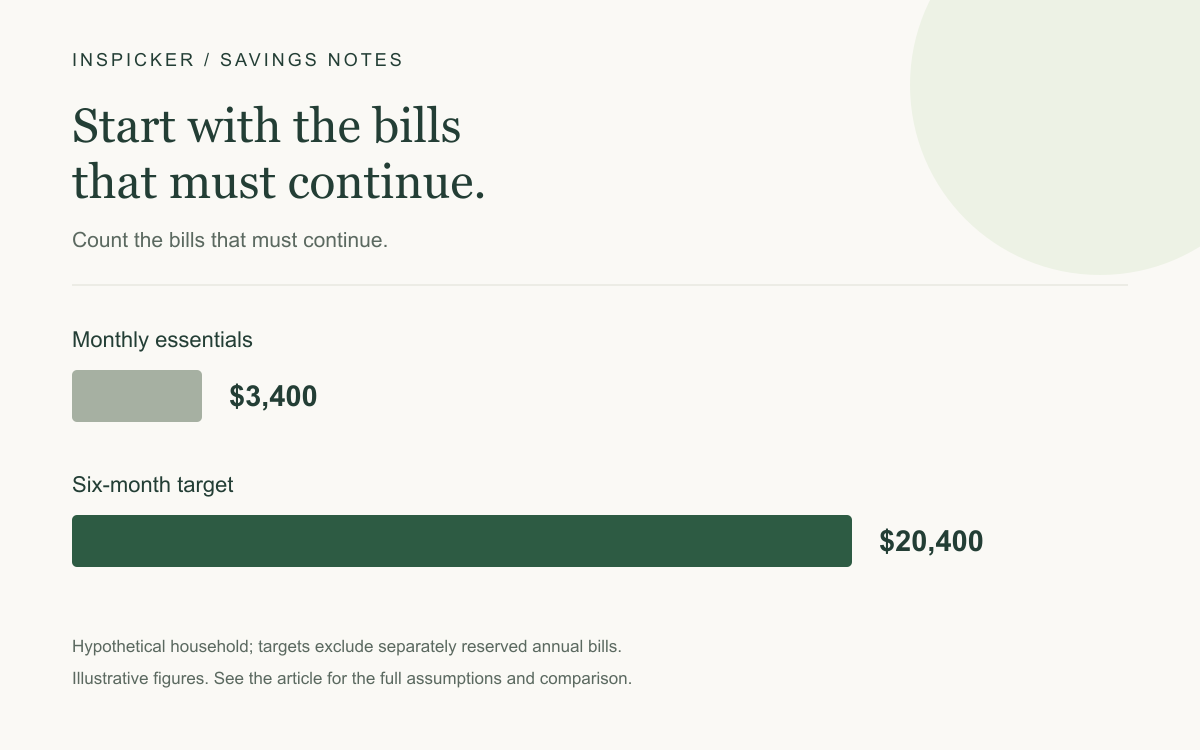
Our hypothetical household has $3,400 of monthly essentials. Three months requires $10,200 and six months requires $20,400. If $6,800 is genuinely available for emergencies, it already covers two months.
Use the emergency fund calculator after building the baseline below.
Build a disruption budget, not an idealized budget
An emergency budget is what you would realistically spend after a shock. Some normal spending can be reduced quickly; other commitments continue even when income falls.
Look through recent bank and card statements, insurance documents, and required payment schedules. Use enough months to identify seasonal utilities and bills that do not arrive every month.
Do not assume every expense labeled a “want” disappears instantly. A contract may continue for a period, or a service may be necessary for finding work. Likewise, an expense that normally looks discretionary may be essential for a dependent's care.
The CFPB's emergency savings guide frames emergency savings around unexpected needs and individual circumstances. This checklist translates that idea into a practical input exercise; it does not prescribe a universal spending level.
Which expenses usually belong in the baseline?
| Category | What to review | Avoid this counting error |
|---|---|---|
| Housing | Rent or mortgage, applicable property costs, required HOA charges | Adding escrow-paid taxes or insurance again |
| Utilities and communication | Essential electricity, water, heating, phone, internet | Assuming every subscription is necessary |
| Food and household basics | Realistic groceries and necessary supplies | Using an implausibly small number to make the target look affordable |
| Transportation | Required vehicle payments, fuel, transit, basic running costs | Counting a car loan in both transport and debt payments |
| Insurance | Coverage you expect to maintain during the disruption | Assuming employer-sponsored costs stay unchanged after job loss |
| Debt obligations | Required minimums and contractual installments | Counting voluntary extra repayments as unavoidable obligations |
| Essential health and care | Recurring medications, necessary care, dependent support | Adding an entire annual deductible every month |
| Other required commitments | Support obligations or necessary taxes that apply to you | Leaving out obligations simply because they are irregular |
Housing needs careful treatment. If your mortgage payment includes escrow, identify what is already inside it. If taxes, insurance, or association fees are paid separately, account for them consistently.
Minimum debt payments can remain obligations even if you stop making extra principal payments. Review the agreements rather than assuming an income loss automatically pauses them.
Include likely changes caused by the disruption
A job loss can change commuting, dependent care, or health-insurance costs. Some spending may fall, while replacement coverage or other expenses may rise.
Build the baseline around the scenario you are planning for. You do not need to predict every possible outcome, but you should avoid relying on a cost that would cease to apply.
The HDHP-versus-PPO high-cost comparison addresses a separate medical-cost stress test. Do not combine its entire annual total with your monthly insurance line without identifying overlapping premiums and care costs.
Handle annual bills and reserved money consistently
An unavoidable $1,200 annual bill has a $100 monthly equivalent. That can help construct an expense rate, but its actual due date matters.
Suppose you already have $1,200 set aside solely for that bill. Keep it recorded as reserved bill money rather than including it in the unrestricted emergency balance. Otherwise, you may count it once as prepaid security for the bill and again as cash that can fund an unrelated expense.
Two approaches can be workable if used consistently:
- Include the bill's monthly equivalent in the spending baseline and exclude cash earmarked for it from the emergency balance.
- Model actual bills due during a chosen stress period, using the amounts and reserve specifically available for each.
The first approach is simpler for a months-of-expenses calculator. The second can be useful for a detailed cash-flow plan. Do not mix the approaches accidentally.
A planned expense is also different from an unexpected shock. A known annual insurance bill, tuition payment, or routine seasonal slowdown needs a funding plan even if it is paid from the same bank account. Distinguish those earmarks from an emergency reserve.
Worked example: a $3,400 essential-expense baseline
These invented figures describe one household, not typical American costs.
| Expense | Monthly emergency-budget amount |
|---|---|
| Housing and required associated costs | $1,600 |
| Essential utilities and communication | $250 |
| Groceries and necessary supplies | $500 |
| Necessary transportation, excluding debt payments | $300 |
| Insurance, excluding amounts already counted in housing | $350 |
| Minimum debt payments | $250 |
| Recurring essential care | $150 |
| Monthly essentials | $3,400 |
The categories have been defined to avoid overlap. In particular, the debt line contains the vehicle installment if applicable; the transportation line contains other running costs.
Now assume $6,800 in dedicated emergency savings and $500 of sustainable monthly saving, with no interest or withdrawals:
| Target | Required balance | Remaining to save | Modeled time to target |
|---|---|---|---|
| Three months | $10,200 | $3,400 | 7 months |
| Four months | $13,600 | $6,800 | 14 months |
| Six months | $20,400 | $13,600 | 28 months |
The model uses whole monthly contributions. Seven deposits of $500 exceed the $3,400 shortfall, so the three-month timeline rounds up to seven months rather than promising a fractional payment date.
If you are deciding between three and six months, read choosing the size of your emergency cushion. The checklist here establishes the expense input; the other article examines the reserve duration.
Check how a change in expenses affects the target
The monthly baseline drives the result. At a six-month target:
- Adding $300 of necessary monthly costs raises the baseline to $3,700 and the target to $22,200.
- Eliminating a $250 monthly debt obligation lowers the baseline to $3,150 and the target to $18,900.
Those are sensitivity checks, not instructions to change essential spending. They show why an outdated budget can leave the reserve too small or direct more cash into it than you intended.
One-time shocks need a separate check. A major repair can consume the reserve without replacing any monthly income. Do not assume six months of ordinary expenses automatically covers both a lengthy income interruption and every possible unexpected bill.
If another earner would reliably pay part of the essential bills, you can manually model the remaining shortfall. The calculator's basic months-covered number assumes savings pay the entire expense baseline, rather than making promises about continued earnings.
Enter three inputs carefully
First, enter the essential monthly expense total. Second, enter savings actually available for emergencies after subtracting earmarked bills and planned goals. Third, choose a monthly contribution your cash flow can sustain.
Set the interest assumption to zero to reproduce the tables. Then test a realistic savings yield if appropriate, recognizing that rates, taxes, expenses, and contributions can change.
The calculator does not model irregular deposits, withdrawals, tax on interest, or every bill's due date. Its timeline is a planning estimate.
Calculate your expense-based savings target. The budget planner can help organize spending before you enter it.
Common questions
Should I include extra debt payments?
Separate required minimums from voluntary acceleration. Decide whether you would continue the extra payments during the emergency scenario and make that assumption visible.
Should I count every dollar in my savings account?
Only count dollars available for this purpose. Planned tuition, taxes, deposits, and annual bills may already claim part of the balance.
Does a deductible belong in monthly expenses?
Recurring necessary care may belong there. A potential one-time deductible or large bill is usually better tested as a separate shock or explicitly reserved amount. Avoid counting the same exposure twice.
What if the monthly amount is uncertain?
Use a range, review recent statements, and identify which costs drive the uncertainty. A low and high baseline can be more informative than a precise-looking but unsupported number.
Should I use expenses or salary?
This calculator uses essential expenses. If you want to protect more of your normal lifestyle, include those costs deliberately rather than silently switching to income replacement.
Editorial note: The checklist is a planning framework. Household figures are hypothetical, and timelines assume constant monthly deposits without withdrawals.
For education and planning. Check assumptions and product terms before making a financial decision.
Put the numbers to work ↗