Savings / Savings goals
Sinking Funds for Annual Bills: Calculate What to Save Each Month
Plan annual bills with sinking funds. Calculate contributions from existing savings and actual deadlines, combine goals, and avoid double-counting expenses.
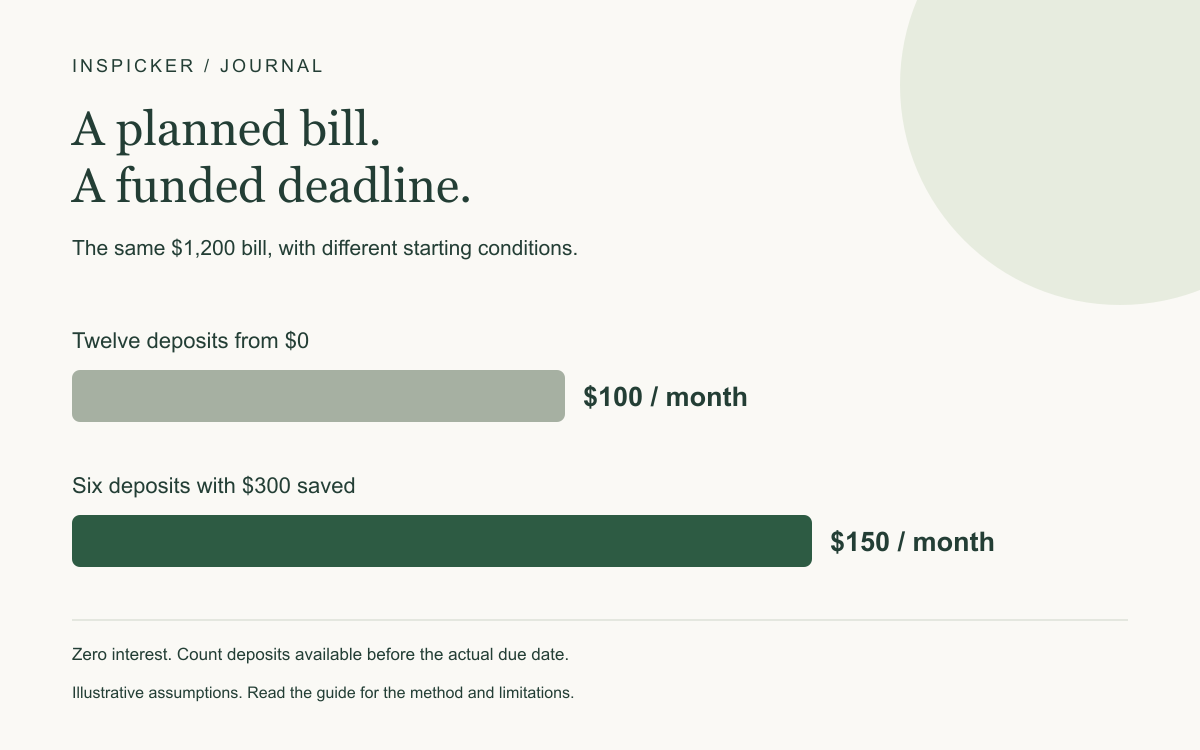
A sinking fund is money set aside gradually for a planned expense. For a $1,200 annual bill, saving $100 monthly works when twelve deposits are available. If the bill arrives sooner, calculate from the remaining gap and actual deposit dates instead.
For example, a $1,200 bill due in six months with $300 already assigned needs $150 per monthly deposit, ignoring interest. Dividing the full bill by twelve would leave the first deadline underfunded.
Use the savings goal calculator for one bill and deadline at a time. Then include the combined contributions in your monthly budget. A target that works individually may still be unaffordable alongside every other commitment.
A predictable bill is different from an unexpected emergency
Annual insurance, registration, school expenses, and an agreed vacation can have known or estimated dates. Setting money aside for them keeps an irregular bill visible in an ordinary monthly plan.
The CFPB’s spending-assessment guidance recommends reviewing several months so less frequent expenses are not missed. A bill need not arrive monthly to belong in your budget.
An emergency reserve serves a different purpose: unplanned expenses or financial emergencies. See the CFPB’s emergency-fund guide and our reserve expense checklist.
You can hold several purposes in one account, but the earmarks must remain distinct. A $2,000 balance containing $1,200 assigned to an insurance bill does not provide $2,000 of unrestricted emergency money as well.
Some expenses are only partly predictable. A vehicle repair allowance can be a planned reserve for eventual maintenance without knowing the invoice date. Label the uncertainty instead of pretending every future cost has a precise deadline.
Calculate the remaining gap before dividing by time
Without interest, the calculation is:
Contribution per deposit = (expected bill − money already assigned) ÷ deposits available before payment.
Consider the same $1,200 bill under different starting conditions:
| Bill | Already assigned | Deposits available | Required deposit |
|---|---|---|---|
| $1,200 | $0 | 12 | $100 |
| $1,200 | $300 | 6 | $150 |
| $1,200 | $0 | 3 | $400 |
| $1,200 | $900 | 3 | $100 |
These are hypothetical amounts and equal monthly deposits. Count deposits that can clear before the bill must be paid. A month-end transfer does not fund a bill due earlier that month.
The first funding cycle is often different from later cycles. Starting halfway through the year means fewer deposits are available, even if the bill itself recurs annually.
If the required amount does not fit, identify the actual constraint. You may need existing available cash, a change in optional spending, a revised purchase, or an arrangement with the biller. Do not solve a cash gap by assuming a speculative return over a short period.
Several reasonable targets can create a large total commitment
Suppose a household starts three funds:
| Purpose | Expected cost | Assigned savings | Monthly deposits left | Monthly allocation |
|---|---|---|---|---|
| Annual insurance | $1,200 | $300 | 6 | $150 |
| Registration | $240 | $0 | 8 | $30 |
| Optional trip | $1,800 | $600 | 12 | $100 |
| Total while all three are active | — | — | — | $280 |
The household needs $280 monthly during the overlapping period. The fact that each target has a different deadline does not make its contribution available to the others immediately.
After a deadline, review the allocation. Registration does not automatically disappear from future planning merely because this year’s bill was paid. A recurring expense needs a new cycle; an optional one-time goal may genuinely finish.
Use the budget planner to include the total commitment alongside ordinary bills, required debt payments, and other saving. If allocations exceed take-home income, the plan needs adjustment.
For a longer savings objective, see the $10,000 annual saving plan. Its contribution schedule follows the same gap-and-deadline logic but should not be added to a budget already fully allocated without identifying the funding source.
Do not budget the same obligation twice
A sinking-fund transfer moves money between accounts or earmarks. The eventual bill spends the amount already reserved. Your records should distinguish the cash movement from the underlying expense.
For example, transferring $100 monthly for a $1,200 annual bill reserves $1,200 over twelve deposits. When the bill is paid from that reserve, do not assume another $1,200 must also be funded from that month’s ordinary income if the reserve already covers it.
At the same time, the payment must still appear in actual cash records. The point is not to hide the expense, but to avoid interpreting the reserved transfer and later payment as two separate new funding needs.
Choose a consistent method. You might allocate monthly earmarks in the plan and release them when the bill is paid, while tracking actual spending separately. A bank-connected app may have its own transfer and rollover conventions.
The InsPicker planner does not maintain account balances or release earmarks. It is a monthly allocation comparison. For category consistency, required annual insurance can be treated as an essential-cost allocation even though the cash sits temporarily in savings. An optional trip remains discretionary in purpose.
After paying, update both the next target and the remaining balance
Suppose the first insurance cycle saved $300 plus six $150 deposits, reaching $1,200. After paying the $1,200 bill, that fund has zero remaining.
If the next estimated bill is still $1,200 and twelve deposits are available, the new contribution is $100. The temporary $150 catch-up schedule is no longer necessary under those assumptions.
If the renewal estimate rises to $1,320, the new twelve-deposit target becomes $110. Use the revised estimate rather than automatically repeating last year’s amount.
If the fund retained $120 after a cheaper bill, a $1,320 next target leaves a $1,200 gap, or $100 across twelve deposits. Confirm that the $120 is genuinely still assigned to this purpose before subtracting it.
Review estimates periodically, especially for bills whose amounts change. A sinking fund is a planning process, not a guarantee that a remembered annual cost will remain unchanged.
Use one deadline at a time
To reproduce the six-month example, enter a $1,200 target, $300 current assigned savings, a half-year horizon, and 0% return. The monthly result should be $150, assuming six month-end deposits are usable.
Run separate calculations for registration and the trip. Adding every bill into one target with one deadline can conceal an earlier shortfall, even if the combined balance eventually reaches the total.
The tool assumes regular month-end contributions and monthly compounding at the nominal annual rate entered. It does not schedule bill withdrawals, manage multiple earmarks, or account for taxes and fees. This guide uses zero return to keep the funding requirement clear.
If you are paid every two weeks, use actual transfer dates rather than silently treating biweekly as twice monthly. Our biweekly budgeting guide explains the difference between an annual average and cash arriving in an ordinary month.
Common questions about sinking funds
Is saving one-twelfth of an annual bill always enough?
Only when the starting balance and twelve available deposits support the deadline. A bill due in three months may need a much larger first-cycle contribution.
Do I need a separate bank account for each bill?
The arithmetic does not require one. Clear earmarks can separate purposes within an account, provided the totals reconcile and the same money is not assigned twice.
Is a sinking fund an emergency fund?
They serve different purposes. Money already committed to a predictable bill is not simultaneously unrestricted emergency cash.
Does the savings calculator handle all my annual bills together?
It models one target and horizon. Use separate runs for different deadlines and a budget or worksheet to reconcile their combined contributions and withdrawals.
Method: hypothetical bills, equal monthly deposits, zero return, and no withdrawals before each stated payment. Actual amounts and usable deposit dates should replace the examples.
For education and planning. Check assumptions and product terms before making a financial decision.
Put the numbers to work ↗