Savings / Budgeting
How to Budget Biweekly Pay Without Double-Counting Third Paychecks
Compare a two-paycheck budget with annualized monthly income. Includes a $2,000 paycheck example, cash-buffer arithmetic, and third-paycheck planning.
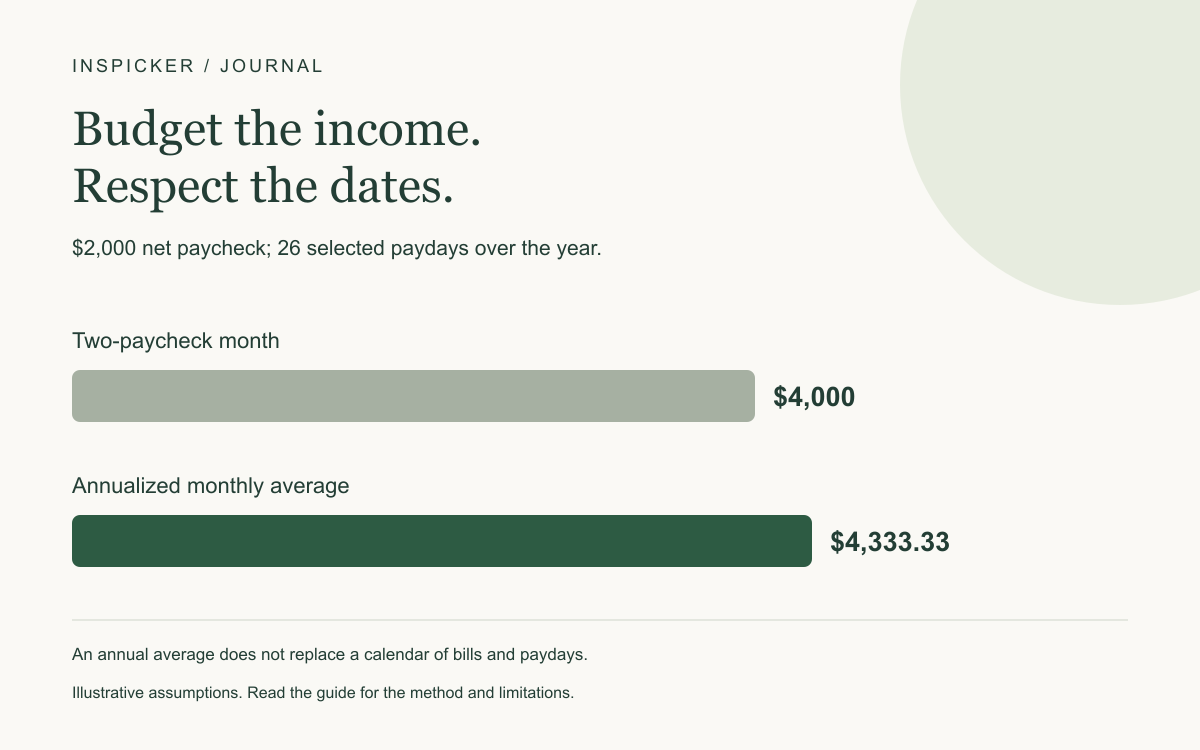
For a monthly budget, biweekly take-home pay can be expressed as an annualized average or as the amount received in a normal two-paycheck month. Those figures answer different questions. The average helps with annual planning; actual paydays determine whether bills can be paid on time.
With $2,000 per paycheck and 26 paychecks, annual take-home pay is $52,000. The monthly average is $4,333.33, while a two-paycheck month brings in $4,000. Spending the average without a cash buffer can create a shortfall in an ordinary month.
Use the budget planner to organize monthly allocations, then keep a separate calendar of income and bill dates. The planner does not automatically distribute biweekly receipts across the year.
Every two weeks is different from twice a month
Biweekly pay follows a repeating two-week interval. Twice-monthly pay follows two dates or scheduled periods in each month. A typical 26-paycheck biweekly year and a 24-paycheck twice-monthly year therefore have different counts.
The CFPB’s pay-schedule worksheet distinguishes these common frequencies. Count your employer’s actual paydays: some calendar arrangements have a different biweekly count, and holiday processing can affect when deposits appear.
This article assumes 26 equal net paychecks. It does not predict which months contain three checks, calculate taxes, or assume every biweekly worker has the same annual calendar.
Also use take-home pay, not gross compensation, when allocating the cash arriving in your account. Retirement deductions and insurance premiums already withheld should not be subtracted a second time from that net figure.
The monthly average is not the amount arriving every month
For the selected $2,000 paycheck:
Annual net pay = $2,000 × 26 = $52,000.
Annualized monthly average = $52,000 ÷ 12 = $4,333.33.
| Measure | Amount | What it describes |
|---|---|---|
| One paycheck | $2,000 | One selected net deposit |
| Two-paycheck month | $4,000 | Actual receipts in that type of month |
| Three-paycheck month | $6,000 | Actual receipts in that type of month |
| Monthly annualized average | $4,333.33 | Annual receipts divided by twelve |
In a 26-paycheck year with at least two paychecks in every month, the calendar has ten two-paycheck months and two three-paycheck months. Verify that distribution against your dates rather than using it as an automatic promise.
The average exceeds ordinary-month receipts by approximately $333.33. That difference is part of the same $52,000 annual income; it is not additional income earned by choosing an averaging formula.
Option one: build recurring allocations around two checks
Suppose the household allocates its ordinary $4,000 month as follows:
| Allocation | Monthly amount |
|---|---|
| Essential expenses and required debt payments | $2,800 |
| Wants | $500 |
| Saving and extra debt payments | $700 |
| Total | $4,000 |
The arithmetic balances without relying on a third paycheck arriving that month. That can make the recurring plan easier to maintain, but it does not prove the amounts are sufficient or affordable for every household.
The planner’s illustrative 50/30/20 benchmarks for $4,000 would be $2,000, $1,200, and $800. Actual allocations here differ. A percentage difference is not automatically a cash deficit: the entered allocations still total $4,000.
See the take-home-pay budgeting guide for category conventions and the distinction between a balanced budget and an adequate plan.
This baseline still needs bill-date planning. Even if monthly receipts cover monthly bills in total, a large payment due before the first paycheck can require money carried over from the previous month.
Option two: use the annual average with deliberate smoothing
An average-based plan can work if money from higher-receipt months is retained to support lower-receipt months. It requires a cash-flow buffer and discipline about what that buffer is for.
Suppose allocations are $4,300 monthly. Annual allocations are $51,600, leaving $400 of the selected $52,000 annual income unassigned.
However, in a two-paycheck month, $4,300 of allocations exceed receipts by $300. In a three-paycheck month, receipts exceed allocations by $1,700.
Across the assumed calendar, ten $300 gaps total $3,000, while two $1,700 surpluses total $3,400. The annual result is the same $400 surplus. The timing determines whether the account can cover the intervening gaps.
Annual arithmetic alone does not tell you the necessary starting buffer. Put the actual months and bill dates in sequence, calculate the running balance, and identify the lowest point. A plan starting after a three-paycheck month can have a different initial funding need from one starting just before it.
Money deliberately held to smooth a known pay schedule is not automatically an emergency reserve. If it is already needed to cover an ordinary month’s allocations, do not count the same amount as fully available for an unexpected emergency.
A third paycheck can only be assigned once
Under the two-paycheck baseline, the two additional $2,000 checks total $4,000 annually beyond the $48,000 assigned through twelve ordinary-month budgets.
That money can be deliberately allocated to annual bills, savings goals, debt reduction, or other priorities. Before calling it all available, check expenses that also recur by paycheck or every two weeks. Those may occur an extra time in the same month.
Under the $4,300 average-based plan, much of the higher-receipt-month surplus is already committed to smoothing the ten lower-receipt months. Assigning the full third checks to a separate purchase would double-count income needed elsewhere in the plan.
The two methods can both work, but mixing their assumptions creates trouble. Write down which method you use before deciding what a third paycheck can fund.
For a specific saving target, use the savings goal calculator. The target contribution must fit the chosen cash-flow method rather than being added to money already fully allocated.
Use a calendar alongside the monthly planner
List the opening available balance, each net payday, bill due dates, and transfers to other purposes. Walk through them chronologically. Check whether money is available before a payment leaves, not merely whether the month ends positive.
Include irregular expenses such as annual insurance or registration. If they are funded through monthly earmarks, keep those amounts visible rather than treating the account balance as unrestricted.
The Consumer.gov budgeting guide recommends gathering income and spending information and comparing planned and actual results. Review the calendar when pay changes, deductions change, or a household member starts a different schedule.
InsPicker’s monthly planner is an allocation tool, not a cash-flow calendar or bank-connected tracker. It will not identify an early-month overdraft from payday timing. Use a dated worksheet for that separate check.
Common questions about budgeting biweekly pay
Should I multiply a biweekly paycheck by two for monthly income?
That gives a two-paycheck-month baseline, not the annualized average. For a 26-paycheck year, multiply by 26 and divide by twelve to calculate the average.
Is the third paycheck extra income?
It is part of the same annual pay. It is unallocated only to the extent your existing plan has not already assigned it to smoothing or other commitments.
Can I safely budget $4,333.33 from $2,000 biweekly pay?
It is the selected annual average, but an average-based plan needs enough money carried between months and attention to actual bill dates. The formula alone does not establish that buffer.
Does the budget planner handle payday timing?
No. It compares monthly income and allocations. Use a calendar and running balance to check timing separately.
Method: hypothetical equal $2,000 net paychecks, 26 annual paydays, and explicitly stated allocation scenarios. Actual calendars, deductions, irregular earnings, and bill timing can change the outcome.
For education and planning. Check assumptions and product terms before making a financial decision.
Put the numbers to work ↗