Emergency fund / Debt
Emergency Fund or Pay Off Debt First? A Cash-Cushion Example
Compare emergency savings with a lump-sum credit-card payment. A checked example shows cash coverage, one-month interest, and time to rebuild savings.
Deciding between an emergency fund and paying off debt means balancing borrowing costs against the cash you need when something goes wrong. A high credit-card rate makes repayment valuable, but sending away all your accessible savings can leave the next urgent bill dependent on borrowing again.
Start with the cash cushion you need to protect essential obligations. Then compare a specific debt payment with the savings coverage it would leave. There is no single dollar amount that fits every household.
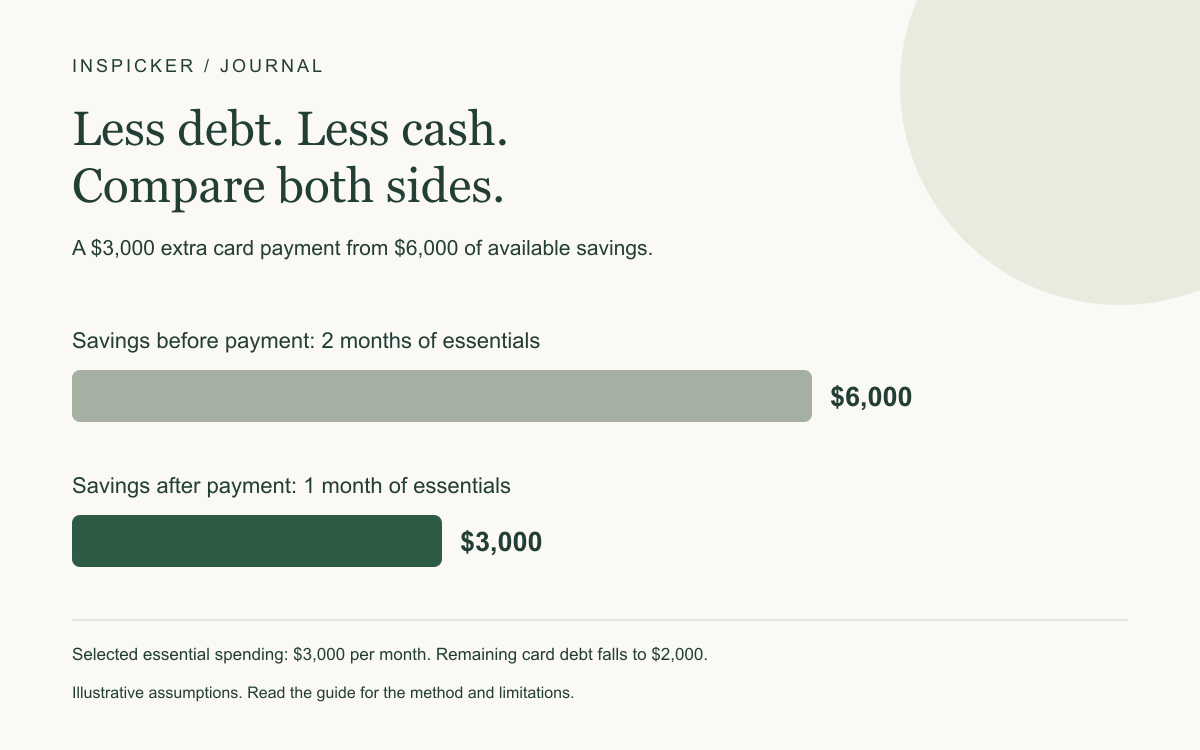
Use the emergency fund calculator to measure the cash side, then check the debt payment separately. Below, a hypothetical $3,000 payment reduces a $5,000 card balance to $2,000 while reducing savings coverage from two months to one month.
Cover immediate obligations before choosing an extra payment
First list the bills that must be paid before the next income arrives: housing, food, utilities, essential transportation, insurance, and required debt payments. Cash assigned to those bills is already committed. It should not also appear as available emergency savings or an extra debt payment.
If those obligations exceed income, begin with a monthly budget and contact creditors about available payment arrangements. A plan based on surplus cash will not solve an ongoing shortfall by itself.
Next, identify accessible savings that are actually available for emergencies. Exclude money already assigned to a known tax bill, an annual premium, or another planned purchase. Our sinking fund guide explains how to keep predictable costs separate.
The CFPB’s emergency fund guide emphasizes that a suitable reserve depends on personal circumstances. Its central point for this decision is practical: accessible cash helps absorb an unexpected expense without necessarily adding new borrowing.
After identifying a reserve you intend to retain, you can compare extra payments across debts. The CFPB’s debt-reduction overview explains the highest-interest-rate and snowball approaches. Those approaches help order repayments; they do not determine how much cash your household should keep.
Example: keep $6,000 or use $3,000 against a card?
Assume this household has the following hypothetical position today:
| Input | Selected amount |
|---|---|
| Available emergency savings, after upcoming bills | $6,000 |
| Essential monthly spending, including required debt payments | $3,000 |
| Credit-card balance before an extra payment | $5,000 |
| Constant annual card rate for the illustration | 24% |
| Extra payment under consideration | $3,000 |
The extra payment comes from existing savings. It is not additional income. With no fees, intervening interest, or new charges at the instant of the payment, the two positions are:
| Position immediately after the decision | Keep savings | Make extra payment |
|---|---|---|
| Emergency savings | $6,000 | $3,000 |
| Essential-spending coverage | 2 months | 1 month |
| Remaining card principal | $5,000 | $2,000 |
| Savings minus card principal | $1,000 | $1,000 |
Moving money from savings to debt does not instantly increase the last row. It changes liquidity and future interest exposure. The household now has $3,000 less cash available and $3,000 less debt outstanding.
Neither column is automatically the right choice. One month of essential spending could be inadequate for someone facing an unstable job or a likely repair. Someone with more dependable cash flow and fewer near-term risks may evaluate the same reduction differently.
An unused credit limit is not the same resource as accessible savings: future borrowing depends on the account and its terms, and some expenses cannot conveniently be paid with a card.
What does the 24% rate tell you?
For a simplified monthly illustration, divide the selected annual rate by 12:
24% ÷ 12 = 2% per month.
A full month at unchanged principal would produce $100 of modeled interest on $5,000, compared with $40 on $2,000. The difference is $60 for that one simplified month.
That is not a prediction of the next statement or a claim that the payment saves exactly $720 each year. Actual cards may use daily balances, different cycle lengths, changing rates, payment dates, and fees. Over time, the remaining balance and repayment schedule also change.
Money retained in savings may earn interest, too. Compare its after-tax return and accessibility with the borrowing cost, while recognizing that this numerical comparison does not price the value of having cash for an urgent expense. A selected savings rate is not a guaranteed permanent return.
For a fuller repayment scenario, use the credit-card payoff calculator. Our 12-month payoff example shows how a deadline changes the required monthly payment. Check your statement’s actual minimum and account terms before acting.
How long would it take to rebuild the cash?
Choose a three-month target purely for this example. At $3,000 of essential monthly spending, the target is $9,000.
Assume the household can contribute $500 to emergency savings at the end of each month after all expenses and required debt payments, with no withdrawals and a selected savings yield of 0%. Hold essential spending and this contribution constant in both cases to isolate the cash effect.
| Savings calculation | Keep savings | Make extra payment |
|---|---|---|
| Starting emergency savings | $6,000 | $3,000 |
| Target savings | $9,000 | $9,000 |
| Gap to target | $3,000 | $6,000 |
| Monthly savings contribution | $500 | $500 |
| Months to reach target | 6 | 12 |
Under these assumptions, using $3,000 of savings adds six months to the rebuilding timeline. This is a savings comparison, not a combined debt-and-cash optimization. It does not calculate future card payments, total interest, or a changing card minimum.
If debt payments fall and you redirect the difference into savings, rerun the plan with that revised contribution. If you instead redirect the $500 toward debt, the table no longer describes your savings timeline. Each dollar needs one assignment.
Choose a retained cushion using your actual risks
Before making a lump-sum payment, consider what could require cash before savings rebuild:
- Income interruption: variable hours, self-employment, an approaching contract end, or several household earners relying on the same employer.
- Necessary repairs: an aging vehicle needed for work or a home issue that cannot wait.
- Health expenses: deductible exposure and bills already expected, separating known costs from unknown emergencies.
- Dependents and support: obligations that continue even if income falls, plus how dependable any backup support really is.
A three-month target in a worksheet is a selected planning assumption. It is not a rule that every household should stop saving at three months, nor a requirement to accumulate that amount before any extra repayment. Compare three and six months of reserves and review the essential-expense checklist.
Use both calculators without counting money twice
- Enter essential monthly spending and accessible, uncommitted savings in the emergency fund calculator.
- Record months covered and the gap to your selected target.
- Subtract the proposed lump-sum debt payment from savings and rerun the cash scenario.
- Enter the remaining card balance and a realistically affordable payment in the debt tool.
- Reconcile the monthly budget so savings transfers and debt payments together fit the available cash.
The emergency tool models fixed month-end contributions and monthly growth using the entered annual yield divided by 12. This article uses 0% so the timeline depends only on contributions. It does not model emergencies, taxes on interest, changing living costs, or debt interest. Its projection also stops after 240 months.
Common questions
Should I empty my emergency fund to pay off a credit card?
Consider the cash position afterward before deciding. Eliminating interest-bearing debt can reduce future costs, but using every available dollar may leave essential bills or a new emergency unfunded. Calculate what you would retain and how quickly you could rebuild it.
Is a $1,000 starter emergency fund enough?
It can be an initial milestone, but it is not a universal adequate reserve. Compare it with essential spending, likely urgent expenses, income stability, and the time needed to replenish it. For the household in this example, $1,000 covers only one-third of a month of essentials.
Can I save and pay down debt at the same time?
Yes, if the budget supports both after required obligations. Assign separate amounts to each and check that their total fits the surplus. A smaller payment plus continued saving is another scenario you can compare; the calculators do not choose that split for you.
Does this example tell me how much interest I will save?
No. It shows a $60 difference for one simplified month at unchanged balances. Total interest depends on the actual payment schedule, account method, rates, fees, and future transactions.
Method: original hypothetical cash-allocation example checked against InsPicker’s emergency-fund calculation. Source links reviewed October 16, 2026. Amounts and rates are illustrative, not a current product offer or a personalized recommendation.
For education and planning. Check assumptions and product terms before making a financial decision.
Put the numbers to work ↗