Savings / Emergency funds
Three or Six Months of Emergency Savings? Choose Your Cushion
Choose a three- or six-month emergency fund using essential expenses, income risk, and worked examples. Calculate your target and the time needed to reach it.
Three months of emergency savings may be a reasonable starting target when your income is dependable, your fixed commitments are manageable, and you have flexibility after a setback. Six months provides a larger cushion when income is harder to replace or more people depend on it. Neither number guarantees that you can absorb every emergency.
Calculate the target from the expenses you would still need to pay during a disruption. Then consider how long you might need to cover them. Three months of income and three months of essential spending are different amounts.
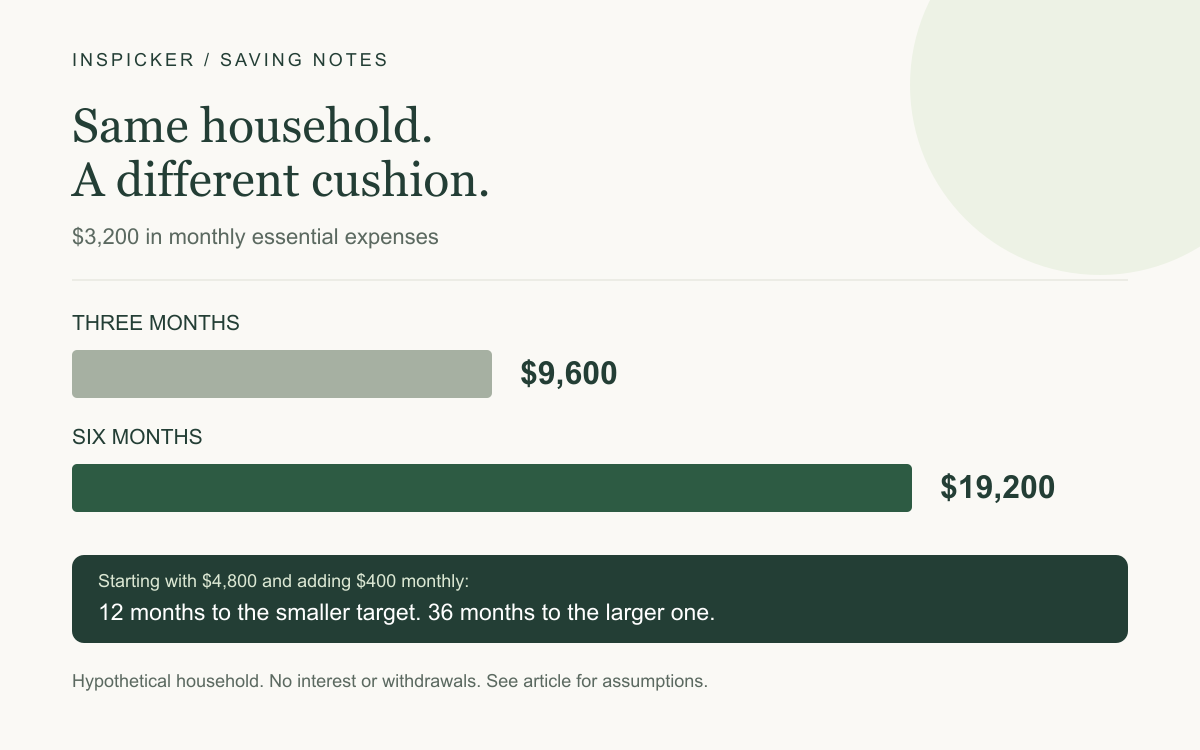
For a hypothetical household with $3,200 in monthly essentials, the targets are $9,600 for three months and $19,200 for six months. The right choice depends on the household's risks and available cash, rather than its salary alone.
Open the emergency fund calculator to compare both targets using your own expenses.
What does a three- or six-month emergency fund cover?
An emergency fund is money reserved for unexpected expenses or a loss of income. A months-of-expenses target asks how long your savings could support essential bills if normal income stopped.
The Consumer Financial Protection Bureau's emergency savings guide emphasizes that the amount needed depends on your circumstances. The FDIC's saving guidance describes six months of living expenses as a commonly recommended cushion.
Treat those guidelines as starting points. They do not measure how secure your particular job is, how quickly you could find another one, or how expensive an uncovered repair might be.
A smaller starting balance can still help. You do not have to wait until you reach three months before the savings become useful.
Start with the bills that would continue
Review recent statements and build an emergency budget. Focus on costs you expect to keep paying during a disruption, including commitments that cannot immediately be canceled.
This illustrative household's baseline is:
| Essential expense | Monthly amount |
|---|---|
| Housing | $1,600 |
| Utilities, phone, and necessary internet | $250 |
| Groceries | $450 |
| Necessary transportation | $250 |
| Insurance premiums | $300 |
| Minimum debt payments | $250 |
| Recurring essential health costs | $100 |
| Total | $3,200 |
These amounts are invented for the example. They are not national averages or recommended spending limits.
Your baseline may also include dependent care, support obligations, required taxes, or an essential service absent from this table. If losing a job would change your health coverage, estimate the replacement cost instead of assuming today's payroll deduction continues.
You may be able to reduce restaurant spending, trips, optional shopping, or subscriptions. Be realistic about how quickly those changes can happen. A contract you cannot end immediately can remain a cash requirement even if you would prefer to stop paying it.
For bills paid annually, include the monthly equivalent if they belong in the emergency budget. Keep the cash already reserved for the upcoming bill separate from your emergency balance so it is not counted twice.
Our expense-based emergency fund guide walks through the basic target calculation. This article focuses on choosing how many months to fund.
When should you consider three months or six?
The table below is a planning framework, not a scoring system that determines a universally correct answer.
| Household factor | May support a smaller initial target | May support a larger cushion |
|---|---|---|
| Income replacement | Several realistic ways to replace lost earnings | A specialized role or a potentially lengthy search |
| Household income | Independent earners whose income would cover essentials after one loss | One primary earner or earners exposed to the same employer or industry |
| Spending flexibility | Costs that can be reduced without disrupting essential needs | Significant fixed bills and dependent-care commitments |
| Income pattern | Predictable receipts and few seasonal gaps | Variable, commission-based, freelance, or seasonal earnings |
| Financial shocks | Limited exposure to large uncovered expenses | Essential vehicle, home, or health costs that could be difficult to absorb |
| Support | Specific, available assistance you can reasonably rely on | Support that is uncertain or unavailable |
Three months can be an intermediate milestone
Suppose you have dependable earnings, manageable commitments, and a realistic way to bridge a temporary shortfall. A three-month target may be a useful first milestone. You can then reconsider whether the next dollars should enlarge the reserve, repay costly debt, or support another goal.
Do not interpret “two incomes” as automatic protection. If both earners work for the same company, lose income during the same downturn, or would need paid care to keep working, the risks may be connected.
Six months can provide more time and flexibility
A larger cushion can be useful when replacing income may take longer, your household has one main earner, or you have commitments that are difficult to reduce. It can let you handle more than one setback without immediately relying on borrowing.
Six months is not a ceiling. A longer reserve may fit a particular household's circumstances, but it also takes more cash away from other goals. Make that tradeoff consciously rather than treating the largest possible balance as the only safe option.
Variable income needs two separate questions
Ask both, “How do I get through predictable slow months?” and “What happens if something unexpected goes wrong?”
Regularly low seasonal revenue may belong in a planned cash-flow buffer. An emergency reserve handles the unexpected shock. If you use one account for both, calculate the combined needs and make the earmarks explicit. Do not treat money needed for next quarter's routine shortfall as entirely available for emergencies.
Worked example: how much do three extra months require?
Use the $3,200 baseline and assume this household has $4,800 already reserved for emergencies. That balance covers 1.5 months of essentials.
Target = monthly essential expenses × target months.
| Measure | Three-month target | Six-month target |
|---|---|---|
| Monthly essentials | $3,200 | $3,200 |
| Target balance | $9,600 | $19,200 |
| Current dedicated savings | $4,800 | $4,800 |
| Remaining amount to save | $4,800 | $14,400 |
| Time at $400 per month, ignoring interest | 12 months | 36 months |
Moving from a fully funded three-month reserve to six months requires another $9,600. At $400 a month, that additional stage takes 24 months, ignoring interest.
Changing the monthly contribution makes a meaningful difference:
| Monthly saving | Time to $9,600 from $4,800 | Time to $19,200 from $4,800 |
|---|---|---|
| $300 | 16 months | 48 months |
| $400 | 12 months | 36 months |
| $600 | 8 months | 24 months |
These are planning estimates with constant expenses and contributions, no withdrawals, and no interest. An emergency during the saving period would change the timeline.
If essential costs rise to $3,500, the targets become $10,500 and $21,000. Recalculate after a rent increase, a new dependent, a major debt change, or a change in insurance coverage.
Stress-test the reserve against a plausible disruption
Imagine the household loses all income for four months while essential spending remains $3,200 a month. It would need $12,800.
- A fully funded three-month reserve of $9,600 falls short by $3,200.
- A fully funded six-month reserve of $19,200 would leave $6,400, before any additional costs.
That is a deliberately simplified scenario, not a forecast of unemployment duration. It makes the tradeoff visible.
Next, test what changes if another earner can still cover some bills. If reliable continuing income covers $900 a month, the modeled cash shortfall is $2,300 a month. Four months of that shortfall is $9,200. That manual scenario assumes the $900 remains available; the calculator's basic months-covered figure instead assumes savings cover the full essential-expense baseline.
Test a bill shock separately. A $2,000 unexpected expense reduces the household's current $4,800 reserve to $2,800, or 0.875 months of its $3,200 essentials. A reserve can be needed for a bill and an income disruption at the same time.
Unemployment benefits, severance, or support may help, but amounts, eligibility, and timing can be uncertain. Avoid counting an unconfirmed payment as cash already available.
Access to the money matters as much as the target
The purpose of this money is to be available when needed. Compare account access, transfer time, fees, and withdrawal conditions as well as the advertised yield.
An insured bank savings account can provide separation from everyday spending while keeping cash accessible. Verify the institution and coverage. The FDIC explains deposit insurance limits and ownership categories; coverage depends on those details, rather than on a product's marketing label.
A bank money market deposit account is different from a money market mutual fund. The investment fund does not receive FDIC deposit insurance. CDs can also have early-withdrawal terms that make some of the balance less convenient for urgent needs.
Avoid counting an unused credit limit as savings. Credit availability and borrowing cost can change precisely when you need support. Similarly, an investment you would have to sell during a market decline is not equivalent to immediately available cash.
Build the reserve in stages you can sustain
Start by deciding which money is actually available for emergencies. Exclude cash earmarked for imminent taxes, tuition, a down payment, or routine bills.
Then set manageable milestones. One household might choose a small initial cushion, one month of essentials, three months, and finally six. Those stages can make progress visible without implying that every household needs identical amounts.
Set a contribution from a budget that also covers required payments. The budget planner can help you find a sustainable monthly amount. Schedule transfers when income arrives and monitor the balance to avoid creating a shortfall elsewhere.
If you carry high-interest debt, consider both risks: paying down debt saves interest, while retaining some accessible cash can reduce the need to borrow again after a shock. There is no single allocation that fits every household. Our credit card payoff calculator lets you see what different repayment amounts change.
After using the reserve, update the balance and rebuild it. Spending emergency money on a genuine emergency means it has served its purpose.
Common questions
Should I use income or expenses to calculate the target?
For this method, use essential monthly expenses. Income may be much higher than the bills you would continue paying. If you intentionally want to replace a larger share of your normal lifestyle, include those costs explicitly.
Is three months enough for a single person?
Household size alone cannot answer that. A person living alone may have fewer dependent costs but no second earner to keep bills paid. Consider obligations, job prospects, and specific available support.
Does my emergency fund include a vacation or house deposit?
Keep planned goals separately identified. The same $5,000 cannot fund an upcoming trip and also remain fully available after a job loss. The savings goal calculator can help plan those separate deadlines.
Should I include retirement accounts?
Do not automatically count them as ready cash. Access rules, potential taxes, penalties, and market value may affect what is actually available. Start the comparison with dedicated liquid savings.
How often should I review the target?
Review it when income, household commitments, or essential expenses change. A periodic check can also catch gradual price increases. Recalculate both the target and the time to reach it.
What if six months feels impossible right now?
Set an achievable first milestone and contribution. Some accessible savings can help before you reach the full target. Use the timeline to plan the next step, not to judge progress against a balance you cannot create immediately.
Compare your three- and six-month targets using your essential spending, current dedicated savings, and a sustainable monthly contribution. Run the example without interest first, then explore the tool's interest assumption if appropriate.
Editorial note: The households and dollar amounts are hypothetical. Timelines assume regular saving without withdrawals; they are not predictions. This article offers a planning framework rather than a prescribed reserve for every household.
For education and planning. Check assumptions and product terms before making a financial decision.
Put the numbers to work ↗