Mortgage / Home affordability
Down Payment vs. Cash to Close: Budget Your Savings Once
Separate down payment, closing costs, retained cash, and deposits. Includes a checked $120,000 savings example and its effect on modeled home affordability.
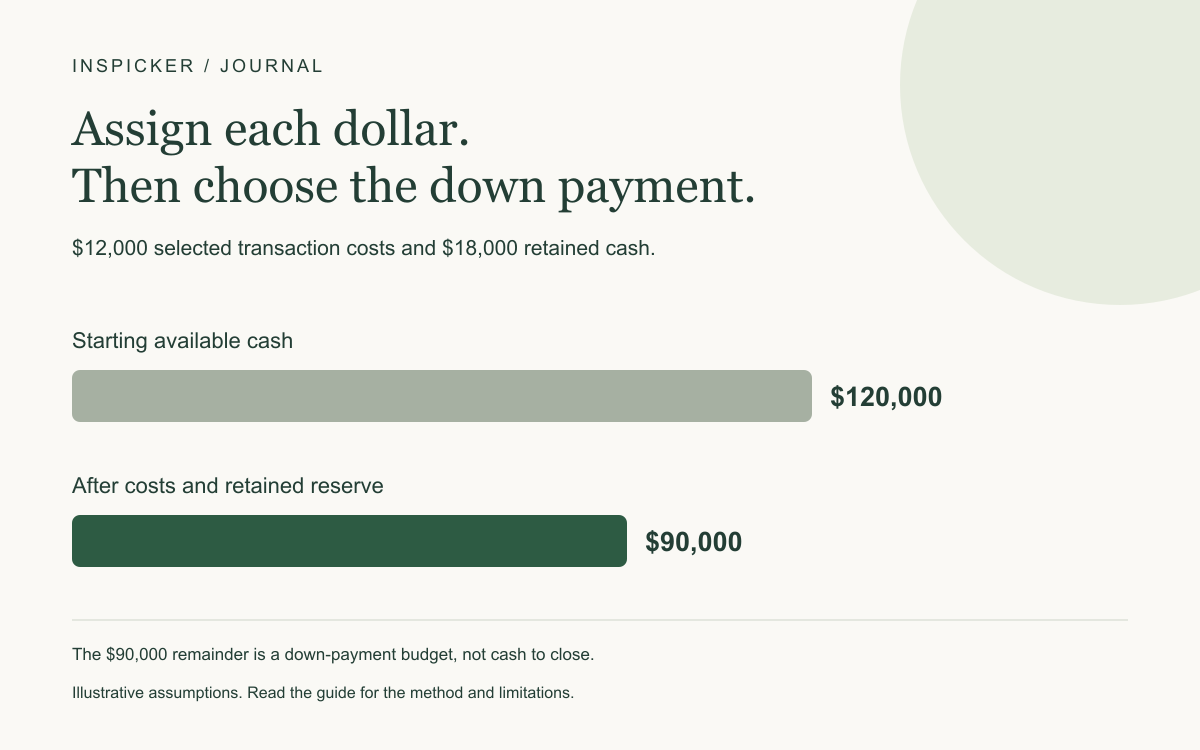
Your savings balance, down payment, and cash to close are different amounts. Before entering a down payment into an affordability calculator, subtract cash needed for closing and money you intend to retain for other obligations.
For a hypothetical household with $120,000 available, $12,000 of selected upfront transaction costs, and $18,000 retained outside the purchase, the remaining down-payment budget is $90,000. Entering the full $120,000 as down payment would allocate the same money to several purposes.
Use the home affordability calculator with the actual intended down payment. Its income-and-payment calculation does not automatically reserve closing costs or protect a cash cushion.
Savings are a resource; cash to close is a transaction figure
The down payment is the purchase-price portion you fund rather than borrow. Closing costs and other adjustments affect the total money needed to complete the transaction.
The CFPB’s down-payment planning guidance explains subtracting other cash needs and closing-cost estimates when determining what is available for a down payment.
The final cash-to-close figure incorporates the transaction’s applicable costs, deposits, credits, financing, and adjustments. The CFPB’s Closing Disclosure explainer distinguishes closing costs from the amount actually brought to closing and shows where to review the calculation.
| Figure | What it represents |
|---|---|
| Available savings | Cash resources being considered for the plan |
| Intended down payment | Purchase-price contribution used to reduce borrowing |
| Cash to close | Amount due under the actual transaction calculation |
| Retained cash | Money deliberately kept for other purposes |
Do not assume a bank balance or a percentage of home price reproduces the final cash-to-close line. Use the transaction documents and confirm changes before funding the purchase.
Decide what each dollar is supposed to fund
The worked household starts with $120,000 before any deposit is paid. For a simple illustration, it assumes no seller credits, lender credits, previously paid charges, or transaction adjustments.
| Cash allocation | Amount |
|---|---|
| Starting available cash | $120,000 |
| Selected upfront transaction costs | −$12,000 |
| Cash retained outside the transaction | −$18,000 |
| Maximum down payment under this allocation | $90,000 |
The $12,000 is a selected combined upfront-cost allowance for the example, not a standard charge or lender quote. Obtain an itemization for the actual transaction rather than assuming the same dollar amount applies to every home.
The $18,000 is a household choice, not a lender reserve requirement or a recommended emergency-fund amount for everyone. Its purpose is to show that money retained elsewhere cannot simultaneously be used as down payment.
Under the simple no-adjustment assumptions, $90,000 plus $12,000 means $102,000 used for the transaction, leaving $18,000. A real disclosure may show a different amount due because deposits, credits, and other items change that calculation.
If the household instead chooses an $80,000 down payment, it would use $92,000 for the selected transaction and retain $28,000. That is a different allocation of the same resources, not another $10,000 of income.
The down-payment input can change a modeled purchase limit
Hold the following assumptions constant: $100,000 gross annual income, $400 other monthly debt, 6.5% mortgage rate, 360-month term, 1.2% annual property-tax allowance, 0.4% insurance allowance, zero HOA dues, and illustrative 28% housing/36% total-debt ratios.
The model’s housing constraint is approximately $2,333.33 monthly. Compare the misleading full-cash input with the worksheet’s intended down payment:
| Down payment entered | Modeled maximum home price | Modeled mortgage |
|---|---|---|
| $120,000, ignoring other cash allocations | $403,946.89 | $283,946.89 |
| $90,000, after the selected costs and retained cash | $379,172.90 | $289,172.90 |
The estimated purchase-price capacity changes by approximately $24,773.98. These calculations use unrounded values internally, so subtraction of the displayed rounded prices can differ by a cent.
The lower down payment does not simply reduce the modeled home price dollar for dollar. The loan payment and the price-based tax and insurance allowances interact within the same housing budget.
The mortgage is slightly larger in the second row even though the home price is lower, because the down payment has fallen by $30,000. That is why the two columns need separate attention.
These are hypothetical budget outputs, not approvals. Both selected down payments exceed 20% of their modeled prices. The tool does not include PMI; different down-payment choices can make that omission important.
An earnest-money deposit is not automatically a second down payment
Track money already paid and how the transaction credits it. A deposit that is credited in the closing calculation should not be treated as a new charge again merely because it appears in several documents.
Suppose the simple $102,000 transaction requirement above includes a $5,000 deposit that has already been paid and is fully credited. With no other changes, the remaining amount to bring would be $97,000.
The total cash used is still $5,000 already paid + $97,000 remaining = $102,000. The deposit did not create another $5,000 expense in addition to the original total.
Starting balances matter too. If your current bank balance is measured after the deposit has left, do not subtract that already-paid amount again from the same balance when planning what remains available.
Confirm actual credits and treatment in the transaction documents. Do not assume every payment made during a home search is refundable or credited in the same way.
Cash to close does not include every future household need
Moving, initial repairs, setup costs, and ordinary bills may occur around the purchase without appearing as closing costs. Give them an explicit allocation rather than assuming the cash-to-close figure is the entire cost of getting established.
Separate known commitments from unexpected-event reserves. The sinking-fund guide explains planned expenses; the emergency-fund checklist helps define accessible reserve needs.
Do not call the same retained $18,000 fully available for both a planned renovation and an emergency reserve. If both purposes matter, divide the allocation or identify the tradeoff.
Keeping cash also has a financing tradeoff: a smaller down payment can mean a larger loan, different pricing, or mortgage insurance. This worksheet does not establish the best allocation for a particular borrower; it prevents a basic double-counting error before comparing choices.
Enter the intended purchase contribution, not total savings
First build the cash worksheet using actual estimates. Then enter the resulting down-payment amount into the affordability calculator, alongside realistic income, debts, financing, and ownership costs.
The tool solves for a price under selected payment ratios. It does not validate funds, calculate the Closing Disclosure, enforce lender reserve requirements, or include every purchase and ownership expense.
For homes with association dues, use the HOA affordability example. For the two income-ratio constraints, see the front-end versus back-end DTI guide.
Finally, check actual take-home cash flow in the budget planner. Having enough upfront cash does not prove the monthly ownership commitment is comfortable, just as a payment ratio does not prove the upfront cash is available.
Common questions about down payment and cash to close
Can I enter my full savings as the down payment?
Only if that is genuinely the amount assigned to down payment after other cash requirements are funded. In the example, $30,000 is assigned elsewhere.
Are closing costs and cash to close the same?
No. Cash to close reflects the applicable transaction calculation, including the down payment and relevant costs, deposits, credits, and adjustments.
Does earnest money need to be counted twice?
No. Track whether it has already been paid and credited. Reconcile total resources and remaining funds rather than treating the same deposit as two costs.
Does the calculator reserve cash for repairs or emergencies?
No. Decide those allocations separately before choosing the down-payment input.
Method: hypothetical cash allocation and fixed-rate affordability scenarios. Selected upfront costs and retained cash are assumptions, not quotes or universal requirements. Actual disclosures, loan terms, credits, and household needs determine the real transaction.
For education and planning. Check assumptions and product terms before making a financial decision.
Put the numbers to work ↗