Mortgage / Home affordability
How HOA Fees Change Your Home Affordability Budget
See how HOA dues affect an estimated home price with fixed income and down payment. Includes checked monthly breakdowns, assessments, and calculator limitations.
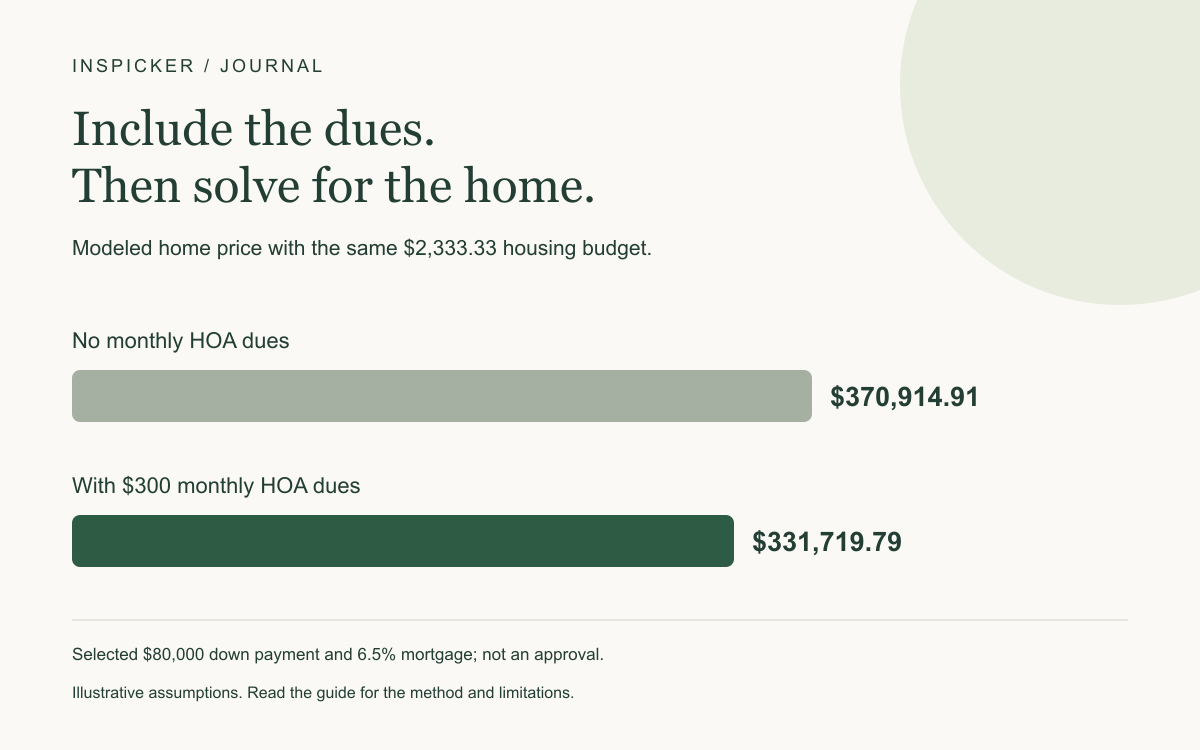
HOA dues use part of your housing budget even when they are paid separately from the mortgage. Holding income, debt, down payment, rates, and other assumptions constant, higher dues leave less room for mortgage principal and interest—and can lower the estimated purchase price.
In the hypothetical example below, adding $300 monthly HOA dues reduces the modeled affordable price from approximately $370,914.91 to $331,719.79. That is about $39,195.12 less purchase-price capacity, not simply $300 less home price.
Use the home affordability calculator to test the full monthly housing cost. Its result is a planning estimate, not a lender approval or a promise that a particular property is affordable for your household.
Separate billing does not mean a separate affordability question
The CFPB explains that HOA dues are usually paid directly to the association, rather than included in the payment sent to the mortgage servicer. They still belong in the cost of owning the property.
A listing’s principal-and-interest estimate can therefore be much smaller than the total recurring commitment. Add property taxes, insurance, HOA dues, and other relevant costs before deciding what fits.
Check how the quoted dues are billed. A $900 quarterly charge is equivalent to $300 monthly for an average budget, but the actual $900 bill still needs funding when due. Do not enter $900 as monthly dues unless that is the real frequency.
If a mortgage estimate already includes the dues, do not add them twice. Itemize the components and identify where each obligation is paid.
Establish the payment constraint before solving for price
This example uses the following selected assumptions:
| Input | Assumption |
|---|---|
| Gross annual income | $100,000 |
| Other required monthly debt payments | $400 |
| Cash down payment | $80,000 |
| Mortgage annual rate | 6.5% |
| Mortgage term | 360 months |
| Annual property tax allowance | 1.2% of modeled home price |
| Annual insurance allowance | 0.4% of modeled home price |
| Housing-ratio benchmark | 28% |
| Total-debt-ratio benchmark | 36% |
Gross monthly income is approximately $8,333.33. The housing benchmark permits approximately $2,333.33 monthly. The total-debt benchmark permits $3,000 for housing plus other debt, leaving $2,600 after the selected $400 debt payments.
The tool uses the lower housing allowance: approximately $2,333.33. That amount must cover mortgage principal and interest, the selected property tax and insurance allowances, and HOA dues.
The 28% and 36% settings are illustrative benchmarks. Actual underwriting and a household’s comfortable spending limit can differ. The front-end versus back-end DTI guide explains the two constraints in more detail.
Compare the same household with $0, $300, and $600 dues
Only monthly HOA changes across these scenarios:
| Monthly HOA dues | Modeled affordable home price | Modeled mortgage amount |
|---|---|---|
| $0 | $370,914.91 | $290,914.91 |
| $300 | $331,719.79 | $251,719.79 |
| $600 | $292,524.66 | $212,524.66 |
The $80,000 down payment stays fixed. The lower price also reduces the model’s price-based tax and insurance allowances.
At $300 dues, the approximate monthly breakdown is:
| Component | Monthly amount |
|---|---|
| Mortgage principal and interest | $1,591.04 |
| Property tax allowance | $331.72 |
| Insurance allowance | $110.57 |
| HOA dues | $300.00 |
| Total | $2,333.33 |
Figures retain precision internally and are rounded for display. These are hypothetical costs, not a quoted mortgage, tax assessment, insurance premium, or association budget.
The selected down payment exceeds 20% of the modeled price in all three rows. The calculator does not include PMI; changing to a smaller down payment can make that omission important.
Why $300 monthly changes the price by more than $300
A mortgage principal is repaid over many monthly payments. Removing $300 of monthly housing capacity therefore changes the amount of debt that can be supported over the loan term.
In this particular model, moving from $0 to $300 dues reduces estimated home price by approximately $39,195.12. Moving from $300 to $600 reduces it by the same amount because the other selected relationships remain linear in this comparison.
That is not a universal conversion between dues and price. A different rate, term, down payment, tax assumption, insurance allowance, or binding budget can produce a different result.
It is also not a property valuation judgment. The model does not say a home with an HOA is worth $39,195.12 less. It says this selected household, under these payment assumptions, has less room to finance a purchase when dues consume part of the monthly budget.
The dues themselves are an ongoing expense. At $300 monthly, they total $3,600 over twelve payments before any increase or assessment. That cash commitment belongs in the budget even if the property offers services you value.
Look beyond the current monthly dues
Ask what the dues cover and which costs remain your responsibility. An association may cover some services that another property’s owner pays separately. Compare complete ownership budgets rather than treating every dollar of dues as a pure addition to otherwise identical expenses.
Avoid counting a covered expense twice. Conversely, do not assume an association’s insurance or maintenance responsibilities eliminate all personal insurance, repairs, or reserves. Review the actual documents and obtain estimates for remaining costs.
Also review known assessments, announced dues changes, and relevant association financial information. An average dues figure does not tell you whether a separate bill is due soon.
The CFPB’s ability-to-repay commentary distinguishes treatment of recurring and one-time assessment obligations in its regulatory context. For your household budget, even a one-time expense still needs a funding source; ask the lender about its actual underwriting treatment rather than assuming the calculator decides it.
For a known future payment, the sinking-fund guide explains how to save from the remaining gap and deadline. Keep money committed to an assessment separate from unrestricted emergency savings.
Enter comparable assumptions for each property
To reproduce the example, use the stated income, debt, $80,000 down payment, 6.5% rate, 30-year term, tax and insurance rates, and ratio settings. Change only HOA from $0 to $300 to $600.
For an actual property, replace the model allowances with reasonable property-specific assumptions. The tool estimates taxes and insurance as percentages of price; actual bills may not follow that relationship.
The model does not include every ownership cost, maintenance, utilities, closing cash, PMI, or separate assessments. Its HOA field assumes a constant monthly amount. A future increase or a dated assessment needs a separate cash-flow review.
Finally, use the budget planner to compare the total commitment with take-home pay and actual living costs. Gross-income ratios do not establish how much cash remains after taxes, care, transport, saving, and other household needs.
Common questions about HOA fees and affordability
Do dues matter if they are not included in my mortgage payment?
Yes. Separate billing changes where the money goes, not whether it must fit the housing budget.
Does $300 in dues always lower affordable price by $39,195.12?
No. That is the output under this article’s fixed assumptions. Different financing and ownership costs change the relationship.
Does the calculator include a future special assessment?
Not automatically. It has a constant monthly HOA input, not an assessment calendar. Review known obligations and funding dates separately.
Is the result a mortgage approval amount?
No. It is a modeled budget estimate. Actual underwriting, property eligibility, costs, and household circumstances require separate review.
Method: hypothetical fixed-rate monthly amortization, price-based tax and insurance allowances, fixed down payment, and selected income ratios. PMI, maintenance, closing costs, dues changes, and special assessments are excluded.
For education and planning. Check assumptions and product terms before making a financial decision.
Put the numbers to work ↗