Retirement / Withdrawal planning
How Much Monthly Income Could $500,000 in Retirement Savings Provide?
Compare 3%, 4%, and 5% withdrawals from $500,000. See monthly amounts before taxes, a spending-gap worksheet, and what a simple withdrawal calculation leaves out.
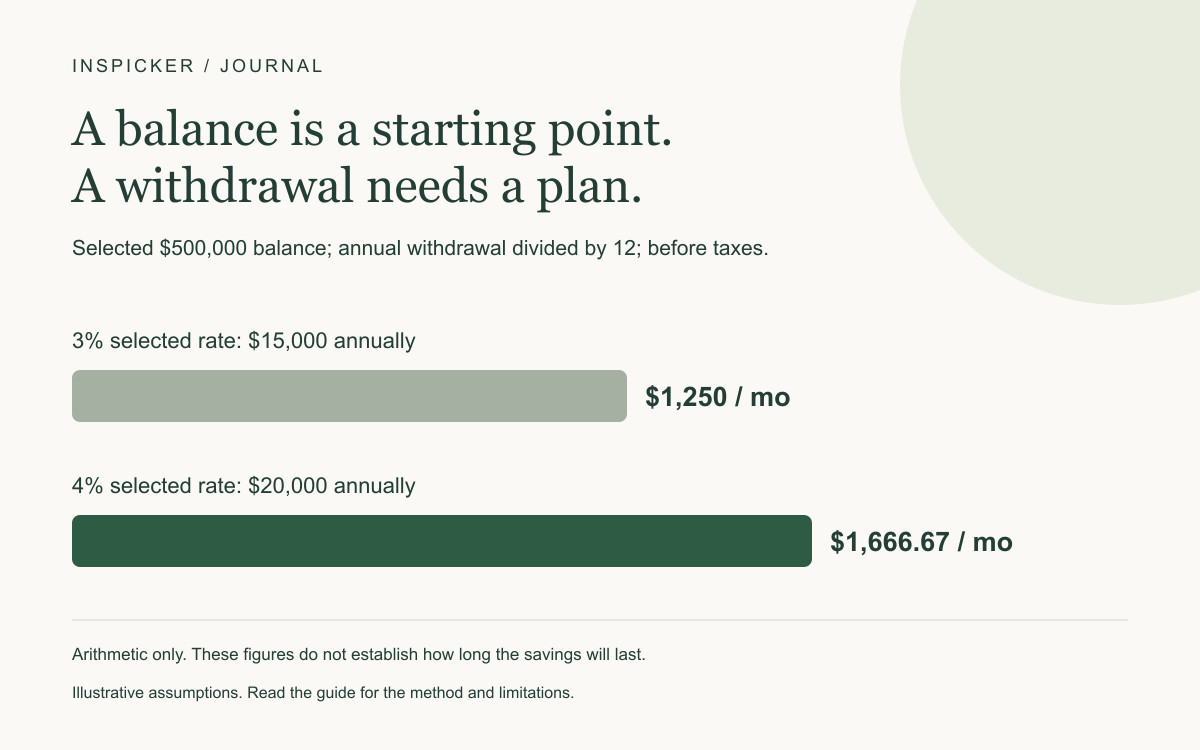
A $500,000 balance multiplied by a selected 4% withdrawal rate gives $20,000 a year, or approximately $1,666.67 per month before taxes. At 3%, the same arithmetic gives $1,250 monthly; at 5%, about $2,083.33.
These are starting withdrawal illustrations. They are not guaranteed investment income, after-tax spending amounts, or evidence that the balance will last for a particular retirement length.
Use the retirement calculator to see how a selected withdrawal rate translates a projected balance into an annual figure. Keep that conversion separate from the broader question of whether the plan can support your expenses over time.
What do 3%, 4%, and 5% mean on $500,000?
The starting calculation is balance × selected annual withdrawal percentage. Divide the annual figure by twelve to express it as a monthly equivalent.
| Selected starting withdrawal rate | Annual amount before taxes | Monthly equivalent before taxes |
|---|---|---|
| 3% | $15,000 | $1,250.00 |
| 4% | $20,000 | $1,666.67 |
| 5% | $25,000 | $2,083.33 |
Each percentage is a scenario, not a recommendation. A higher percentage produces more money withdrawn initially, but this table does not calculate the resulting future balances or the chance of running out.
The monthly amounts are annual figures divided by twelve and rounded. Multiplying the displayed monthly amount back by twelve may differ by a few cents from the exact annual amount. The calculation does not schedule twelve transfers or simulate their timing.
A withdrawal is different from a return
Withdrawing 4% does not mean the portfolio earns 4%, pays a 4% dividend, or preserves principal. A withdrawal may involve cash distributions, selling assets, or spending some of the original savings.
For example, if a $500,000 portfolio had no return, no fees, and no taxes, a single $20,000 withdrawal would leave $480,000. This one-step arithmetic explains where the money comes from; it is not a realistic retirement forecast.
The Investor.gov guide to managing lifetime income emphasizes the responsibility of managing retirement savings and the risk of outliving assets. An account balance and a percentage alone cannot answer that longer-term question.
InsPicker’s retirement tool projects saving before retirement. Its annual withdrawal figure is the projected balance multiplied by your selected percentage. It does not run a retirement drawdown simulation, test historical market sequences, or calculate a success probability.
Compare the amount with a spending gap
A useful next step is to list expected expenses and income on the same basis. For illustration, suppose a household chooses these before-tax planning figures at the retirement start date:
| Selected annual planning item | Amount |
|---|---|
| Gross cash requirement, including a placeholder tax allowance | $48,000 |
| Other gross income assumed available for this example | $30,000 |
| Remaining gross amount to fund from savings | $18,000 |
| Monthly equivalent of that remaining amount | $1,500 |
An $18,000 starting withdrawal from $500,000 corresponds to 3.6%. The arithmetic is $18,000 ÷ $500,000. It identifies the initial portfolio draw needed under these selected figures; it does not establish that 3.6% is sustainable.
The $30,000 is only an assumed income figure. It is not a Social Security estimate, pension quote, or promise that every household has that income. Use your own benefit estimates, start dates, and account information. Our Social Security claiming-age guide explains one separate timing comparison without determining your whole retirement plan.
Do not subtract gross income from after-tax spending and treat the result as an exact gross withdrawal requirement. Taxes can depend on income sources, account types, and circumstances. The placeholder allowance in this example keeps the worksheet internally consistent but does not calculate an actual tax bill.
Use the budget planner to organize expenses, then build a retirement-specific worksheet that distinguishes income, withdrawals, and taxes. Predictable annual bills also need room in the plan; see our sinking fund guide.
What a simple percentage leaves out
Several decisions remain after converting the balance into an annual withdrawal:
- Retirement length: a plan for an uncertain lifetime needs more than a first-year calculation.
- Market returns and their order: early losses combined with withdrawals can affect future balances differently from a smooth assumed return.
- Inflation: keeping a dollar withdrawal unchanged is different from keeping purchasing power unchanged.
- Taxes and fees: money withdrawn from an account is not necessarily the amount available to spend.
- Large or irregular costs: health expenses, repairs, and family needs may not fit a constant monthly average.
The Investor.gov guidance for older investors discusses fees, account monitoring, and tax considerations when drawing on savings. These are reasons to inspect the full plan rather than treating a calculator’s annual figure as a paycheck quote.
If $500,000 is a projected balance twenty years from now, the withdrawal amounts above are also figures for that future starting point. They are not automatically today’s purchasing power. Our future dollars versus buying-power guide explains why the valuation date matters.
Fixed dollars and a percentage of the current balance differ
Two withdrawal instructions can sound similar but create different cash flows:
| Instruction | What changes after the first calculation? |
|---|---|
| Withdraw $20,000 each year | Dollar withdrawal stays fixed unless you revise it |
| Withdraw 4% of each year’s current balance | Dollar withdrawal changes when the balance changes |
For example, 4% of a later $450,000 balance would be $18,000, while 4% of $550,000 would be $22,000. These are independent balance snapshots, not a simulated sequence.
A third approach could start with $20,000 and adjust that dollar amount for inflation. It is different from both methods in the table. InsPicker’s simple annual conversion does not choose among these ongoing withdrawal rules or test their outcomes.
Reproduce the starting-balance illustration
For a snapshot that isolates the percentage calculation, set current age and retirement age both to 65, and enter $500,000 current savings. With zero years until the selected endpoint, there is no accumulation period in this model. Salary, contribution, matching, and growth inputs therefore do not add money before the snapshot.
Set the selected withdrawal rate to 3%, 4%, and 5% in turn. The annual result should be $15,000, $20,000, and $25,000 respectively. Divide by twelve for the monthly equivalents in this guide.
For a genuine pre-retirement projection, use your actual age, planned retirement age, starting savings, salary, contributions, matching assumptions, salary growth, and estimated return. The tool models fixed assumed returns during saving; its withdrawal percentage still only converts the ending balance into an annual amount. Contribution limits, vesting, taxes, fees, Social Security, and post-retirement depletion are not modeled.
Common questions
Can I retire with $500,000?
The balance alone cannot answer that. Compare expenses, other income, taxes, timing, expected retirement length, and the risks to the plan. The $1,666.67 monthly figure at 4% is arithmetic, not a retirement-readiness decision.
Is $1,666.67 per month guaranteed at 4%?
No. It is $500,000 × 4% ÷ 12 before taxes. The calculation does not guarantee investment performance, preserve principal, or prove the withdrawal can continue for life.
Is a 4% withdrawal rate the same as earning 4% interest?
No. Withdrawal rate describes money taken out relative to a balance. Investment return describes gains or losses. You can withdraw money even when the portfolio has no gain, in which case the withdrawal can reduce principal.
Does this include Social Security or pension income?
No. The percentage table uses only the $500,000 savings balance. The separate spending-gap worksheet has a clearly selected other-income assumption that must be replaced with your own information.
Method: original hypothetical withdrawal arithmetic checked against InsPicker’s retirement calculation. Sources reviewed October 19, 2026. Percentages illustrate starting amounts and are not safe-withdrawal recommendations, tax calculations, or income guarantees.
For education and planning. Check assumptions and product terms before making a financial decision.
Put the numbers to work ↗