Savings / Savings goals
How to Save $10,000 in a Year: Monthly and Paycheck Targets
Plan a $10,000 savings goal with monthly and paycheck targets, existing-savings examples, and realistic interest assumptions.
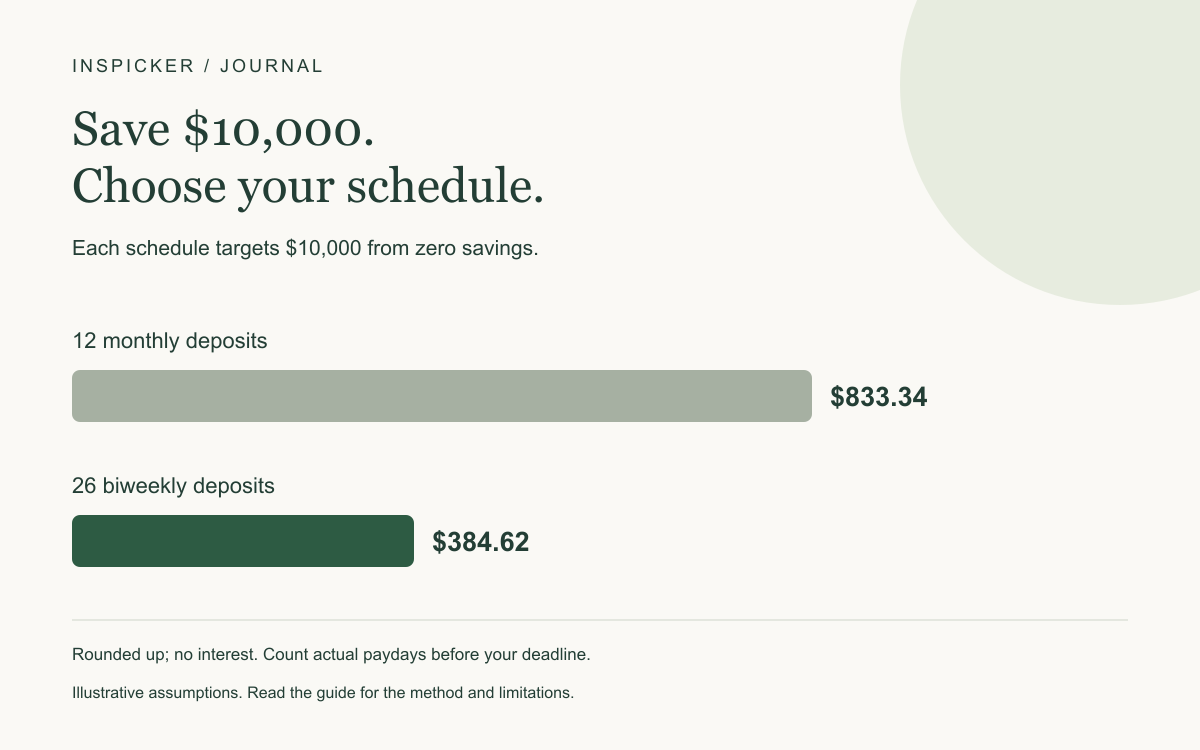
To save $10,000 in twelve months from zero, set aside $833.34 a month when rounding the target upward to whole cents. If you already have savings assigned to the goal, subtract that amount before calculating the remaining contribution.
A different pay schedule can make the target easier to organize, but it does not reduce the total money needed. Twenty-six biweekly deposits require $384.62 each; twenty-four twice-monthly deposits require $416.67 each, ignoring interest.
The target is a planning calculation, not a claim that everyone can free that amount from an existing budget. If it does not fit, change the amount, deadline, or available income rather than assuming an unrealistic return will close the gap.
Calculate your monthly savings target.
Start with the goal, the deadline, and money already assigned
Write down the exact amount needed and the date it must be available. A year from today is different from the end of the current calendar year.
Then identify the savings already dedicated to this goal. Exclude cash that must remain available for essential bills, taxes, or another commitment.
With no assumed interest:
Monthly contribution = (goal − available current savings) ÷ remaining monthly deposits.
| Starting goal savings | Gap to $10,000 | Deposits available | Rounded-up monthly target |
|---|---|---|---|
| $0 | $10,000 | 12 | $833.34 |
| $2,000 | $8,000 | 12 | $666.67 |
| $0 | $10,000 | 18 | $555.56 |
| $0 | $10,000 | 6 | $1,666.67 |
These examples ignore interest and withdrawals. Each amount is rounded upward so cent rounding does not leave a shortfall. You can adjust the final deposit to reach exactly the goal.
The Consumer.gov budgeting guide provides a practical starting point for comparing income with expenses. Use that cash-flow picture before deciding a contribution is affordable.
Convert the annual target to your actual pay schedule
If transfers happen when you are paid, divide by the number of paydays before the deadline.
| Assumed schedule | Deposits in this example | Rounded-up deposit for $10,000 |
|---|---|---|
| Monthly | 12 | $833.34 |
| Twice monthly | 24 | $416.67 |
| Every two weeks | 26 | $384.62 |
| Weekly | 52 | $192.31 |
Biweekly and twice monthly are different schedules. A calendar period may also contain a different number of actual weekly or biweekly paydays depending on the starting date. Count them rather than automatically assuming 26 or 52.
Changing frequency alone does not create savings. It can align transfers with money arriving and reduce the temptation to spend amounts intended for the goal.
Before setting an automatic transfer, check bill dates and the balance needed in the paying account. A transfer that causes an overdraft or missed essential payment needs a revised schedule.
Interest can help, but it does not replace contributions
Suppose the account earns a hypothetical constant 3% nominal annual rate compounded monthly, with deposits at each month-end. Starting from zero, the calculated monthly contribution to reach $10,000 after twelve months is about $821.94.
The unrounded model requires approximately $9,863.24 of deposits and produces $136.76 of growth. Rounding each actual deposit to $821.94 creates a slightly different final cent amount.
That is useful, but it is much smaller than the contribution commitment. The zero-interest target remains a helpful first test.
The 3% assumption is not a current savings-account quote. Rates can change, taxes may reduce retained interest, and an advertised APY uses a different convention from a nominal rate divided by twelve.
For the mechanics of contribution timing, read compound interest with monthly contributions.
Match the account to the deadline
Money needed on a fixed near-term date should not be modeled as though a smooth investment return is certain. Consider access, account charges, withdrawal restrictions, and the possibility of losing value.
The SEC's risk explanation describes risks that can affect investments, including market value and liquidity. Do not use a favorable long-term return assumption to make a one-year spending commitment appear affordable.
Build a contribution plan before automating it
Use normal, reasonably dependable income and current expenses. Separate a recurring contribution you can sustain from occasional extra deposits.
For example, if $600 is affordable each month, twelve transfers produce $7,200 before interest. The remaining $2,800 must come from existing assigned savings, additional income, lower spending, or a changed deadline.
A bonus may help when received, but an unconfirmed bonus is not money already in the account. Avoid making the whole plan depend on uncertain cash.
Our budget planner can help identify the actual monthly surplus. If you are also paying expensive debt, compare the interest cost and required payments instead of treating every saving goal as equally urgent.
Keep money needed for genuine emergencies separately identified. The emergency-fund expense checklist explains how to avoid claiming the same savings for two purposes.
Track the gap, not just whether a transfer happened
Ignoring interest, a $10,000 annual plan has simple checkpoints:
| End of period | Cumulative target |
|---|---|
| Month 3 | $2,500 |
| Month 6 | $5,000 |
| Month 9 | $7,500 |
| Month 12 | $10,000 |
The schedule does not require every real household to save at the same pace. If your income is seasonal, a customized schedule can be more realistic. The useful measure is whether the expected deposits still close the gap before the deadline.
Suppose you have $4,000 saved with six deposits left. The remaining $6,000 requires $1,000 per deposit, ignoring interest. Recalculate from the current balance instead of continuing a stale $833.34 target and assuming it will recover missed deposits.
If the new amount is not affordable, decide promptly whether to extend the date or reduce the goal. That is a planning adjustment, not a reason to assume a speculative return.
How to enter the examples
Enter $10,000 as the target, zero current assigned savings, one year, and 0% return. Then enter $2,000 current savings to see how the gap changes.
To reproduce the interest example, keep zero starting savings and select a 3% nominal annual return. The tool assumes month-end deposits and monthly compounding. It does not model irregular transfers, withdrawals, taxes, fees, or a changing rate.
Paycheck amounts in this article are separate no-interest arithmetic examples; the tool's main result is a monthly contribution.
Common questions
Do I need $833.34 if I already have some of the money?
No. Subtract savings genuinely allocated to the goal before dividing by the remaining deposits.
Is every-two-weeks saving the same as twice monthly?
No. The example uses 26 biweekly deposits versus 24 twice-monthly deposits. Your actual dates determine the count.
Should the $10,000 include an emergency fund?
It can be your emergency-fund goal, but then it is not simultaneously unrestricted money for another purchase. Label the purpose and avoid double-counting.
What if the savings rate drops?
Use a lower-rate scenario and update the contribution or deadline. Contributions should do most of the work in a short-horizon plan.
Editorial note: Targets are hypothetical planning examples. Interest scenarios assume constant rates, month-end deposits, and no withdrawals, taxes, or fees.
For education and planning. Check assumptions and product terms before making a financial decision.
Put the numbers to work ↗