Retirement / Social Security
Social Security at 62 vs. 67: Work Through the Break-Even
Compare hypothetical Social Security benefits at 62 and 67. Understand the simple break-even calculation and the tax, work, and family factors it leaves out.
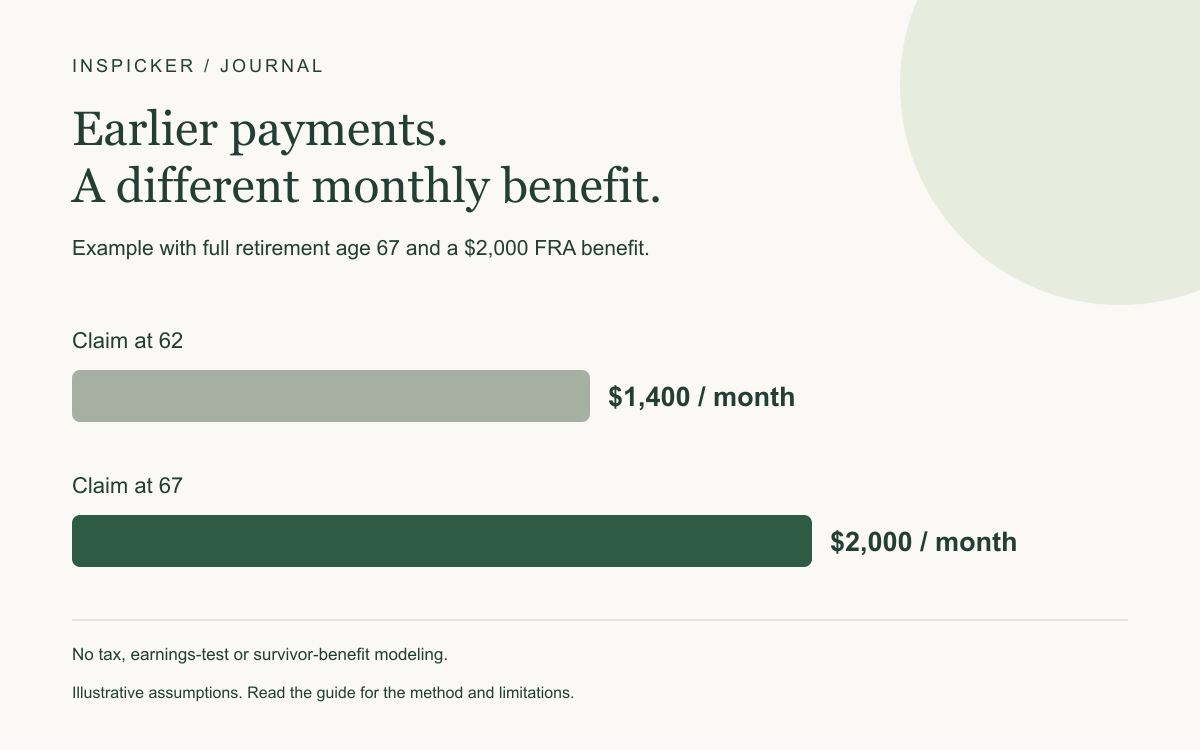
Claiming Social Security at 62 provides payments sooner; waiting until 67 can provide a higher monthly retirement benefit when 67 is your full retirement age. A simple break-even calculation compares the early payments with the later monthly increase.
For a hypothetical person whose full retirement age is 67 and whose benefit at that age is $2,000 monthly, claiming at 62 produces approximately $1,400 monthly under the standard early-retirement adjustment. The simplified cumulative break-even is around age 78 years and 8 months.
That calculation is not a recommendation. Cash needs, work, taxes, household benefits, longevity, and the resources used while waiting can all affect the decision.
Compare claiming ages using an estimate based on your own earnings record.
Start with your actual full retirement age and benefit estimate
Full retirement age depends on birth year. This article's example uses 67, applicable to people born in 1960 or later under the current schedule.
Do not substitute an arbitrary age or assume the $2,000 example represents your entitlement. Use your Social Security estimate and review the assumptions about future earnings.
If one scenario assumes working longer and another assumes stopping early, the underlying benefit estimate may also change. Holding the same full-retirement-age benefit constant isolates the claiming-age adjustment; it does not model every possible earnings history.
The SSA's early-or-late retirement explanation describes the birth-year schedule and benefit adjustments.
Worked example: $1,400 now versus $2,000 later
Assume eligibility for an ordinary retirement benefit, full retirement age 67, and a $2,000 monthly benefit at that age. Compare claiming at exactly 62 with exactly 67.
For a claim sixty months before full retirement age, the standard adjustment is:
- A reduction of 5/9 of 1% per month for the first 36 months.
- A reduction of 5/12 of 1% per month for the remaining 24 months.
- A combined reduction of 30% in this example.
| Claiming age | Share of the example FRA benefit | Monthly amount |
|---|---|---|
| 62 | 70% | $1,400 |
| 67 | 100% | $2,000 |
The later monthly amount is $600 higher.
This is a hypothetical comparison using one benefit base. It excludes taxes, benefit withholding due to earnings, other benefit types, and future rule changes.
How the simple break-even calculation works
Before the later strategy begins, the early strategy has roughly five years of monthly payments.
$1,400 × 60 = $84,000.
Once both strategies are paying, waiting provides $600 more each month under the constant-benefit comparison.
$84,000 ÷ $600 = 140 months.
One hundred forty months is eleven years and eight months. Add that to age 67:
Simple break-even: approximately age 78 years and 8 months.
This uses equal monthly intervals and ignores exact benefit-payment dates. The tool's monthly plotting convention and actual payment timing can shift individual chart points around a boundary. Treat the result as an approximate comparison, not a promised calendar date.
Use the right question
Break-even asks when accumulated benefits match under the selected assumptions. It does not determine which strategy best supports a household's full financial plan.
An earlier cumulative lead and a higher later monthly payment are different features. A choice can affect both cash available today and income available much later.
What does this simple calculation leave out?
Taxes and other income
The amount deposited after withholding or taxes can differ from the modeled gross benefit. Other income and account withdrawals can affect the broader tax picture. This calculator does not calculate a tax return.
Work before full retirement age
An earnings test can affect payments when you work and claim before full retirement age. The applicable limits change over time. Review the SSA's current work-and-benefits guidance rather than applying the full $1,400 payment to every working scenario.
Do not assume a simple permanent reduction story describes all earnings-test adjustments. The SSA's rules and your record determine the effect.
Spouse, dependent, and survivor benefits
A one-person comparison is not a complete household-benefit analysis. Review relevant family benefits rather than simply adding two independent break-even calculations.
The SSA's survivor-benefit information is a starting reference for eligible family members. The InsPicker claiming tool does not calculate a household survivor strategy.
Returns and discounting
Money received sooner can support spending or reduce withdrawals from other assets. An alternative investment outcome or borrowing cost is not included in the simple benefit-total comparison.
Do not assume early benefits earn a guaranteed market return, or that waiting has no cost to the rest of the plan.
Longevity and uncertainty
The calculation uses a chosen comparison horizon. It does not predict an individual's life expectancy or identify a universally correct claiming age.
Personal health, dependents, household resources, and income needs can all matter. A single average or break-even age should not stand in for those considerations.
Plan how expenses are funded if you wait
If you stop working before you claim, identify the cash or other income that supports the intervening years. Delaying a benefit can require using other resources.
For example, the absence of the hypothetical early $1,400 payment does not automatically mean a $1,400 monthly shortfall: the household may have wages, a pension, savings, or different expenses. Build the actual cash-flow plan.
Conversely, do not assume retirement savings can fund the gap without considering tax, withdrawal timing, or unfavorable markets.
The retirement savings calculator explores a separate accumulation scenario. It does not automatically integrate every account withdrawal with Social Security timing.
An emergency fund also has a different job from money deliberately allocated to a multi-year retirement bridge. Avoid counting the same assets as fully available for both.
How to reproduce the example
Use a birth year with full retirement age 67 and a $2,000 monthly benefit at that age. Compare ages 62 and 67 and a range of later endpoints.
Read both the monthly amount and cumulative comparison. Then examine assumptions outside the tool: work, tax, family benefits, resources while waiting, and potential changes in the underlying estimate.
The model presents simplified constant-dollar comparisons. It does not estimate your earnings record, forecast future COLAs, calculate earnings-test withholding, or model taxes and survivor benefits.
Compare your claiming-age scenarios. The Social Security guide introduces the wider set of ages, including waiting beyond full retirement age.
Common questions
Is 67 everyone's full retirement age?
No. It depends on birth year. The example uses 67 deliberately; confirm your applicable age with the SSA.
Does the $2,000 example tell me what I will receive?
No. It is a hypothetical benefit base. Use your own estimate and check its earnings assumptions.
Does reaching break-even prove I should wait?
No. It describes one cumulative comparison under stated assumptions. A household decision includes other resources and risks.
What if I will keep working?
Review the current earnings-test rules and whether future earnings change the benefit estimate. The unadjusted example does not answer that scenario.
Editorial note: Benefits and dates are illustrative. This article does not replace an SSA benefit estimate or individualized claiming analysis.
For education and planning. Check assumptions and product terms before making a financial decision.
Put the numbers to work ↗