Savings / Compound growth
Compound Interest With Monthly Contributions: A Worked Example
Understand compound growth with monthly deposits, a checked formula, and return scenarios. Separate contributions from growth and account for inflation.
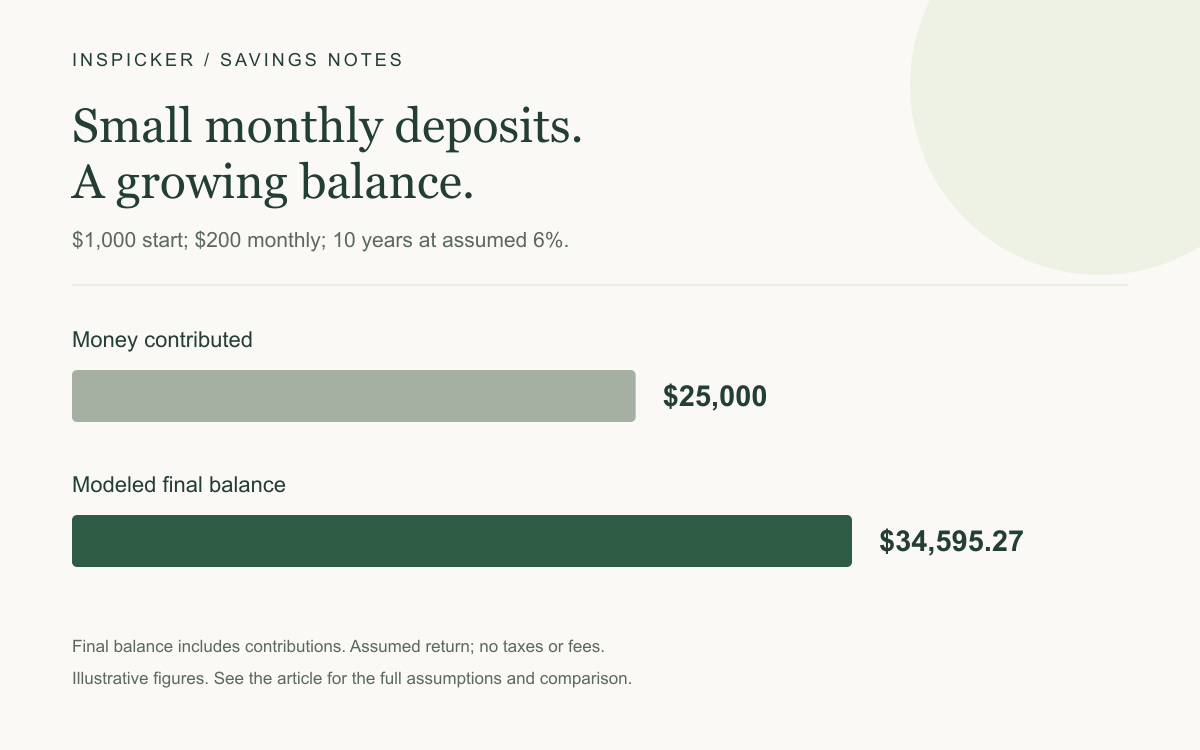
Compound growth with monthly contributions combines the growth of your starting balance with the growth of deposits added over time. Earlier money has longer to grow. Each later deposit has its own shorter compounding period.
For a hypothetical $1,000 starting balance, $200 deposited at each month-end, and a constant 6% nominal annual return compounded monthly, the balance after ten years is approximately $34,595.27. Of that, $25,000 is money contributed and $9,595.27 is modeled growth.
The 6% rate is an assumption, not a promised investment return or current account offer. Changing rates, fees, taxes, or deposit timing changes the result.
Use the compound interest calculator to see the contributions and growth separately.
What happens when you add money every month?
Start with $1,000 and divide the assumed nominal 6% annual rate by twelve. The monthly rate is 0.5%.
In month one:
- The $1,000 starting balance earns $5 under the constant-rate assumption.
- A $200 deposit arrives at month-end.
- The balance becomes $1,205.
In month two:
- $1,205 earns $6.025 before rounding.
- Another $200 arrives at month-end.
- The balance becomes $1,411.025, or about $1,411.03 when displayed.
The first month's growth is now part of the balance that earns the second month's growth. The first deposit also begins growing in later months. The second deposit does not earn the earlier months' returns.
This distinguishes a series of monthly deposits from putting the full contribution amount into the account at the beginning.
The SEC's Investor.gov calculator likewise treats starting money, ongoing contributions, rate, and compounding frequency as separate inputs.
Worked example: deposits versus growth
Assume:
- Initial balance: $1,000.
- Contribution: $200 at the end of every month.
- Duration: 10 years, or 120 deposits.
- Constant nominal annual return: 6%, compounded monthly.
- No withdrawals, taxes, fees, or missed deposits.
Your contributed money is:
$1,000 + ($200 × 120) = $25,000.
The modeled final balance is $34,595.27. Subtracting contributions leaves $9,595.27 of growth.
| Component after 10 years | Amount |
|---|---|
| Starting money | $1,000 |
| Monthly deposits combined | $24,000 |
| Total contributed | $25,000 |
| Modeled growth | $9,595.27 |
| Final balance | $34,595.27 |
Do not add the contributed amount to the final balance again. The final balance already contains it.
This is a transparent scenario, not a forecast of market performance. Investment values may rise and fall rather than earn a smooth amount each month.
The formula for constant month-end contributions
With a constant monthly rate, the future-value formula is:
Final balance = P × (1 + r)^n + C × [((1 + r)^n − 1) ÷ r].
Here:
| Symbol | Meaning | Example value |
|---|---|---|
| P | Starting balance | $1,000 |
| C | Contribution at each month-end | $200 |
| r | Monthly assumed return | 0.06 ÷ 12 = 0.005 |
| n | Number of months | 120 |
The first term grows the initial $1,000 for all 120 months. The second term combines deposits that each grow for a different number of months.
At a zero rate, the expression with division by r is replaced by the straightforward contribution total: P + C × n. In the example, that is $25,000.
The formula requires the rate and deposits to be constant. For changing deposits or returns, a month-by-month schedule is more appropriate.
Test more than one rate and duration
Keep the $1,000 start and $200 month-end deposit, then vary the constant nominal rate.
| Assumed annual rate | Final balance after 10 years | Final balance after 20 years |
|---|---|---|
| 0% | $25,000 | $49,000 |
| 3% | $29,297.64 | $67,481.15 |
| 6% | $34,595.27 | $95,718.38 |
These rates are illustrative assumptions. They are not probability bands, historical averages, or recommendations for any product.
At twenty years, contributions total $49,000. Under the 6% assumption, growth totals approximately $46,718.38.
The larger twenty-year balance reflects both another decade of contributions and more time for existing money to grow. It would be misleading to attribute the entire difference to compounding alone.
A useful plan tests a lower return and a lower affordable contribution as well as a favorable scenario. If only the optimistic version reaches the goal, identify the saving or timing changes needed in a less favorable path.
For the shorter mechanics of the formula, see our compound growth guide. This article adds contribution timing, scenario interpretation, and purchasing-power checks.
Read future dollars alongside purchasing power
A larger nominal balance does not tell you how much it will buy. For a simplified constant inflation assumption:
Today's-dollar equivalent = future balance ÷ (1 + annual inflation)^years.
Using the ten-year $34,595.27 result and assumed 2.5% annual inflation gives approximately $27,025.77 in today's purchasing power.
This does not mean inflation removes dollars from the account. It means the same future dollars may buy less than dollars today.
Keep the assumptions consistent. If you use a nominal growth rate and separately adjust for inflation, do not also treat that growth rate as already inflation-adjusted. Applying inflation twice understates purchasing power.
The calculator's inflation input is a scenario, not a prediction of future prices.
Four details can change the modeled outcome
1. Deposit timing
The example adds money at month-end after that month's growth. Beginning-of-month deposits have more time invested. A lump sum invested at the start is another schedule entirely.
The tool models regular month-end contributions. Do not compare it with a different deposit schedule and interpret the difference as an error.
2. Rate convention
A nominal annual rate divided by twelve is not the same as an effective annual yield quoted after compounding. Our 6% input uses the former convention.
If comparing an actual savings product, check whether the quoted figure is APY, how the institution compounds interest, and whether the rate can change. Match the convention before attempting to reproduce a statement.
3. Fees and taxes
An account can charge fees or incur taxes that affect the amount retained. The simple projection does not apply those automatically.
Use an explicitly defined net-rate approximation only when appropriate, or model the cash flows separately. Do not add a second fee deduction if the selected net assumption already includes that same fee.
4. Variable investment returns
A smooth monthly rate is a mathematical simplification. With ongoing contributions, the timing of gains and losses can affect the result. Two uneven return paths need not behave like a constant-rate illustration.
Investments can lose value. A target projection is not a guaranteed balance or a substitute for considering risk and the timing of when you need the money.
Enter the example and then adjust it
Use $1,000 initial money, $200 monthly contributions, 6% annual nominal growth, ten years, and 2.5% inflation. Compare the nominal balance, contributions, growth, and purchasing power.
Then rerun at 3% and 0% without changing deposits. Finally, extend the term to twenty years and notice that the contributed amount also increases.
Explore your monthly contribution scenarios. If you have a fixed goal and deadline, the savings goal calculator asks a related question: how much to contribute each month.
Common questions
Does every monthly deposit earn ten years of returns?
No. The first deposits grow for longer; the final month-end deposit has no time to grow before that endpoint.
Why is the final balance not just contributions plus 6% a year?
Each part of the balance has a different investment duration, and previous growth compounds. A simple percentage of the final contribution total does not describe the schedule.
Are contributions counted as interest?
No. Contributions are money you put in; growth is the amount above that contributed money under the stated model.
Is 6% a safe assumption for my savings account?
The article does not recommend that rate. Use terms applicable to the actual account or clearly labeled investment scenarios, including less favorable outcomes.
Editorial note: All returns and inflation rates are hypothetical constants. Figures use month-end contributions, monthly compounding, and no taxes or fees.
For education and planning. Check assumptions and product terms before making a financial decision.
Put the numbers to work ↗