Auto / Negative equity
Can a $5,000 Car Down Payment Help Avoid Negative Equity?
Compare zero down with $5,000 down on the same car loan. See payments, interest, one-year equity, and the limits of a depreciation-based estimate.
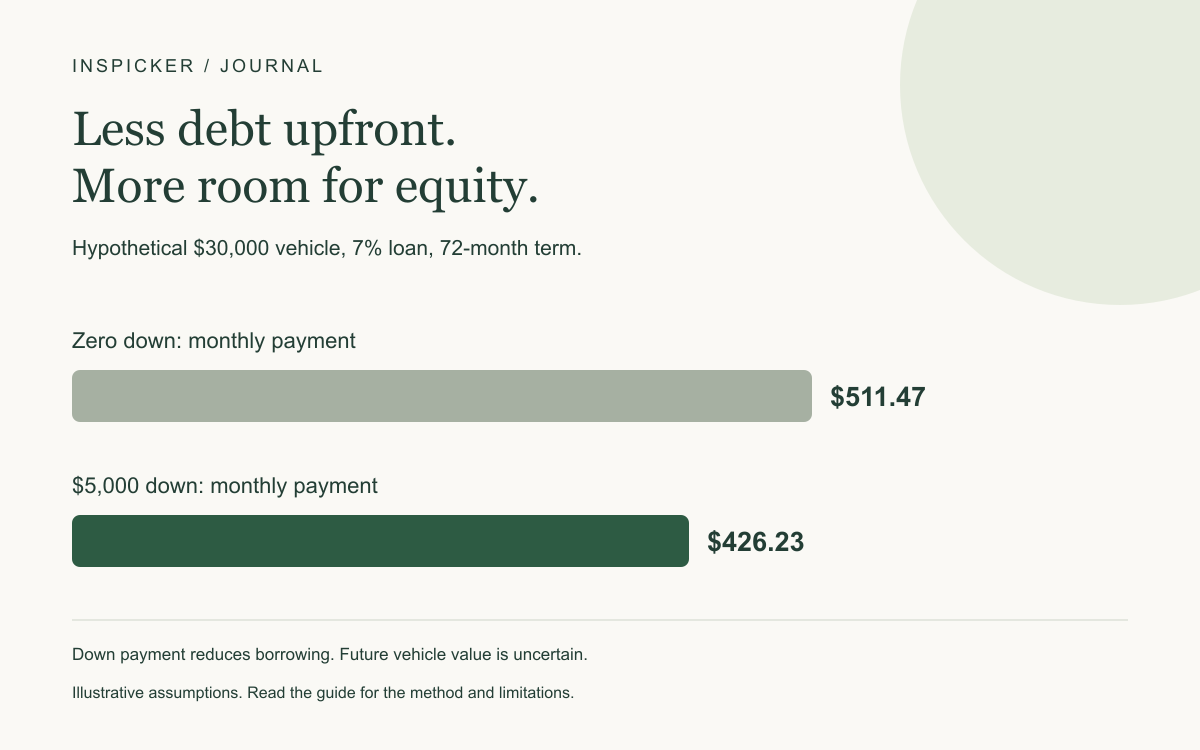
A larger car down payment reduces the loan balance, which can reduce both interest and the risk of owing more than the vehicle is worth. It does not prevent depreciation, guarantee a future trade-in value, or eliminate the need for an affordable cash reserve.
In the hypothetical $30,000 vehicle, 7% loan, 72-month term below, putting $5,000 down lowers the payment from approximately $511.47 to $426.23. After one year, the modeled equity changes from negative $1,830.26 to positive $2,474.78, using the same depreciation assumption.
Use the auto loan calculator to compare down payments, terms, and interest. The value estimate is a scenario input, not a prediction for a particular car.
Negative equity means the payoff exceeds the vehicle’s value
If a vehicle can be sold for $20,000 but the loan payoff is $23,000, the ownership position is negative $3,000 before selling costs. A sale does not make that debt vanish; the difference still needs to be settled.
For an actual transaction, use a current lender payoff quote and a realistic written purchase or trade-in offer. A statement balance and an online valuation can be useful starting points, but they are not necessarily the exact amounts available on your transaction date.
The CFPB’s guidance on trading a car with an unpaid loan explains that rolling negative equity into another loan can increase the new borrowing and its cost. Separate the old shortfall from the price of the replacement car.
This article examines a new loan without an old-loan shortfall. That isolates what the down payment changes.
Hold the car, rate, and term constant
| Input | Zero down | $5,000 down |
|---|---|---|
| Vehicle price used in the model | $30,000 | $30,000 |
| Cash down payment | $0 | $5,000 |
| Trade-in credit | $0 | $0 |
| Amount financed | $30,000 | $25,000 |
| Annual loan rate | 7% | 7% |
| Loan term | 72 months | 72 months |
| Annual depreciation assumption | 20%, compounded | 20%, compounded |
For clarity, the $30,000 is both the modeled vehicle price and its starting value. Taxes, financing fees, and optional products are excluded. In a real purchase, financed taxes or add-ons can increase debt without increasing the vehicle’s resale value by the same amount.
These inputs are hypothetical. The 20% depreciation assumption is not an industry forecast, and the 7% rate is not a current offer.
| Loan result | Zero down | $5,000 down |
|---|---|---|
| Monthly payment | $511.47 | $426.23 |
| Total scheduled interest | $6,825.85 | $5,688.21 |
| Loan payments over 72 months | $36,825.85 | $30,688.21 |
| Down payment plus loan payments | $36,825.85 | $35,688.21 |
The $5,000 down payment lowers total interest by approximately $1,137.64. It does not save the full $6,137.64 difference between the loan-payment totals, because $5,000 was paid upfront.
That distinction is easy to miss. Include the down payment when comparing total cash paid, even though it is not included in the lender’s monthly installments.
Compare the balance and value after twelve payments
With 20% annual depreciation, the selected value model gives:
$30,000 × 0.80 = $24,000 after one year.
Monthly loan amortization produces the following balances after twelve scheduled payments:
| Position after 12 payments | Zero down | $5,000 down |
|---|---|---|
| Modeled vehicle value | $24,000.00 | $24,000.00 |
| Remaining loan balance | $25,830.26 | $21,525.22 |
| Value minus remaining balance | −$1,830.26 | $2,474.78 |
The same car depreciates by the same amount in both paths. The down payment changes the financing side of the comparison.
Positive equity is not an immediate cash refund. It is an estimated asset position that could be realized through a transaction, subject to the actual sale value and costs. Likewise, negative equity does not itself change the required installment, but it can make selling or trading more difficult.
Interest and principal are included in each monthly payment. Early in the loan, part of the payment compensates the lender for that month’s interest, so the balance does not fall by the full payment amount.
What the calculator’s underwater-month count means
For this scenario, the calculator counts 43 month-end observations with debt above modeled value in the zero-down case. It counts zero in the $5,000-down case.
That is a model result, not a promise that the second borrower can never have negative equity. The tool samples the balance and a smoothly depreciating value at the end of each month. It does not see an immediate dealer spread, sudden damage, unusual mileage, or a market-price decline.
It also counts observations rather than predicting the exact day a car becomes safely tradable. Actual trade-in quotes may differ substantially from a smooth annual-percentage estimate.
Try a less favorable value assumption or a lower trade-in estimate before making a decision that depends on selling soon. A longer loan can also leave more principal outstanding at an early exit. The 60- vs. 72-month loan comparison explores that term tradeoff separately.
A down payment must leave room for the rest of ownership
The financing advantage is only part of the household decision. Paying $5,000 upfront reduces available cash. A household also needs to fund insurance, registration, fuel, maintenance, repairs, and ordinary living expenses.
Do not treat every dollar in savings as available for a vehicle. Identify money already assigned to essential bills or emergencies. The emergency-fund expense checklist can help keep those commitments separate.
If using $5,000 leaves no practical reserve, compare a less expensive vehicle, a different down payment, or more time to save. Increasing the loan term simply to make a price fit can reduce the installment while increasing interest and delaying balance reduction.
Use the budget planner for the recurring commitment. The loan payment is not the full monthly cost of having a car.
Keep an old-loan shortfall separate from trade-in credit
Suppose an existing vehicle has a $15,000 payoff and a $12,000 trade-in offer. Its net position is negative $3,000. Entering $12,000 as though it were debt-free trade-in credit would substantially understate new borrowing.
InsPicker’s simple auto tool subtracts the trade-in amount from price; it does not have separate fields for old payoff and negative-equity financing. Do not use that field alone to model an upside-down trade.
Write out the replacement transaction separately: new vehicle cost, old payoff shortfall, taxes and fees, cash paid, and amount financed. Then compare the actual financing disclosure. If a dealer says it will “pay off” the old loan, identify where the money comes from in the new transaction.
For an ownership-versus-leasing comparison, use the common-period cost guide, which distinguishes cash outflow from remaining equity.
Common questions about down payments and equity
Does $5,000 down save $5,000?
It reduces the amount borrowed by $5,000, but that money is paid upfront. In this example, the additional financial saving is approximately $1,137.64 of avoided interest over the full loan term.
Can a car with a down payment still become underwater?
Yes. Actual depreciation, financed fees, a trade-in shortfall, and other changes can leave the debt above value. A down payment reduces the initial loan but does not guarantee future value.
Are 43 underwater months a prediction for my car?
No. They are monthly observations from the selected loan and smooth depreciation assumptions. Use actual payoff and purchase offers for a real transaction.
Can I enter an upside-down trade as ordinary trade-in credit?
Not accurately without accounting for its outstanding debt. The simple tool does not separately model an old loan payoff, so reconcile that transaction outside the trade-in field.
Method: fixed-rate monthly amortization with unrounded calculations, no extra payments, and vehicle value declining by a constant compounded annual percentage. Taxes, fees, transaction costs, and real-world value changes are excluded.
For education and planning. Check assumptions and product terms before making a financial decision.
Put the numbers to work ↗