Auto / Leasing
Lease or Buy a Car? Compare Costs Over the Same Period
Compare leasing and buying over the same period, including upfront costs and remaining equity. See a checked example and how resale assumptions change the result.
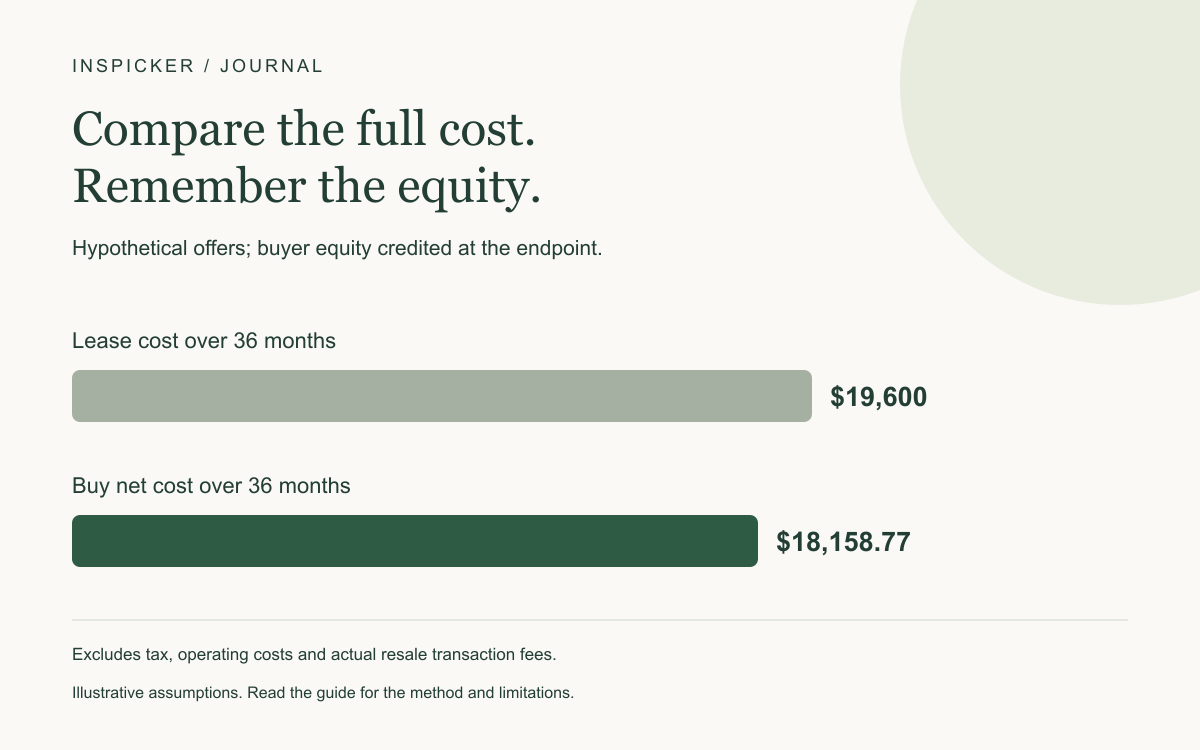
Compare a lease and a purchase over the same number of months, then account for the buyer’s remaining equity. A lower monthly payment does not automatically mean a lower total cost. Upfront charges, financing, resale value, mileage, and end-of-contract costs can change the result.
In the hypothetical 36-month comparison below, leasing costs $19,600. Buying requires more cash during those months but has an estimated net cost of $18,158.77 after crediting the vehicle’s equity. That makes buying cheaper by approximately $1,441.23 under these assumptions. A lower resale value reverses the result.
Use the lease vs. buy car calculator to compare your own offers. These figures illustrate a method; they are not current dealer quotes.
Start with the same comparison period
A 36-month lease and a 60-month loan have different contract lengths. Comparing the sum of their full payments would mix two different time horizons. Instead, choose the point at which you want to reassess the car—36 months in this example—and measure both options at that point.
For the lease, total the costs incurred through the return date. For the purchase, total cash paid through that date, then subtract the equity you would own. Equity means estimated sale value minus the outstanding loan balance. It is not the full vehicle value when a loan remains.
| Assumption | Hypothetical input |
|---|---|
| Purchase price | $35,000 |
| Comparison period | 36 months |
| Lease payment | $450 monthly |
| Lease upfront charges, excluding every monthly installment | $3,000 |
| Lease end fees | $400 |
| Purchase down payment | $5,000 |
| Amount financed | $30,000 |
| Loan rate and term | 7% annually; 60 months |
| Annual vehicle depreciation assumption | 15%, compounded |
Taxes, operating costs, sale transaction fees, and the opportunity cost of upfront cash are excluded here. That keeps the financing comparison readable, but a real decision needs those additional items.
Add upfront charges, installments, and end fees once
For this example, the lease calculation is:
$3,000 + (36 × $450) + $400 = $19,600.
The $3,000 is defined to exclude all 36 monthly installments. This matters because a dealer’s advertised “due at signing” can include the first monthly payment. Adding that amount to 36 more payments would count the first installment twice.
Before entering an actual quote, separate the signing amount into its components. If it includes a $450 first payment, do not also include that same payment as an additional upfront cost. Likewise, a genuinely refundable deposit is different from a nonrefundable charge: its treatment depends on whether and when it is returned.
The Federal Trade Commission’s car financing and leasing guide explains why lease terms, mileage limits, wear charges, and early termination conditions deserve attention. Read the actual agreement rather than assuming the advertised payment covers everything.
At the end of this modeled lease, the car is returned and no ownership equity is credited. A lease buyout is a separate scenario that would require its own purchase price, financing, and fees.
Subtract equity from the purchase cash outflow
The purchase loan finances $30,000 over 60 months at a nominal annual rate of 7%. With monthly amortization, its payment is approximately $594.04. Calculations retain the unrounded payment internally.
Over the first 36 months, cash outflow is approximately:
$5,000 down payment + 36 loan payments = $26,385.29.
That exceeds the lease’s cash cost. However, the buyer also owns a vehicle with an outstanding loan attached to it. Under the assumed depreciation pattern:
Estimated vehicle value = $35,000 × 0.85³ = $21,494.38.
After 36 scheduled payments, the loan balance is approximately $13,267.85. Estimated equity is therefore:
$21,494.38 − $13,267.85 = $8,226.52.
The economic comparison credits this equity against the buyer’s cash outflow:
$26,385.29 − $8,226.52 = $18,158.77 net purchase cost.
| At the 36-month comparison point | Lease | Buy |
|---|---|---|
| Cash outflow in this model | $19,600.00 | $26,385.29 |
| Ownership equity credited | $0.00 | $8,226.52 |
| Net modeled cost | $19,600.00 | $18,158.77 |
Equity is not a cash refund from the lender. You would usually need to sell or trade the vehicle to realize it, and the actual proceeds can differ. If you keep the car, the equity remains an asset while the remaining loan payments continue.
For a closer look at financing length, read the 60- vs. 72-month car loan example or use the auto loan calculator.
A different resale estimate can reverse the result
Depreciation is a major uncertainty. The calculator applies a constant annual percentage compounded over the comparison period. It does not predict the market price of a specific model, condition, or mileage history, and real depreciation is not necessarily uniform.
Change the assumption from 15% to 20% annually while keeping all other inputs unchanged:
| Purchase outcome after 36 months | 15% annual depreciation | 20% annual depreciation |
|---|---|---|
| Estimated vehicle value | $21,494.38 | $17,920.00 |
| Remaining loan | $13,267.85 | $13,267.85 |
| Estimated equity | $8,226.52 | $4,652.15 |
| Net purchase cost | $18,158.77 | $21,733.15 |
With the lower resale value, leasing is cheaper by approximately $2,133.15 in this limited model. Financing did not change; the asset estimate did. A small apparent advantage should therefore be tested against a reasonable range of resale outcomes.
If expected value falls below the outstanding loan, equity becomes negative. The shortfall belongs in the purchase comparison too; it does not disappear when you trade in the car.
Add the costs that differ between your options
Start with the same vehicle or a genuinely comparable alternative. Then list excluded costs separately so you can see which assumptions drive the choice:
- Taxes and fees: include the actual charges for each offer under your location’s rules.
- Mileage and return condition: estimate possible lease charges using the written allowance and your likely usage.
- Insurance and maintenance: compare requirements, coverage prices, and expenses over the same period.
- Selling costs: reduce expected sale proceeds for costs you would actually incur.
- Early exit: compare the consequences if you need to change vehicles before the planned endpoint.
- Upfront cash: consider the value of keeping a cash reserve and any alternative use of the money.
Do not add identical costs to one side only. Conversely, an item that is included in one offer but excluded from the other needs an explicit adjustment. A spreadsheet with a source or quote beside every assumption can prevent accidental omissions.
The budget planner can help check whether the monthly cash commitment fits. An option can have a lower estimated economic cost and still require more cash than your budget comfortably supports.
Use written offers and test your holding period
Enter the exact loan amount, term, rate, lease installments, and separated upfront charges from your offers. Confirm whether the quotes include taxes and fees. Use a resale estimate that reflects your expected mileage and condition rather than selecting a depreciation rate simply to favor one option.
Then vary two inputs: the comparison period and the resale assumption. Someone who keeps a purchased vehicle well beyond the loan term faces a different decision from someone replacing it every three years. Repeated leasing also requires another contract after the first lease ends; this single-period example does not price that future contract.
Keep the cash-flow view beside the net-cost view. They answer different questions: “What must I pay during this period?” and “What did access to the vehicle cost after allowing for the asset I still own?”
Common questions about leasing versus buying
Is leasing always cheaper because the payment is lower?
No. The installment is one part of the cost. Upfront charges and lease-end costs matter, while a purchaser may retain equity. Compare the same period and account for both cash outflow and remaining ownership value.
Should I subtract the full resale value when comparing buying?
Subtract net equity, not the full resale value, when a loan remains. In this example, a $21,494.38 vehicle has only $8,226.52 of modeled equity because approximately $13,267.85 is still owed.
Does due at signing include the first payment?
It can. Read the itemized quote. The worked example defines upfront charges to exclude all monthly installments so each payment is counted exactly once.
Can this calculator tell me a vehicle’s actual future value?
No. Its depreciation input is a scenario assumption. Compare multiple values and allow for selling costs, condition, and mileage before relying on the result.
Method: hypothetical fixed-rate monthly loan amortization, scheduled payments, compounded annual depreciation, and a common 36-month comparison period. Figures are rounded for display. Taxes, operating costs, and resale transaction fees are excluded; actual contracts and outcomes vary.
For education and planning. Check assumptions and product terms before making a financial decision.
Put the numbers to work ↗