Auto / Auto loans
60- vs. 72-Month Car Loans: Payment Relief and Total Interest
Compare 60- and 72-month car loans with the same amount and rate. See payment savings, total interest, equity considerations, and loan-offer checks.
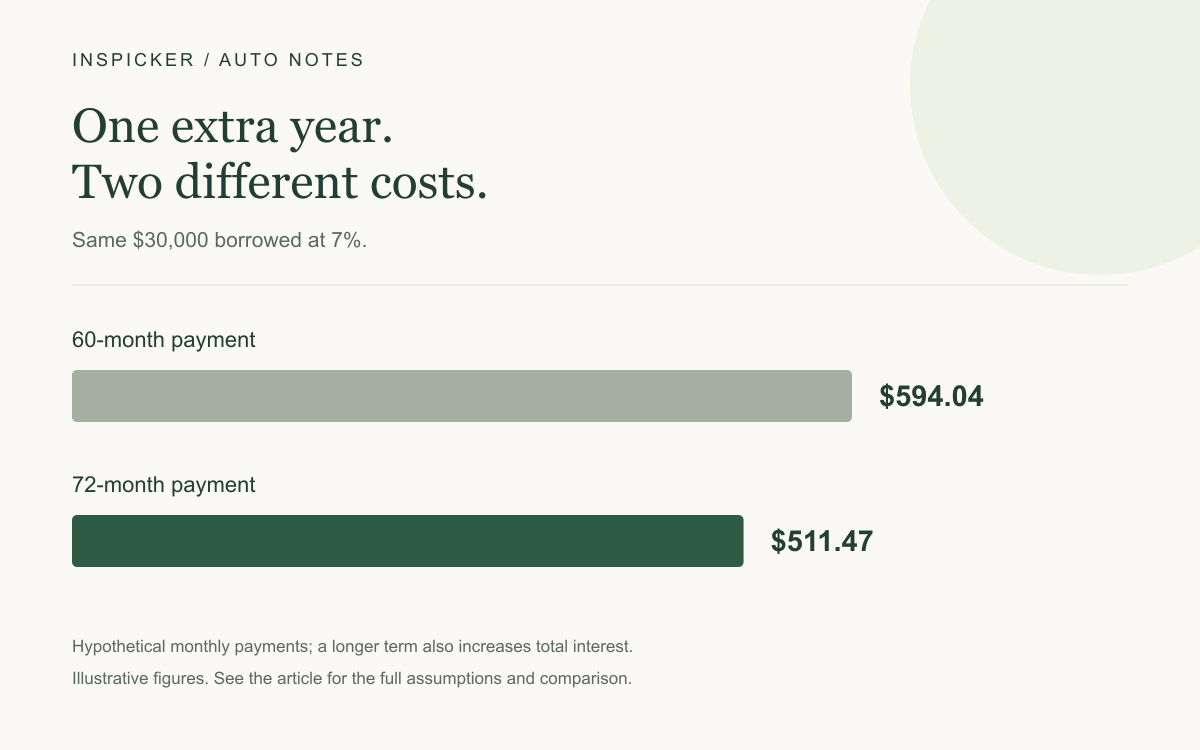
A 72-month car loan usually reduces the payment compared with a 60-month loan at the same amount and rate, but increases total interest. Compare the amount borrowed, contractual rate, fees, and ownership period rather than shopping by the payment alone.
For a hypothetical $30,000 loan at 7%, 60 months produces a payment of about $594.04. Extending it to 72 months reduces that to $511.47, approximately $82.57 less per month. The extra year adds approximately $1,183.70 in interest.
That tradeoff can matter to your budget. It does not determine whether the car itself is affordable or whether a particular lender will offer either loan.
Compare car-loan terms with the price and financing you actually expect.
Start with the amount financed, not the advertised price
Our example car costs $35,000. A $5,000 cash down payment and no trade-in leave $30,000 borrowed. We exclude taxes, dealer fees, add-ons, and lender fees to isolate the term choice.
Real financing may include some of those costs. Review the amount financed on the quote rather than assuming it equals the vehicle price minus the down payment.
Keep the rate constant for the first comparison. If the lender charges a different rate for 72 months, that creates another difference you must price separately.
The CFPB's auto-loan comparison guidance identifies rate, term, and amount financed as important inputs. The payment is one output of those choices.
Worked example: $82.57 of payment relief costs more interest
Both hypothetical loans are fixed-rate, fully amortizing, and repaid as scheduled. Payments occur monthly; displayed figures are rounded, while total costs use unrounded payments.
| Measure | 60 months | 72 months |
|---|---|---|
| Amount borrowed | $30,000 | $30,000 |
| Contractual annual rate | 7% | 7% |
| Loan duration | 5 years | 6 years |
| Monthly payment | $594.04 | $511.47 |
| Total interest | $5,642.16 | $6,825.85 |
| Total loan repayment | $35,642.16 | $36,825.85 |
The 72-month payment is lower by $82.57. Total interest is higher by $1,183.70, calculated from the unrounded schedules.
Total loan repayment is not the car's all-in ownership cost. Add the $5,000 down payment and any excluded taxes or charges when comparing purchase cash flows. Insurance, fuel, maintenance, parking, and repairs are separate ownership costs.
Understand why the interest rises
The longer loan spreads principal over more payments. You owe money for longer and reduce the balance more slowly early in the schedule.
A lower payment is therefore not the same as a lower purchase price or a cheaper rate. The same car can look more affordable each month because the commitment has been extended.
What if the $82.57 difference matters to your budget?
That is a legitimate cash-flow consideration, but compare alternatives rather than assuming six years is the only way to make the purchase work.
A lower vehicle price, a different quote, a different down payment, or postponing the purchase can change the amount financed. Each has its own consequences, including how much emergency cash remains available.
The budget planner can help you include operating costs alongside the installment. Do not use the calculator's payment as the entire transportation budget.
Compare the loan with how long you may keep the car
A 72-month contract does not require you to keep the vehicle for six years, but selling early means settling the remaining loan.
Compare the estimated sale proceeds with the lender's payoff amount at the date you may sell. If you owe more than you receive, you need to cover the difference or finance it under another agreement.
The car's value is uncertain. The auto calculator's depreciation assumption is a scenario, not a vehicle-specific resale forecast. A favorable modeled equity position does not guarantee you can sell for that amount.
A longer loan generally leaves more debt outstanding at a comparable point when amount and rate match. Check the actual amortization and anticipated value together.
Consider what happens to your budget if repair costs rise while payments continue. The extra year may overlap with a stage of ownership when maintenance needs differ from those at purchase.
Handle taxes, fees, and trade-in debt explicitly
If taxes or add-ons are financed, the borrowed amount rises and so do payments and interest. Identify them before comparing terms.
Trade-in value is not always all available as a down payment. An existing loan may need to be paid from that value. If the payoff exceeds the trade-in value, the negative equity must be dealt with separately.
The CFPB's auto-loan guide provides a starting framework for reviewing financing offers and costs. Ask for an itemized quote so you can distinguish vehicle price, down payment, trade-in allowance, existing payoff, optional products, and financing charges.
The basic calculator subtracts the entered trade-in amount from the price. Do not enter a gross allowance as though it were net equity when an old loan still has to be settled. Some negative-equity structures require an adjusted amount-financed comparison rather than a simple trade-in input.
An advertised APR can include some borrowing fees. Use the contractual interest rate for the payment calculation and the lender's disclosures to review APR and total finance charges. Do not blindly substitute a fee-inclusive APR and then add the same fee again.
Compare the real quotes after the controlled example
Once you understand the term effect, enter each actual offer's rate and amount. A lender may price the longer term differently, so the same-rate table is a baseline, not a prediction of available quotes.
Review whether the rate is fixed, whether there are conditions or penalties, and how extra payments are applied. If you intend to make additional principal payments, confirm that the agreement permits the schedule you want.
You may choose the longer required term for flexibility while intending to pay more. That plan can reduce interest if carried out under suitable terms, but the quoted scheduled cost is not the accelerated cost. Do not claim the shorter payoff unless you model and maintain the extra payments.
A lease is a different contract with different costs and end-of-term outcomes. If that is another option, use the lease-versus-buy calculator over a matching comparison period.
How to reproduce the comparison
Enter a $35,000 purchase price, $5,000 down payment, zero trade-in, 7% annual rate, and a 60-month term. Then change only the term to 72 months.
The monthly payment and interest results do not depend on the depreciation assumption. The equity estimate does. Treat those outputs as two different analyses.
Compare your 60- and 72-month loan costs.
The model excludes variable rates, lender-specific fees, tax details, changing extra payments, and an actual resale quote. Include those terms in the wider decision.
Common questions
Is a 72-month loan always a bad choice?
It is a longer and usually more interest-expensive commitment at equal amount and rate. Whether the cash-flow flexibility is worth that cost depends on the actual quote and your situation.
Does a lower payment mean I can afford a more expensive car?
Not automatically. Ownership costs, remaining debt, saving needs, and payment duration all matter. Increasing the purchase price while extending the term can hide the larger commitment.
Can I pay a 72-month loan off sooner?
Check the agreement and how the lender applies extra payments. The scheduled-cost table assumes no acceleration.
Should I compare APR or interest rate?
Review both in the disclosure. The contractual interest rate drives an ordinary payment calculation; APR provides a broader cost measure. Fees and financing structure still need explicit attention.
Editorial note: Figures use fictional fixed-rate loans and monthly amortization. They exclude taxes, fees, ownership costs, and vehicle-specific resale assumptions.
For education and planning. Check assumptions and product terms before making a financial decision.
Put the numbers to work ↗