Auto loans / Down payments
How Much Does $1,000 Down Lower a Car Payment?
See how an extra $1,000 down changes car payments over 36, 60, and 72 months. Includes checked interest savings, upfront-cash comparisons, and calculator steps.
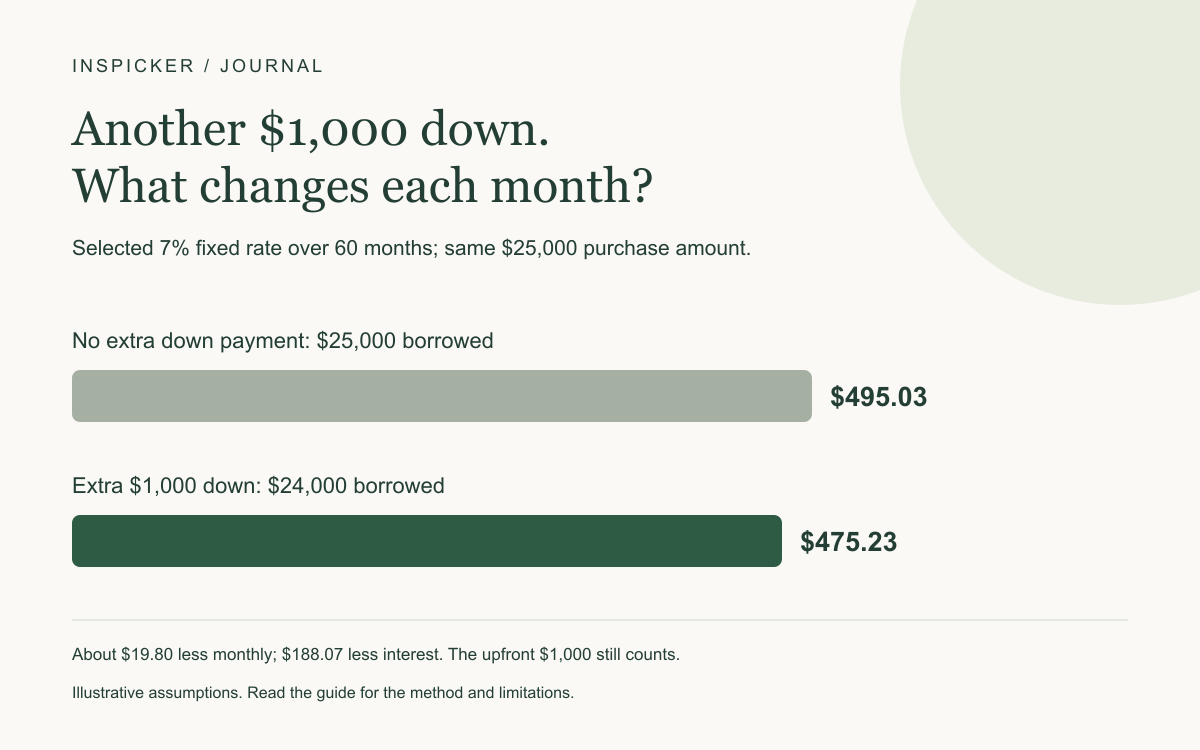
An extra $1,000 down reduces the monthly payment by about $19.80 on a hypothetical 60-month car loan at a fixed 7% rate. At the same rate, it reduces a 36-month payment by about $30.88 or a 72-month payment by about $17.05.
There is no universal payment reduction per $1,000. It depends on the interest rate and repayment term. The amount paid upfront also needs to stay in your total-cost comparison: moving $1,000 from borrowing to a down payment is not itself a $1,000 discount on the car.
Use the auto loan calculator to compare two down payments while keeping the vehicle cost, rate, trade-in, and term unchanged.
Keep the purchase and loan terms the same
Suppose the amount being financed before the additional down payment is $25,000. Paying another $1,000 upfront reduces principal to $24,000. Both alternatives use a selected fixed 7% contract rate, monthly amortization, and payments made on schedule.
| Selected input | Before extra down payment | After extra down payment |
|---|---|---|
| Purchase amount in this simplified comparison | $25,000 | $25,000 |
| Additional down payment | $0 | $1,000 |
| Loan principal | $25,000 | $24,000 |
| Fixed annual interest rate | 7% | 7% |
| Trade-in and outstanding trade debt | None | None |
These are hypothetical inputs, not a current loan offer. There are no separate fees, taxes, add-ons, or operating costs in the numerical example. For an actual transaction, identify which purchase costs will be financed and which will be paid separately.
The CFPB’s down-payment explanation describes how paying more upfront can reduce borrowing. A lender might also offer different pricing with a different down payment, but this illustration holds the rate constant to isolate the principal reduction.
How much does $1,000 down reduce the payment?
Here is the effect at the selected 7% rate:
| Term | Payment on $25,000 | Payment on $24,000 | Monthly reduction | Full-term interest reduction |
|---|---|---|---|---|
| 36 months | $771.93 | $741.05 | $30.88 | $111.58 |
| 60 months | $495.03 | $475.23 | $19.80 | $188.07 |
| 72 months | $426.23 | $409.18 | $17.05 | $227.53 |
The shorter schedule spreads the $1,000 principal reduction across fewer payments, producing more monthly relief. The longer schedule avoids interest on that $1,000 over more months, producing a larger total interest reduction in this same-rate comparison.
That does not make the longer loan cheaper overall. Before the extra down payment, total modeled interest on $25,000 is $2,789.39 over 36 months, $4,701.80 over 60 months, and $5,688.21 over 72 months. Compare the full schedule, not just the interest avoided by one change. Our 60- versus 72-month car-loan guide examines that separate term decision.
Figures are rounded to cents after calculation. Differences use unrounded results, so subtracting two displayed rounded amounts can occasionally differ by one cent.
The $1,000 is still money you pay
For the 60-month case, compare loan payments and upfront cash together:
| Selected cash-flow item | No extra down payment | Extra $1,000 down |
|---|---|---|
| Extra cash paid upfront | $0.00 | $1,000.00 |
| Loan principal repaid | $25,000.00 | $24,000.00 |
| Total loan interest | $4,701.80 | $4,513.73 |
| Scheduled loan payments in total | $29,701.80 | $28,513.73 |
| Upfront cash plus scheduled loan payments | $29,701.80 | $29,513.73 |
The loan payments alone fall by about $1,188.07. Of that amount, $1,000 is principal you paid upfront instead. The reduction in combined nominal cash paid is therefore $188.07, representing avoided modeled interest.
This is not a discounted present-value comparison. It does not calculate what the retained $1,000 might earn elsewhere, changes in taxes, or the value of keeping cash available. It simply keeps the upfront payment visible alongside the loan payments.
The calculator’s “total cost” result covers principal and interest on the loan. Add the down payment and separately paid purchase costs yourself when comparing overall cash outlay. Fuel, maintenance, insurance, registration renewals, and eventual resale value require a broader ownership budget.
Calculate the payment reduction per $1,000
For a fixed-rate monthly amortizing loan, payment is proportional to principal when the rate and term stay unchanged. The payment reduction from an additional $1,000 down is:
$1,000 × monthly rate ÷ [1 − (1 + monthly rate) raised to the negative payment count].
Here the monthly rate is 0.07 ÷ 12, and the payment count is 60 for the five-year example. The result is approximately $19.801199 per month. Multiply the unrounded reduction by 60 to obtain $1,188.071912 less in scheduled loan payments, then subtract the $1,000 upfront to find $188.071912 of avoided interest.
At a 0% rate, the payment reduction is simply $1,000 divided by the number of payments. Across 60 payments, that is about $16.67 monthly, with no interest savings in a no-fee model. Any real promotional offer still needs its price, fees, and terms checked separately.
An additional $2,000 would double the modeled reduction only if the amount financed falls by the full $2,000 and all other inputs stay the same. If the vehicle price, add-ons, rate, or term changes, rerun the comparison.
Keep the remaining cash and ownership expenses visible
Before increasing a down payment, ask what cash would remain for upcoming bills and unexpected expenses. The payment reduction alone does not determine whether using that cash is a good fit for your household.
The CFPB’s auto affordability guidance includes purchase charges and ongoing ownership expenses in the planning process. A loan payment that fits by itself may still leave too little room for insurance, fuel, repairs, and other obligations.
Use the budget planner with those costs included, and review your emergency-fund expenses before assigning more savings to the purchase. The interest calculation does not price the risk of needing to borrow again after using your cash.
If trading in a financed vehicle, check its outstanding payoff separately. This example assumes no trade-in debt. The auto tool has no separate old-loan-payoff input, so it should not be treated as a complete negative-equity rollover calculation. Our down payment and negative-equity example explains the difference between loan balance and estimated vehicle value.
Run the down-payment comparison
- Enter $25,000 vehicle cost, $0 down, $0 trade-in, 7% interest, and 60 months.
- Record the monthly payment and total interest.
- Change down payment to $1,000, keeping other inputs unchanged.
- Compare payment and interest, then add the extra upfront cash when comparing total outlay.
- Replace the hypothetical figures with the actual purchase and loan terms.
The calculator assumes monthly amortization and no extra payments. Its depreciation input affects the equity illustration, not the payment or interest figures used here. Taxes, fees, insurance, and other charges are not added automatically. For a payment estimate, make sure financed purchase costs are reflected without counting them twice; including nonvehicle costs in the price field can also distort a vehicle-value projection.
Common questions
Does every $1,000 down lower a car payment by $20?
No. It is close to $20 in the selected 7%, 60-month example. At the same rate over 36 months, it is about $30.88; over 72 months, about $17.05. Use the actual rate and term.
Does $1,000 down save $1,000 on the car?
It moves $1,000 from loan principal to upfront payment. In this same-price comparison, the additional saving is the interest avoided on that borrowing, not the down payment itself.
Will a larger down payment guarantee a lower rate?
No. This example does not model lender pricing or approval. Obtain the actual offer terms for each down-payment option, then compare them.
Does paying $1,000 extra after the loan starts lower the payment?
That is a different transaction. How an extra payment affects principal, interest, due dates, and the required payment depends on the contract and servicing. This article calculates down payment before origination, not a later payment adjustment.
Method: original hypothetical examples checked against InsPicker’s auto-loan calculation. Sources reviewed October 19, 2026. Rates and amounts are illustrative, not a market quote or personalized recommendation.
For education and planning. Check assumptions and product terms before making a financial decision.
Put the numbers to work ↗