Mortgage / Extra principal
A Mortgage Lump Sum vs. a Recast: Earlier Payoff or Lower Payments?
Compare keeping your mortgage payment after a $10,000 principal reduction with a separate recast illustration. See payoff timing and payment limitations.
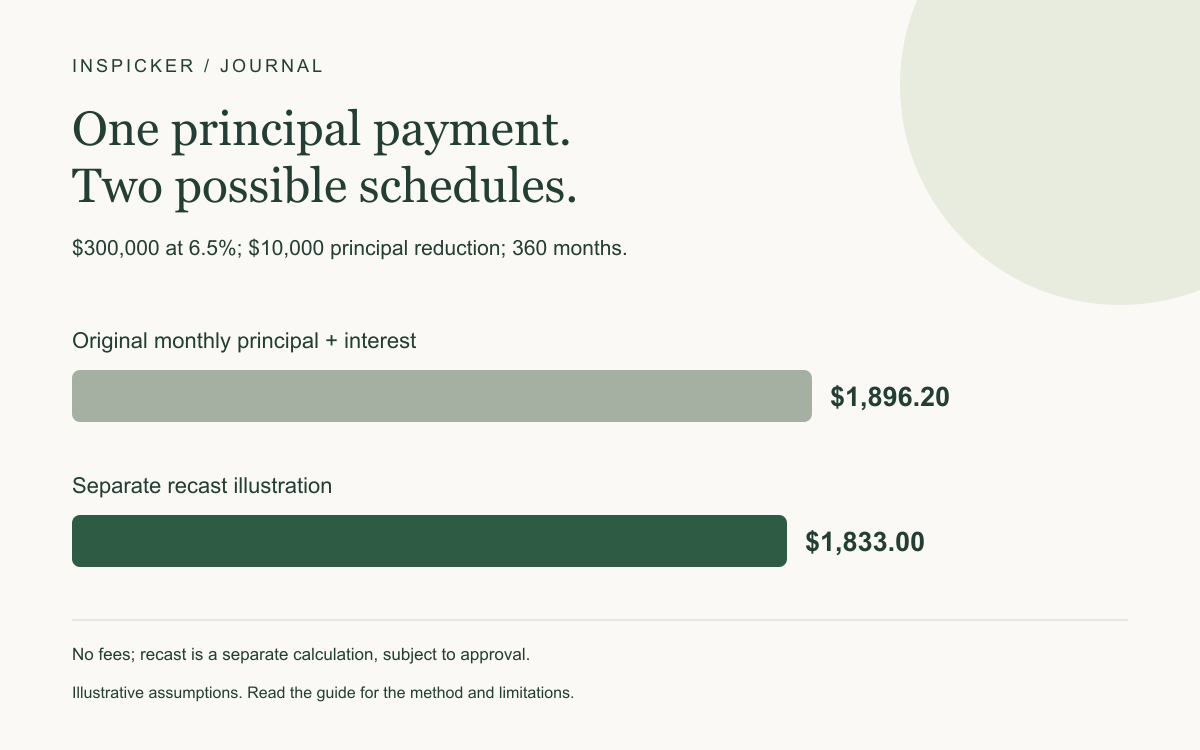
A lump-sum mortgage principal payment can shorten payoff without automatically lowering the required monthly payment. A recast, when available, recalculates the payment over the remaining term. These are different uses of the same principal reduction.
For a hypothetical $300,000 balance at 6.5% with 360 months remaining, paying $10,000 immediately toward principal and keeping the original payment clears the loan in approximately 327 monthly payments. A separate no-fee recast calculation would instead reduce principal and interest to approximately $1,833.00 monthly over 360 months.
Use the extra mortgage payment calculator for the first scenario. Its lump-sum field does not request or simulate a servicer-approved recast; the recast arithmetic below is a separate illustration.
The principal payment and the payment schedule are separate
A principal-only payment reduces what remains borrowed. For a fixed-rate amortizing loan, continuing the existing principal-and-interest installment then generally pays the reduced balance off sooner.
A recast takes a reduced balance and recalculates the required principal-and-interest installment over the remaining repayment term, subject to the loan and servicer’s rules. It need not change the interest rate.
Chase’s recast explanation describes this distinction for its program and notes that availability depends on investor guidelines. Do not assume a particular lender’s eligibility rules, fees, or process apply to your loan. Ask your own servicer for written details.
Refinancing is a third possibility: replacing the loan with a new one. It can involve a different rate, term, and closing costs. See the refinance break-even guide rather than treating a recast as a new mortgage quote.
Scenario one: pay $10,000 and keep the original installment
The selected inputs are:
| Input | Amount |
|---|---|
| Current balance | $300,000 |
| Fixed annual rate | 6.5% |
| Remaining scheduled term | 360 months |
| Immediate extra principal | $10,000 |
| Additional recurring extra payment | $0 |
The original principal-and-interest installment is approximately $1,896.20. The lump sum reduces the modeled balance to $290,000 before the next month’s interest accrues, but the monthly installment remains unchanged.
| Result | No extra principal | $10,000 immediate principal payment |
|---|---|---|
| Continuing monthly principal and interest | $1,896.20 | $1,896.20 |
| Monthly payments to payoff | 360 | 327 |
| Remaining modeled interest | $382,633.47 | $328,716.78 |
The interest difference is approximately $53,916.69, and payoff arrives 33 monthly payments earlier. The final installment is smaller than the normal amount.
These figures use monthly amortization with unrounded balances. The savings are not cash deposited into your checking account now; they are interest avoided over the selected remaining loan life if the schedule continues as modeled.
If you sell or refinance earlier, the full-lifetime interest figure is not the saving realized by that earlier date. You would need an exit-date comparison using payments made and the remaining payoff balance.
Scenario two: spread the reduced balance over the remaining term
For a standalone mathematical recast illustration, amortize $290,000 at the same 6.5% over the same remaining 360 months. The resulting principal-and-interest payment is approximately $1,833.00.
That is about $63.21 less per month than the original unrounded $1,896.20 payment. It is not a monthly reduction of $10,000 divided by twelve, because the remaining loan is being amortized over a much longer period.
| After the same $10,000 principal reduction | Keep original payment | Recast illustration |
|---|---|---|
| Balance being amortized | $290,000 | $290,000 |
| Monthly principal and interest | $1,896.20 | $1,833.00 |
| Modeled payoff schedule | 327 payments | 360 payments |
| Main illustrated effect | Earlier payoff | Lower required installment |
The recast row assumes approval, an immediate recalculation, no fee, and no other changes. It is not a quote from any lender. Real processing dates and requirements can change the result.
The extra-payment tool does not produce that recast row. Do not enter $10,000 as a lump sum and then interpret the accelerated result as a promise of a lower required payment.
The same principal reduction can support different goals
Keeping the original installment directs more cash toward debt reduction each month than following the lower recast installment. That is why the two paths have different payoff dates.
If a borrower recasts but voluntarily keeps paying the old amount as principal and interest, the amortization can resemble the accelerated path, assuming the same balances, timing, and no fees. The lower required amount creates flexibility; it does not force the borrower to spend the difference.
The upfront $10,000 is also a liquidity decision. Money sent to mortgage principal is not the same as an accessible cash reserve. Accessing home equity later may involve a new borrowing decision or sale.
Before committing it, identify upcoming bills, taxes, repairs, and an emergency reserve. The emergency-fund expense checklist can help separate available extra cash from money already assigned elsewhere.
This article does not compare after-tax mortgage interest with investment returns or calculate the best use of funds for a particular household. It isolates the effect of payment scheduling after one selected principal reduction.
Confirm where the money goes and what changes afterward
Ask the servicer how to designate additional principal, whether the loan has relevant prepayment terms, and how the transaction will appear on the statement. A payment intended for principal should not be confused with an escrow deposit or merely advancing a due date.
If seeking a recast, ask about loan eligibility, minimum reduction requirements, charges, processing time, the revised payment start date, and the schedule to follow while the request is pending. Do not begin sending a lower amount based solely on a calculator.
Escrow is separate from principal and interest. Property taxes and insurance can change the total bill even when the principal-and-interest amount is fixed or recalculated. Compare the actual statement components before treating a change in the total bill as an amortization result.
After the lump sum posts, verify the balance and retain confirmation. After an approved recast, verify the new required payment using the servicer’s documents. The calculator illustrates mechanics; it does not alter the loan agreement.
Common questions about mortgage lump sums and recasts
Does paying $10,000 automatically lower my monthly bill?
Not in the extra-payment scenario here. The same monthly principal-and-interest installment continues, and payoff occurs earlier. A lower required installment would need the applicable servicer process or another loan change.
Does the extra-payment calculator include a recast?
No. It keeps the original installment and adds the selected extra payments. The $1,833.00 recast amount in this guide is a separate mathematical example.
Is a recast available on every mortgage?
No availability is assumed. Confirm the rules, eligibility, timing, and fees for your own loan with its servicer.
Are the interest savings guaranteed if I move early?
The displayed lifetime saving assumes the modeled repayment schedule continues. Selling or refinancing earlier requires a comparison at that earlier date.
Method: hypothetical fixed-rate monthly amortization, immediate principal reduction, no fees or penalties, and no escrow in the payment figures. Recast arithmetic is separate from the existing extra-payment calculator and does not imply lender approval.
For education and planning. Check assumptions and product terms before making a financial decision.
Put the numbers to work ↗