Mortgage / Refinancing
How to Calculate Refinance Break-Even Without Missing the Term Reset
Calculate refinance break-even using closing costs and payment savings. Compare equal-term and extended-term examples, holding periods, and remaining loan costs.
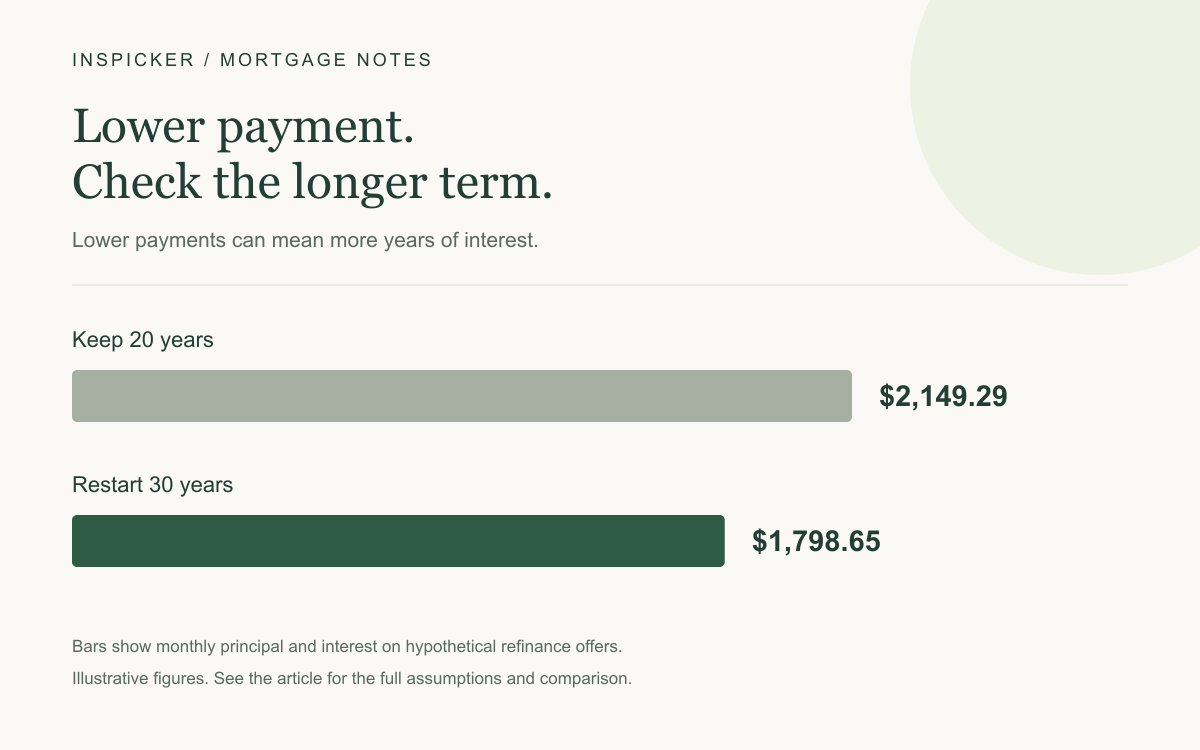
Simple refinance break-even is the upfront refinancing cost divided by monthly payment savings. It estimates when reduced payments have recovered the cash cost. It does not, by itself, show that refinancing improves your total borrowing cost or equity.
A term reset is the key trap. Replacing 20 remaining years with a new 30-year loan may produce a quick payment-based break-even while adding years of interest.
Our hypothetical example starts with a $300,000 balance, a 7% rate, and 20 years remaining. Refinancing to 6% over the same 20 years saves about $176.60 monthly. With $6,000 of costs paid upfront, simple break-even is about 34 months. Extending the new loan to 30 years drops simple break-even to about 11.4 months, but increases modeled remaining interest and closing costs by $95,299.33 over the full schedules.
Use the refinance calculator to examine both the payment and the term.
What simple refinance break-even measures
The calculation is:
Payment break-even in months = upfront refinancing costs ÷ monthly principal-and-interest savings.
If the new payment is equal to or greater than the old payment, that version of break-even does not exist. Refinancing might still serve another goal, such as shortening the term, but monthly payment savings do not recover the costs.
Use the incremental costs caused by the refinance and a consistent payment comparison. Do not compare an old payment excluding escrow with a new payment including taxes and insurance.
The CFPB's refinance handout explains why your refinancing goal, expected holding period, closing costs, and new term all matter.
Worked example: one rate, two different terms
Assume fixed-rate fully amortizing loans with no cash out. The existing balance is $300,000. The old loan has a 7% contractual annual interest rate and 240 monthly payments remaining. New offers use 6%, and $6,000 of transaction costs are paid in cash rather than added to principal.
We exclude mortgage insurance, tax effects, prepayment penalties, variable rates, and changes in property costs. The numbers are illustrations, not current lender quotes.
| Measure | Keep current loan | Refinance for 20 years | Refinance for 30 years |
|---|---|---|---|
| Balance financed | $300,000 | $300,000 | $300,000 |
| Remaining or new term | 240 months | 240 months | 360 months |
| Interest rate | 7% | 6% | 6% |
| Monthly principal and interest | $2,325.90 | $2,149.29 | $1,798.65 |
| Monthly payment reduction | — | $176.60 | $527.25 |
| Upfront refinance costs | — | $6,000 | $6,000 |
| Simple payment break-even | — | About 34 months | About 11.4 months |
| Interest over the remaining or new schedule | $258,215.23 | $215,830.36 | $347,514.57 |
The equal-term offer produces approximately $36,384.87 less interest and transaction costs than keeping the existing schedule.
The extended-term offer produces approximately $95,299.33 more. The lower payment is real, but you make payments for an additional ten years. Cost differences use unrounded values.
Simple break-even answers a narrow cash-flow question. Total borrowing cost answers another. Both deserve a place in the decision.
Compare the break-even with how long you expect to keep the loan
For the 20-year refinance, about $176.60 of monthly payment savings accumulates against $6,000 paid upfront.
| Time after refinancing | Cumulative payment savings less $6,000 costs |
|---|---|
| 24 months | Approximately −$1,761.51 |
| 36 months | Approximately $357.73 |
| 60 months | Approximately $4,596.22 |
These figures are nominal cash-flow differences, calculated from unrounded payments. They exclude investment earnings on the upfront cash, discounting, and differences in remaining loan balances.
If you expect to sell after two years, this offer has not recovered its costs through payment savings. If you keep the loan longer, that particular hurdle may be cleared. It still does not replace a complete comparison.
Use more than one holding period when your plans are uncertain. A refinance intended for ten years should also be tested against an earlier move or another refinance.
Separate transaction costs from cash that remains yours
Read the Loan Estimate and proposed closing figures carefully. Lender fees, points, appraisal charges, and applicable settlement expenses can contribute to the incremental refinancing cost.
A new escrow deposit and an expected refund of old escrow are different from a fee you never recover. Prepaid interest and insurance also need a consistent treatment across the alternatives. Some items change timing rather than representing an entirely new expense.
Do not subtract an escrow refund before confirming that it is expected and available. Keep the cash needed to close separate from the incremental transaction cost used in break-even.
For the document fields, consult the CFPB's Loan Estimate and Closing Disclosure resources. Ask the lender to identify which items are loan costs, prepaid expenses, deposits, credits, and additional funds.
Financed costs require a different comparison
If $6,000 is added to the loan instead of paid upfront, the new principal becomes $306,000 under that assumed structure. Payment and interest must be recalculated. It is not accurate to keep the $300,000 payment calculation and call the loan cost-free.
Likewise, a lender credit may reduce cash at closing in exchange for different pricing. Compare the actual rate, principal, payment, term, and credits together.
Compare remaining balances at the same future date
When you sell, refinance again, or finish a chosen holding period, you still owe the remaining principal. A complete comparison should therefore include:
- Cash paid toward installments and transaction costs over the period.
- The remaining loan balance at the end of that same period.
- Any relevant differences in mortgage insurance or other financing costs.
For two loans starting at the same principal, a useful undiscounted financing-cost check is payments made + ending balance − starting balance + upfront costs. The payment and balance terms together identify the interest incurred over that period. Include financed costs consistently so they are not counted twice.
A lower payment produced partly by slower principal repayment can leave you owing more at sale. That remaining balance offsets some of the apparent cash savings.
The basic InsPicker refinance calculator reports payment-based break-even and full-schedule interest comparisons. It does not calculate every holding-period equity scenario, tax effect, or discounted cash flow. Use the loan schedules and documents for those additional checks.
How to reproduce the example
Enter a $300,000 current balance, 7% current rate, 240 months remaining, 6% new rate, 240 new months, and $6,000 closing costs. Then rerun with a new term of 360 months.
Pay attention to the term-extension warning and the interest comparison, not just the break-even number. The model assumes costs are paid separately, with the same principal refinanced.
If you plan to maintain a higher payment after refinancing, compare that accelerated schedule separately. Our extra mortgage payment calculator can explore a constant extra principal payment.
Compare your refinancing terms.
Common questions
Is a one-percentage-point rate reduction enough?
There is no universal threshold. The balance, remaining term, new term, transaction costs, and holding period determine the result.
Does a shorter break-even mean the better loan?
Not necessarily. The 30-year example has a shorter payment break-even but a higher full-schedule cost. Decide which financial goal you are measuring.
Should I include interest already paid?
That interest cannot be recovered by today's decision. Compare costs from today forward, while accounting for your current balance and remaining schedule.
Does the break-even include property taxes?
Only include a change that is actually caused by the financing choice and modeled consistently. Do not confuse a different escrow estimate with lower underlying tax liability.
What if I pay the old amount on the new loan?
Extra principal can change payoff time and interest. Verify how the lender applies extra payments, then model that schedule rather than using the minimum-payment result.
Editorial note: All loans are hypothetical. Figures use monthly amortization and costs paid upfront. This comparison is educational and does not quote current rates or guarantee a refinance benefit.
For education and planning. Check assumptions and product terms before making a financial decision.
Put the numbers to work ↗