Debt / Balance transfers
Is a Balance Transfer Fee Worth It? Compare the Full Payoff Cost
See when a balance transfer fee saves money, with $5,000 payoff examples, a promotional-deadline calculation, and a checklist for comparing offers.
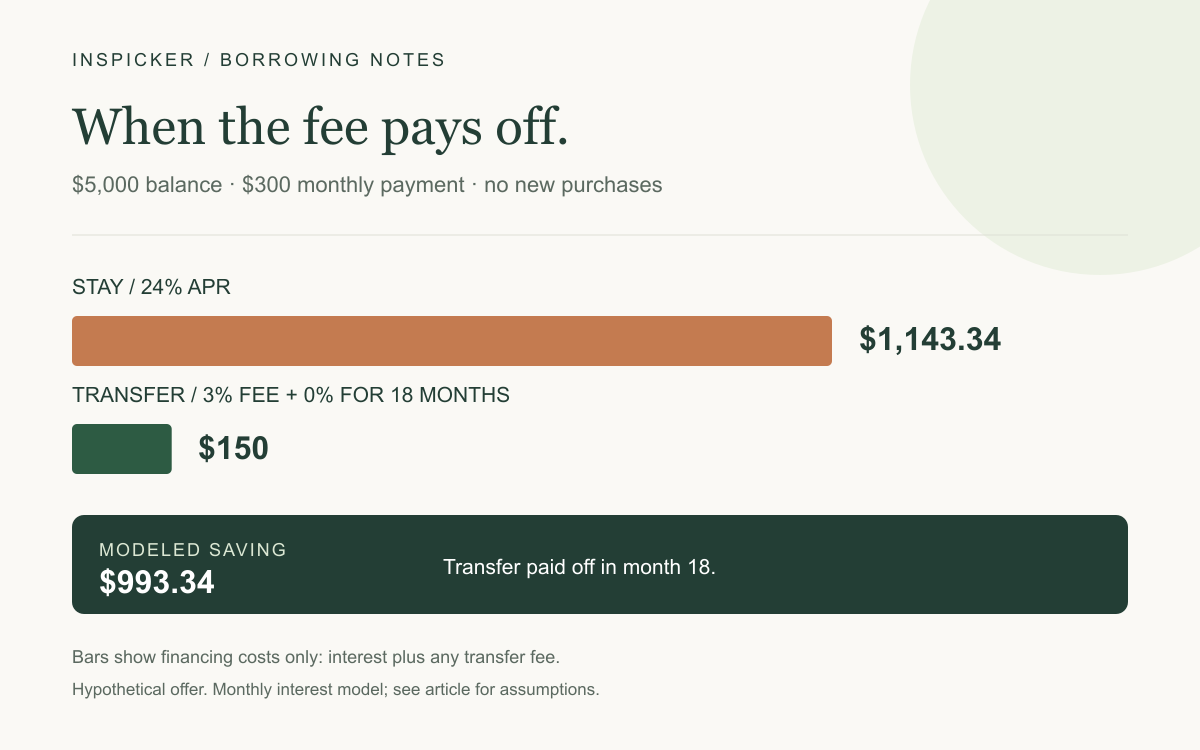
A balance transfer fee is worth paying when the fee plus interest on the new card is lower than the interest you would pay by keeping the debt where it is. Compare both options using the same realistic monthly payment, and include any balance left when the introductory rate ends.
A 0% offer can produce substantial savings, a negligible saving, or a higher cost. In our hypothetical $5,000 example, a 3% transfer fee saves $993.34 at $300 a month. If you can clear the old card with a $5,100 payment after one modeled month, however, the transfer costs $50 more.
Use the balance transfer calculator to compare the offer you actually received.
What does a balance transfer fee actually cost?
A balance transfer moves eligible debt to another credit card. The issuer may charge a fee for that move even when the introductory transfer APR is zero. The Consumer Financial Protection Bureau confirms that a fee can apply to a 0% offer.
For a percentage-based offer:
Transfer fee = amount transferred × fee percentage.
A 3% fee on $5,000 is $150. A 5% fee on the same amount is $250. These percentages are examples, not a claim about every available offer.
| Amount transferred | Illustrative 3% fee | Illustrative 5% fee |
|---|---|---|
| $1,000 | $30 | $50 |
| $3,000 | $90 | $150 |
| $5,000 | $150 | $250 |
| $10,000 | $300 | $500 |
Some offers specify a minimum dollar fee. For a hypothetical “3% or $10, whichever is greater” offer, a $200 transfer costs $10, not $6. Check the actual disclosure rather than relying on the percentage alone.
Also confirm how the issuer treats the fee. In the examples here, the fee is added to the new balance and receives the transfer's promotional rate. That means moving $5,000 with a $150 fee creates a $5,150 payoff obligation. A different fee treatment requires a different calculation.
Worked example: a transfer that saves $993.34
Suppose you have one balance and the following hypothetical offer:
| Input | Staying on the current card | Transferring |
|---|---|---|
| Starting debt | $5,000 | $5,000 |
| Transfer fee | None | 3%, or $150 |
| Starting balance after the fee | $5,000 | $5,150 |
| APR | 24% | 0% for 18 months |
| APR after the promotion | 24% | 29% |
| Planned monthly payment | $300 | $300 |
Assume no new purchases, annual fees, late fees, or rate changes. We model interest monthly as APR ÷ 12, before each payment, and reduce the final payment to the amount actually owed. Real statements may differ because of daily balances, billing dates, processing time, and rounding.
The current card starts with $100 of interest in the first month: $5,000 × 24% ÷ 12. A $300 payment then leaves $4,800. Repeating the calculation as the balance falls produces approximately $1,143.34 in total interest and a payoff in 21 months.
With the transfer, 17 payments of $300 reduce $5,150 to $50. The final $50 payment clears it in month 18, within the assumed promotion. No promotional interest is charged in this model, so the total financing cost is the $150 fee.
| Result | Staying | Transferring |
|---|---|---|
| Payoff time | 21 months | 18 months |
| Interest plus transfer fee | $1,143.34 | $150 |
| Total repayment, including original debt | $6,143.34 | $5,150 |
Modeled saving: $1,143.34 − $150 = $993.34.
That saving comes from comparing the same payment in both cases. Increasing your payment only after transferring would combine two changes: the new offer and faster repayment. Keep them separate when judging the offer itself.
For a shorter example that follows the balance through an expired promotion, see our step-by-step $1,200 transfer guide.
The same fee can be worthwhile—or expensive—depending on your payment
Keep the $5,000 balance, 24% existing APR, 3% transfer fee, 18-month 0% offer, and 29% follow-on APR. Change only the monthly payment.
| Monthly payment budget | Interest if you stay | Transfer fee plus interest | Modeled saving from transferring |
|---|---|---|---|
| $5,100 | $100 | $150 | −$50: staying costs less |
| $2,500 | $155.04 | $150 | $5.04 |
| $300 | $1,143.34 | $150 | $993.34 |
| $150 | $3,322.09 | $853.83 | $2,468.25 |
At a $5,100 payment budget, the old card is cleared after the first modeled month's $100 interest. The transfer still has its $150 fee. If you can pay immediately before more interest accrues, the old card's incremental interest may be smaller still.
At $2,500 a month, the transfer saves only $5.04 in this model. Minor differences in billing dates, a different fee, or an added charge could erase that margin. A barely positive modeled saving is a reason to examine the offer more closely.
At $150 a month, the transfer reduces total cost substantially, but it does not eliminate interest. Eighteen payments remove $2,700 from $5,150, leaving $2,450 when the assumed promotion ends. The 29% follow-on APR then applies, producing about $703.83 in later interest on top of the $150 fee. Payoff takes 40 months after transferring, versus 56 months if you stay.
A transfer can save money even when it runs beyond the promotion. The important distinction is between saving compared with your alternative and repaying without any interest.
How much must you pay to finish before 0% ends?
For an offer with no interest during the entire repayment window:
Monthly payoff target = transferred balance including the fee ÷ available payments before the promotional deadline.
For $5,150 over 18 payments:
$5,150 ÷ 18 = $286.11 repeating.
Rounding up gives a target of $286.12 per month, assuming all 18 payments are available. Paying $300 provides a modest cushion.
| Payments available | Rounded-up monthly target for $5,150 |
|---|---|
| 18 | $286.12 |
| 17 | $302.95 |
| 12 | $429.17 |
Count the payment dates that occur before the actual expiry, rather than assuming “18 months” always means 18 convenient due dates after the transfer posts. Read whether the introductory period starts at account opening or another event.
This division works for a true 0% balance under the stated assumptions. A low-but-nonzero promotional APR needs an interest-bearing payoff calculation. If the planned payment is below the card's required minimum, the contractual minimum still applies.
Why the quick fee break-even formula can mislead
A common screening shortcut divides the fee by the first month's interest saving. In the main example, the fee is $150 and the old card's initial monthly interest is $100, so the shortcut gives 1.5 months.
That is a rough scale comparison, not an exact payoff break-even date. Your old-card balance shrinks with payments, so its monthly interest falls. The transfer begins with a fee, may have a different promotional rate, and may later revert to a higher rate.
The $2,500 payment example makes the weakness visible: although the initial interest is still $100, the entire modeled old-card interest is only $155.04. There is just $5.04 left after the transfer fee.
Use a full repayment schedule for the decision. Compare remaining interest if you stay with the transfer fee and all interest until the new balance is cleared.
Check these details before accepting the offer
Can the full balance be transferred?
Approval and the available transfer amount may differ from the balance you want to move. Check whether the credit limit must also accommodate the fee. If only part of the debt moves, calculate the transferred portion and the balance left on the old card separately.
Confirm which creditors and debt types are eligible. Do not assume an offer permits a transfer between every pair of accounts.
Are there deadlines or additional charges?
Find the deadline for requesting the transfer, the promotional expiry, the fee applicable at the time of the request, and the follow-on APR. Include an annual fee or other unavoidable incremental charge when comparing total costs.
Continue meeting the old card's payment obligations until the transfer is confirmed. Processing time can leave additional interest or a small residual balance.
Will you make new purchases on the transfer card?
The purchase APR can differ from the transfer APR. Carrying a promotional transferred balance can affect the grace period on purchases. The CFPB explains this interaction.
The examples in this article assume no new spending. Using the card for everyday purchases requires a separate analysis of rates and payment allocation.
Is the offer true 0% APR or deferred interest?
A true 0% promotion and an offer saying interest is waived if paid in full can have different consequences. Deferred-interest purchase promotions may add previously accrued interest if their conditions are not met. Read the agreement and the CFPB's explanation of the distinction. The InsPicker transfer model does not simulate deferred interest.
Can you sustain the planned payment?
Use an amount your budget supports through ordinary months and less convenient ones. The monthly budget planner can help you estimate that amount. Set up payment reminders and understand the minimum-payment requirements; automatic minimum payments alone may fall short of your payoff target.
How to compare your offer in InsPicker
- Enter the balance you plan to transfer and its current APR.
- Enter the offered transfer fee percentage and promotional APR.
- Enter the promotion's duration and the APR that applies afterward.
- Enter a realistic fixed monthly payment.
- Compare total costs, payoff dates, and whether the transfer clears within the promotion.
- Rerun with a lower payment and, if relevant, a higher follow-on APR to see how sensitive the result is.
Calculate your balance transfer savings.
The tool adds a percentage fee to the balance and uses monthly interest accrual. It does not include minimum dollar transfer fees, annual fees, partial approval, processing delays, new purchases, or multiple rate categories on one card. Adjust the wider comparison for those terms rather than treating a small positive result as certain.
If you are comparing repayment methods across several debts, use the debt payoff calculator. If you want to understand the existing card's repayment schedule first, use the credit card payoff calculator.
Common questions
Is a 5% transfer fee automatically too expensive?
No. A $250 fee on $5,000 could be cheaper than the interest on a longer payoff schedule. It could also be more expensive if you will repay the existing card quickly. Compare the actual fee, duration, follow-on rate, and the same planned payment.
Does 0% mean the transfer is free?
No. A transfer fee and other applicable charges can remain even when promotional interest is zero. Include the fee in both the total cost and the amount you need to repay.
Should I transfer if I cannot finish before the promotion ends?
Compare the full schedule. The $150-per-month example still saves money despite later interest, but that result depends on the stated rates and payment. A higher follow-on APR or weaker payment could change it.
Does paying the fee reduce the original debt?
No. In these examples, it increases the balance on the new card. Moving the debt changes its terms; it does not forgive any of the original principal.
What if the calculator says the saving is almost zero?
Check the inputs and the exclusions. A tiny margin may not survive real statement timing or an overlooked charge. Consider whether the account change is useful given the actual costs and effort.
Editorial note: These hypothetical examples use InsPicker's monthly repayment method and are rounded for display. They are educational comparisons, not card offers or guarantees of approval or savings. Check the issuer's current disclosures before acting.
For education and planning. Check assumptions and product terms before making a financial decision.
Put the numbers to work ↗