Debt / Loan comparisons
Interest Rate vs. APR: Why You Cannot Just Add the Loan Fee
Follow a $10,000 loan with a withheld fee to distinguish interest rate, APR, and dollar cost. Avoid double-counting fees in a loan calculator.
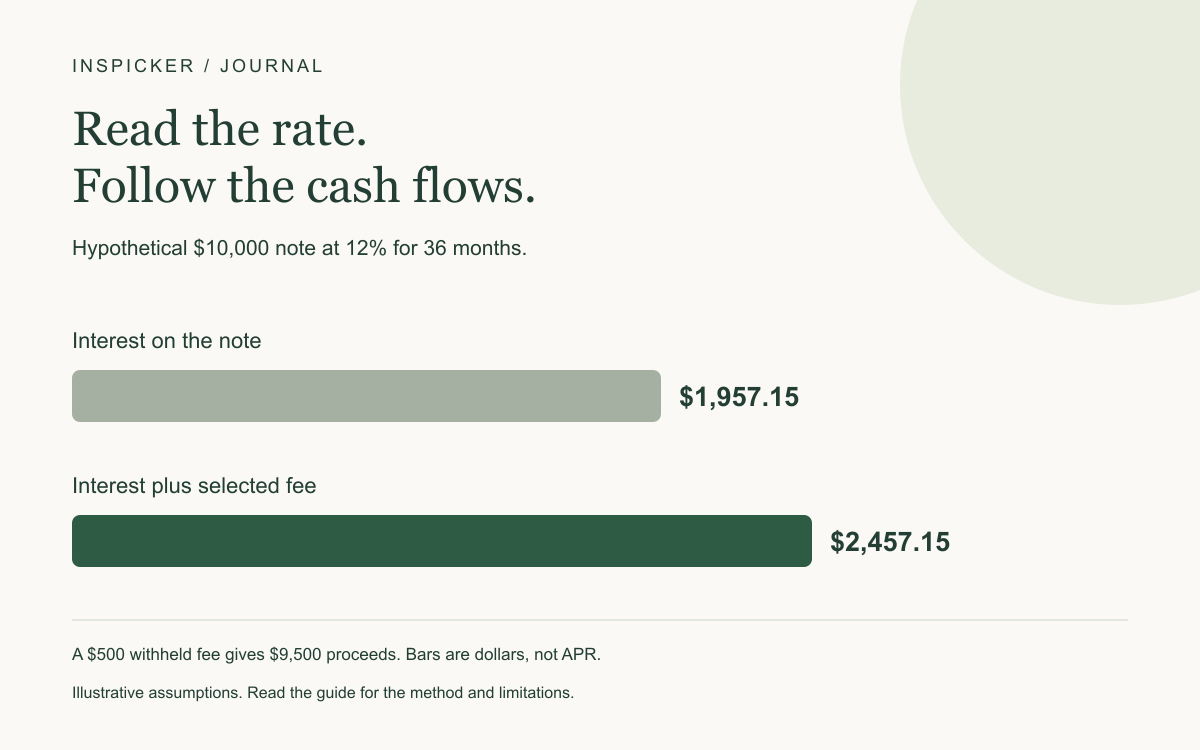
A loan’s contract interest rate determines its interest calculation, while APR is an annualized borrowing-cost measure that includes applicable finance charges. You cannot generally calculate APR by adding an origination-fee percentage to the interest rate.
For a hypothetical $10,000 loan at 12% over 36 months, monthly amortization gives a payment of approximately $332.14. If a $500 fee is withheld, the borrower receives $9,500 but still makes payments based on the $10,000 note. The cash received, payment schedule, and fee treatment all matter.
The loan comparison calculator uses the contract interest rate, with fees entered separately under its stated cash-fee convention. It does not calculate regulatory APR or automatically reproduce a fee deducted from proceeds.
Three figures answer different questions
The CFPB’s interest-rate and APR explanation distinguishes the cost of interest from the broader annualized measure incorporating additional charges.
| Figure | What it helps explain |
|---|---|
| Contract interest rate | How interest accrues under the loan’s terms |
| APR | Annualized borrowing cost including applicable finance charges |
| Total dollar cost | How many dollars the specified borrowing schedule costs |
APR is not a dollar amount, and a payment is not an APR. A longer loan can have a smaller installment but a larger dollar cost. Fees and timing can also make APR differ from the rate used to amortize the note.
Different products and charges have specific disclosure rules. Use the lender’s required disclosures to identify the actual APR rather than treating this simplified illustration as a legal disclosure calculation.
Follow the money received and the payments made
Assume a fixed-rate loan with 36 equal monthly periods, a nominal contract rate of 12%, and no extra payments. The monthly rate used for amortization is 1%.
| Selected input | Amount |
|---|---|
| Note principal | $10,000 |
| Contract annual interest rate | 12% |
| Loan term | 36 months |
| Fee withheld at origination | $500 |
| Cash received | $9,500 |
The fee is deducted from the proceeds. It does not reduce the note principal on which this example’s installments are based.
| Result | Amount |
|---|---|
| Scheduled monthly payment | $332.14 |
| Sum of scheduled payments, using unrounded calculations | $11,957.15 |
| Interest relative to the $10,000 note | $1,957.15 |
| Payments minus the $9,500 received | $2,457.15 |
The $2,457.15 difference combines the selected fee and interest. It is not additional to both of them: $1,957.15 + $500 = $2,457.15.
The calculation retains unrounded payments internally. A real lender may round monthly installments and adjust a final payment. That can cause small differences from multiplying the displayed $332.14 by 36.
The CFPB’s installment-loan fee guidance recommends reviewing the disclosures and documents for actual charges. This $500 fee is a hypothetical input, not a typical fee or a current offer.
A 5% fee plus a 12% rate is not automatically 17% APR
The $500 fee is 5% of the selected $10,000 note. It is charged once at origination. The 12% contract rate applies over time to the outstanding balance according to the repayment terms.
Those percentages do not describe the same thing. Simply adding them ignores the timing of the upfront charge and the declining balance repaid through the installments.
Dividing total interest and fees by the original principal does not solve that problem either. In this example, $2,457.15 divided by $10,000 is about 24.57% across the full three-year schedule. That ratio is not the annualized APR.
Dividing that ratio by three is not generally a valid APR calculation. It treats the original principal as though it stayed outstanding for the entire period, even though installments reduce it.
An annualized cash-flow calculation needs to account for when money is advanced and repaid. Required disclosure methods can also involve product-specific rules. This article therefore does not assign an independently calculated APR to the hypothetical offer.
Do not use APR as the contract rate and then add its fees again
Suppose a quote provides both a contract rate and an APR that reflects an origination charge. Entering that APR into an interest-rate amortization field and also adding the same charge can overstate the comparison.
For InsPicker’s tool, use the contract interest rate to calculate installments. Enter a separately paid fee only in the fee field. Review the lender’s APR alongside the result as a separate disclosed measure.
If you have only APR and no contract rate, do not assume the two are identical. Ask for the information needed to reproduce the payment schedule.
This is also different from APY on savings. The APY-versus-interest-rate guide explains compounding on deposits; its conversion is not a method for calculating loan APR with fees.
Compare the amount available for the intended purpose
If you need $10,000 of usable cash, a $10,000 note with $500 withheld provides only $9,500. It is not directly equivalent to receiving $10,000 from a different lender.
If a lender withholds exactly 5% of the note amount, the note required to receive $10,000 would be:
$10,000 ÷ 0.95 = approximately $10,526.32.
That larger principal would create a different installment and interest total. Do not reuse the original $332.14 payment after changing the amount borrowed.
The calculation also depends on how the fee is defined. A flat $500 charge, 5% withheld from the note, and 5% added to requested cash are different structures. Read the actual wording before deciding which formula applies.
For a direct comparison of selected offers over the same term, see the lower-rate-versus-upfront-fee example. That article uses separately paid cash fees and identifies its fee threshold; it should not be mixed with a deducted-fee assumption without adjustment.
Understand the tool’s cash-fee convention
The loan comparison tool calculates principal and interest from the amount entered, contract rate, and term. It then adds the entered fee as a separate upfront cash cost. It assumes the principal is received in full.
It does not have a dedicated net-proceeds field or solve APR. Entering $10,000 principal, 12%, 36 months, and a $500 cash fee reproduces the note’s installment and the same selected fee-plus-interest total, but its timing and proceeds convention differs from the withheld-fee example.
Keep that distinction visible. Equal dollar totals do not make two cash-flow arrangements identical for APR, available cash, or affordability.
Use the budget planner to check the recurring installment against actual take-home cash. A comparison of rates does not establish that the payment fits the household’s other obligations.
Common questions about interest rate and APR
Can I add a 5% fee to a 12% interest rate?
Not to obtain APR reliably. One is a selected origination charge and the other applies over the repayment schedule. Timing and cash flows matter.
Is the $2,457.15 borrowing cost the APR?
No. It is a dollar difference between scheduled payments and selected net proceeds. APR is an annualized rate.
Should I enter APR into the calculator’s rate field?
Use the contract interest rate for this tool. Adding fees separately after entering an APR that already reflects them can double-count their effect.
Does the calculator model a deducted origination fee?
It assumes fees are paid separately in cash and principal is received in full. Reconcile net proceeds separately for a deducted-fee offer.
Method: hypothetical fixed-rate monthly amortization and a clearly labeled withheld-fee example. No regulatory APR is independently calculated. Actual disclosures, charge definitions, rounding, and payment dates control the real offer.
For education and planning. Check assumptions and product terms before making a financial decision.
Put the numbers to work ↗