Debt / Loan comparisons
9% With a Fee or 11% Without One? Compare the Full Loan Cost
Compare a 9% loan with a $600 fee against 11% with no fee. Find the fee threshold and distinguish cash, deducted, and financed origination charges.
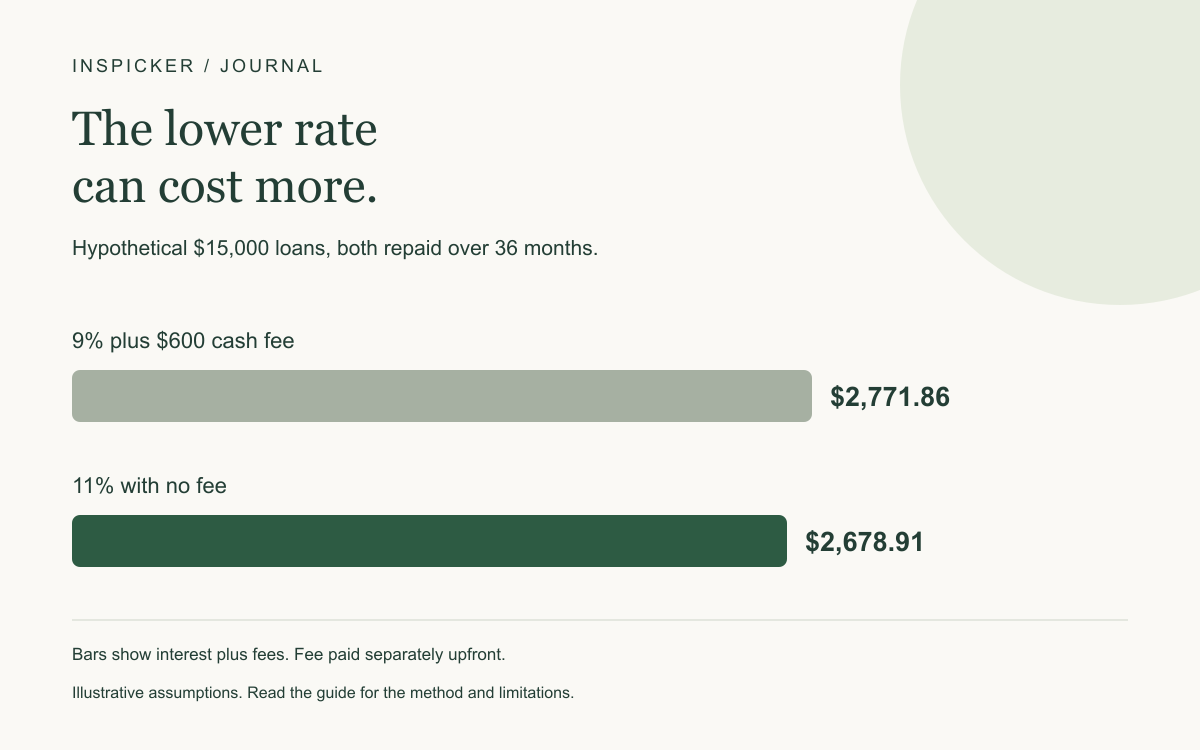
A lower loan interest rate can still cost more when an upfront fee exceeds the interest saved. Compare the same amount borrowed over the same repayment term, then add each offer’s fees once.
For a hypothetical $15,000 loan over 36 months, 9% interest plus a $600 cash fee costs approximately $2,771.86 in interest and fees. An 11% loan with no fee costs approximately $2,678.91. The higher-rate offer is cheaper by $92.95 if both are repaid on schedule.
Use the loan comparison calculator with contract interest rates and separately paid fees. This guide’s fee is paid upfront in cash; it is not financed or withheld from the proceeds.
Keep the amount and repayment term the same first
A fair initial comparison holds the amount borrowed and the number of installments constant. Otherwise a lower payment may simply reflect borrowing less or taking longer to repay.
| Input | Offer A | Offer B |
|---|---|---|
| Amount borrowed and received | $15,000 | $15,000 |
| Contract annual interest rate | 9% | 11% |
| Monthly payments | 36 | 36 |
| Upfront cash fee | $600 | $0 |
| Variable rate, balloon, or extra payment | None | None |
These are invented offers for calculation, not advertised rates or approval predictions. Both use fixed rates, monthly amortization, and payments at the end of each month. The borrower receives the full $15,000 in each case and pays Offer A’s fee from separate cash.
If an offer has another required charge, include it consistently. If it includes an optional product, identify whether you intend to buy it rather than silently treating it as required on one side.
The lower payment does not settle the cost comparison
The monthly payment calculation applies the contract interest rate to the outstanding balance. It does not spread a separately paid cash fee into the installments.
| Result | 9% plus $600 fee | 11% with no fee |
|---|---|---|
| Monthly payment | $477.00 | $491.08 |
| Interest over 36 months | $2,171.86 | $2,678.91 |
| Upfront fee | $600.00 | $0.00 |
| Interest plus fee | $2,771.86 | $2,678.91 |
| Principal, interest, and fee | $17,771.86 | $17,678.91 |
Offer A saves approximately $14.08 per month in scheduled installments. Across all 36 payments, its interest saving is approximately $507.05. Paying $600 to obtain that saving makes its total borrowing cost approximately $92.95 higher.
The arithmetic uses unrounded payments internally. Multiplying the displayed $477.00 by 36 can produce a small rounding difference from a lender’s schedule or the table’s totals.
This illustrates why two views matter. The payment shows the recurring cash commitment. Interest plus fees shows the modeled cost of obtaining the money over the full term. Neither should be substituted for the other.
Calculate the fee threshold for the lower rate
When the principal and term are identical and fees are paid separately:
Maximum extra fee justified by the lower rate = interest on the higher-rate loan − interest on the lower-rate loan.
Here, $2,678.91 − $2,171.86 = approximately $507.05. That is the full-term threshold before accounting for the timing value of money or other differences.
If Offer A’s fee were $400 instead, its interest-plus-fee cost would be approximately $2,571.86, making it about $107.05 cheaper than Offer B. At a $600 fee, it is more expensive. The rate did not change; the price charged to obtain it did.
If both loans charge fees, compare their difference. For example, an extra $300 fee needs at least $300 of offsetting interest savings in this simple full-term comparison.
Do not interpret the threshold as an APR calculation. It is a dollar-cost comparison under stated cash-flow assumptions. A proper annualized comparison also reflects when cash is received and paid.
A cash fee is different from a fee withheld or financed
The calculator’s fee field represents money paid separately upfront. Other structures require different inputs or a different calculation:
- Cash fee: borrow and receive $15,000, then separately pay $600. This is the worked example.
- Deducted fee: sign for $15,000 but receive only $14,400 after a $600 deduction. You have less usable money.
- Financed fee: receive the needed $15,000 but add a fee to the balance. You pay interest on the larger principal.
For a fee equal to 4% of the note amount and withheld from proceeds, receiving exactly $15,000 would require $15,000 ÷ 0.96 = $15,625 of principal. The withheld fee would be $625. A $15,000 principal and a $600 cash fee would not reproduce that arrangement.
Read the lender’s definitions. A fee stated as a percentage of principal can work differently from a fixed fee or a percentage added to requested cash. Keep the amount you receive visible beside the amount you owe.
For a different example that explicitly finances a consolidation fee, see the debt-consolidation origination-fee guide. Its assumptions should not be mixed with this article’s cash-fee comparison.
A longer term can overwhelm a lower rate
Extend Offer A to 60 months while keeping its $15,000 principal, 9% rate, and $600 cash fee. Its payment falls to approximately $311.38, but interest rises to approximately $3,682.52. Interest plus fee becomes $4,282.52.
That is $1,603.61 more borrowing cost than the 36-month 11% no-fee offer, even though the monthly payment is about $179.71 lower.
The longer term can help monthly affordability, but it does not create full-term savings. If a shorter schedule is unaffordable, identify that constraint honestly using the budget planner.
Early repayment changes the fee threshold
The $507.05 threshold assumes every scheduled payment occurs. If you repay early, you may avoid some future interest on both offers while the upfront fee may remain paid. The full-term threshold then no longer answers your actual situation.
To compare an early exit, total fees and payments through the planned payoff date, plus the remaining payoff amount. Ask each lender about any prepayment terms and obtain a payoff quote. This calculator does not model that early-exit comparison.
Use APR disclosures alongside the dollar comparison
The CFPB explains the distinction between interest rate and APR: APR incorporates interest and additional borrowing charges. Entering APR as though it were the contract rate and then adding the same fee again can overstate the modeled cost.
For the calculator, collect the amount borrowed, actual cash received, contract rate, term, fee treatment, and any other required charges. Then review the lender’s APR and total-payment disclosures as a separate cross-check. If the figures differ materially, investigate the missing assumption before relying on the result.
Common questions about loan rates and fees
Is 9% always better than 11%?
No. With the selected $15,000 principal and 36-month term, a $600 fee makes the 9% offer slightly more expensive than 11% with no fee.
How large a fee could the lower rate justify here?
Approximately $507.05 of additional upfront fee at full scheduled repayment, ignoring the time value of money. Different rates, amounts, terms, or payoff dates produce a different threshold.
Should I put APR into the interest-rate field?
Use the contract interest rate for this calculator’s amortization and enter separately paid fees separately. APR may already include those fees; counting them twice gives a misleading comparison.
Does the tool model a fee deducted from the loan proceeds?
No. Its fee is paid upfront from separate cash. A deducted or financed fee changes usable proceeds or principal and needs an adjusted comparison.
Method: hypothetical fixed-rate monthly amortization and fees paid separately at origination. Totals assume full scheduled repayment, no penalties, and no extra charges. Actual lender rounding and contract terms can differ.
For education and planning. Check assumptions and product terms before making a financial decision.
Put the numbers to work ↗