Insurance / Life insurance
Life Insurance for an Unpaid Caregiver: Estimate Replacement Costs
Build a household-specific caregiving replacement budget. Includes a checked coverage-gap example, duration scenarios, offsets, and calculator limitations.
A parent or caregiver without a salary can still create a financial protection need. If their work would have to be replaced, the household may face paid care, household support, or reduced earnings for another family member.
Estimate those replacement costs from the work actually performed and the time it would be needed. A zero salary does not automatically mean zero financial impact, while a headline “salary equivalent” does not automatically establish the right policy amount.
The life insurance calculator can help organize a hypothetical needs estimate, but its income field normally represents income. This article explains the limits of using a separately calculated replacement-cost proxy and includes a transparent manual example.
Start with duties, not the absence of a paycheck
List care and support that would need to continue: child supervision, transport, household administration, meal preparation, or care for another dependent. Then identify which duties would require paid help and which another person could realistically take on.
The NAIC’s guidance on insurance for caregivers recognizes that unpaid caregiving has financial implications and discusses life-insurance considerations. The relevant question is how the household would function and fund support if that person were no longer there.
Do not assume the surviving adult can absorb every duty while maintaining the same work schedule. Conversely, do not price every hour as a separate full-price service if one paid arrangement would cover several duties at once.
A practical worksheet records the task, hours, likely replacement arrangement, expected duration, and a local cost estimate. Use actual quotes or a plausible household plan where possible.
An illustrative annual replacement budget
Consider a hypothetical household that identifies the following additional costs:
| Replacement need | Monthly cost chosen for the example |
|---|---|
| Childcare or supervision | $1,800 |
| Household support | $700 |
| Transport and coordination | $500 |
| Total | $3,000 |
That totals $36,000 annually. These amounts are invented for arithmetic; they are not national averages or quotations for your location.
The categories are defined to avoid overlap. The childcare amount does not already include the separately listed transport or household-support costs. If a real arrangement bundles them, use the bundled total instead of adding them twice.
Also check whether the household’s current budget already pays for part of the service. The additional protection need is the extra expense after the event, not necessarily the full invoice for a service partly funded already.
A different family might rely on relatives, pay for more intensive support, or experience an earnings reduction instead. Model the actual intended arrangement. If the survivor reduces paid work, estimate the net income change separately and avoid charging twice for the same hours of care.
The years of replacement matter as much as the annual amount
Suppose the selected $36,000 annual need lasts ten years. Without discounting or inflation adjustments, the total is $360,000.
For a present-value model, both inflation and the assumed return on funds matter. InsPicker uses a real rate calculated as:
(1 + nominal return) ÷ (1 + inflation) − 1.
If both selected rates are 3%, the real rate is zero. Under that particular assumption, ten annual year-end amounts of $36,000 have a present value of $360,000 in today’s dollars.
| Selected duration, at zero real rate | Replacement-cost component |
|---|---|
| 5 years | $180,000 |
| 10 years | $360,000 |
| 15 years | $540,000 |
This table changes only duration. It does not imply every year of care costs the same. Younger children may need more paid supervision; later years might require less supervision but other forms of support. A detailed plan can use changing annual costs rather than a single constant amount.
The equal 3% rates are assumptions, not forecasts or guaranteed returns. Taxes, investment expenses, and the practical accessibility of funds also matter when planning how benefits would support future expenses.
Add other needs only when they are not already funded
For a worked estimate, add $10,000 of a distinct consumer-debt obligation and $15,000 of final expenses. Assume there is no additional mortgage-payoff or education lump sum in this particular calculation.
| Component | Amount |
|---|---|
| Ten-year replacement-cost present value | $360,000 |
| Distinct consumer debt | $10,000 |
| Final expenses | $15,000 |
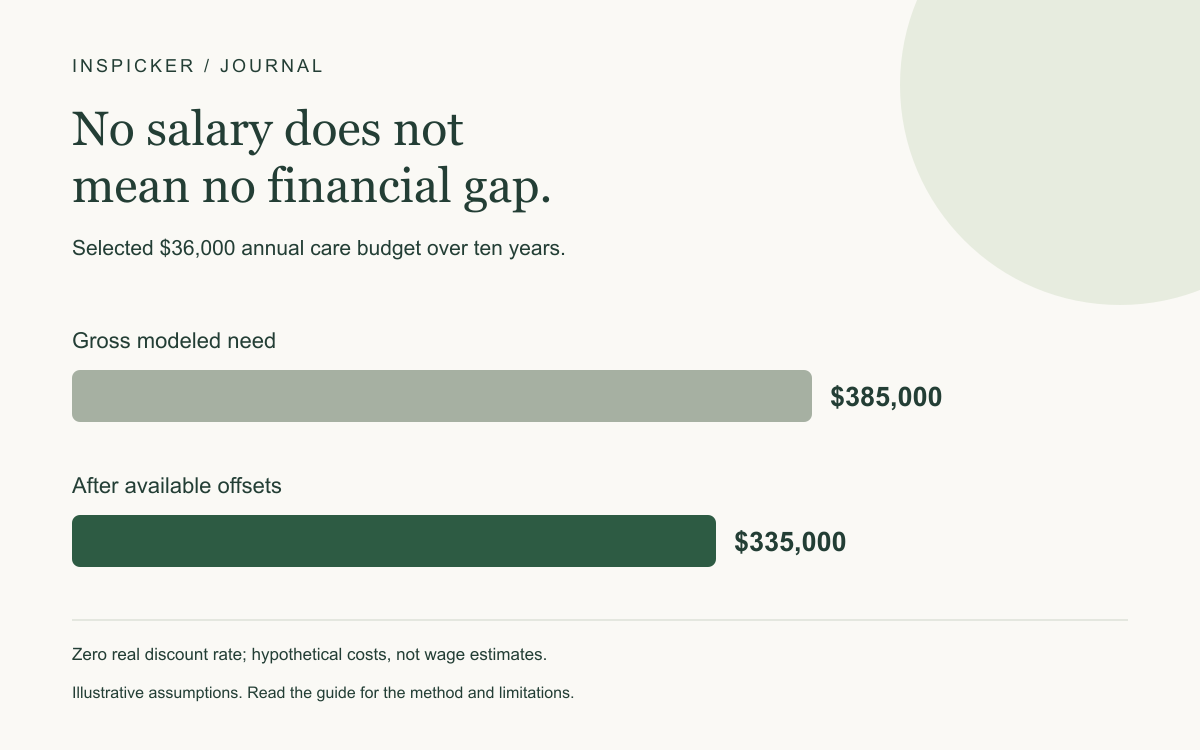
| Gross modeled need | $385,000 |
| Existing coverage available for this need | −$25,000 |
| Liquid savings genuinely available | −$25,000 |
| Net modeled gap | $335,000 |
The $335,000 is a scenario output, not a quote or recommended policy for every caregiver. It depends entirely on the household assumptions.
Only subtract money actually available for the intended purpose. Do not subtract the same reserve from several independent protection plans as though each can use it fully at the same time. Likewise, existing coverage on a different person does not necessarily offset this person’s coverage need.
For a broader household framework, read the DIME life-insurance example, which separates debt, income, mortgage, education, and available offsets.
Treat a replacement-cost proxy as a manual scenario
The tool does not have a dedicated unpaid-caregiving field or a local-care-cost database. To reproduce the arithmetic only, the $36,000 annual replacement budget can be entered as an income-stream proxy with a 100% replacement setting and ten years of support.
Use 3% nominal return and 3% inflation for the zero-real-rate example, then add the stated debts and offsets. Keep mortgage and education components at zero to reproduce the table.
This use does not mean the caregiver earns a $36,000 wage or that an insurer will underwrite that amount using the same method. The proxy is a way of valuing a selected annual expense stream inside a simplified formula.
If the interface restricts a value or your costs change substantially by year, do the worksheet separately. Do not distort inputs just to force a preferred answer. A calculator result is only as meaningful as the definitions behind it.
Match the protection period to the actual obligation
An estimate of need does not select a policy type, duration, price, or insurer. Confirm how long the additional support would be necessary and what coverage is available for the person being insured.
Compare premiums and policy terms against a budget that can be maintained. Underwriting, available benefits, exclusions, and other provisions require review of the actual policy and quotation.
If comparing term protection with a cash-value policy, see the premium-gap comparison. Its account-value scenarios are separate from determining the amount of protection needed.
Common questions about life insurance for an unpaid caregiver
Can someone without a salary still have a financial protection need?
Yes. Paid replacement services or a survivor’s reduced earnings can create a household funding gap. Estimate that impact rather than assuming salary alone measures it.
Is $36,000 the value of every caregiver’s work?
No. It is an invented replacement budget used to demonstrate arithmetic. Local prices, duties, family resources, and support duration differ.
Does the calculator estimate childcare costs?
No. You must supply the replacement-cost estimate. Using an income proxy is a manual modeling technique, not a built-in caregiving assessment.
Should every family use the $335,000 result?
No. It follows from this example’s costs, duration, debts, and offsets. Build the worksheet around your own household before comparing actual coverage options.
Method: hypothetical constant annual replacement costs valued as a year-end stream, equal nominal return and inflation, and explicitly separated one-time needs and offsets. No local wage survey, underwriting decision, tax model, or personalized coverage recommendation is implied.
For education and planning. Check assumptions and product terms before making a financial decision.
Put the numbers to work ↗