Insurance / Life insurance
The DIME Method: Estimate Life Insurance Without Double-Counting
Estimate debt, income, mortgage, and education needs with the DIME method. Includes a checked example, asset offsets, and double-counting checks.
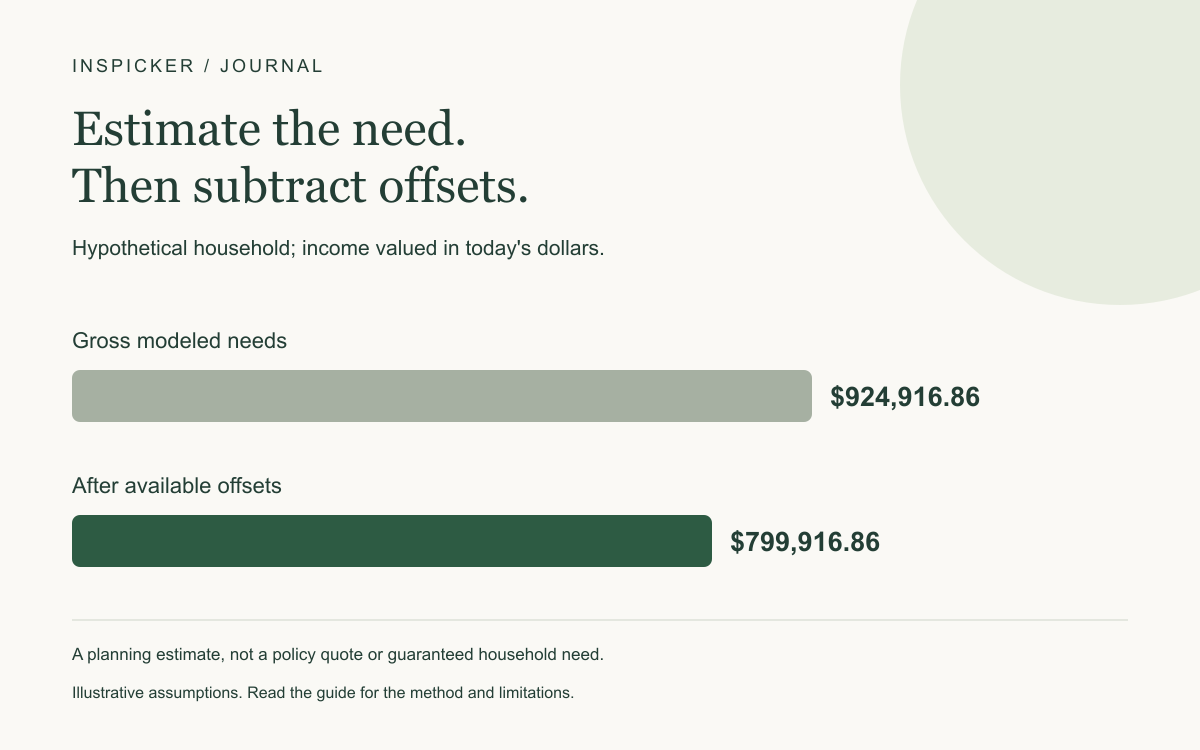
DIME organizes a life-insurance estimate into debt, income, mortgage, and education needs. Add the obligations and support you want to fund, then subtract resources genuinely available for those same purposes.
The most important step is preventing overlap. If the estimate pays off the mortgage separately, the income-replacement budget should not also fund the same mortgage payments in full.
Our hypothetical household has approximately $924,916.86 of modeled needs and $125,000 of available offsets, leaving approximately $799,916.86 to consider funding. This is a planning scenario, not an exact insurance recommendation or policy quote.
Explore your life-insurance coverage estimate.
What does each part of DIME represent?
| Component | Planning question |
|---|---|
| Debt | Which consumer debts and final expenses should be funded? |
| Income | How much ongoing support is needed, and for how long? |
| Mortgage | Will the plan provide a separate amount for the outstanding mortgage? |
| Education | What contribution toward dependents' education do you intend to fund? |
These are organizing categories. They do not determine who is legally responsible for a debt, whether an account passes outside an estate, or how a particular policy pays.
Use documented balances and an explicit household support plan. Debt treatment, beneficiaries, taxes, and estate arrangements may require qualified advice beyond a calculator.
The NAIC's life-insurance consumer overview explains policy purposes and product differences. It does not endorse the exact DIME calculation or assumptions used here.
Define the income need before multiplying salary
A salary multiple is simple, but it can miss how a household's expenses, taxes, existing resources, and dependents change after a death.
Start with the amount of annual support you want to replace. Decide whether that includes housing, care, and other costs already funded in another DIME component.
This calculator values the income stream in today's dollars using assumed investment return and inflation. It asks how much starting capital would support the modeled stream under those constant assumptions.
That is different from multiplying the annual amount by years with no investment growth. Neither method guarantees that actual returns, inflation, taxes, or expenses will follow the assumed path.
Use a support horizon that matches the obligation
Fifteen years of support might be one household's chosen scenario; another may need a different period. A dependent's age, surviving income, care needs, and other obligations can affect that choice.
Do not automatically assume a surviving adult will immediately replace all lost earnings or stop needing support after an arbitrary number of years.
Worked example: a roughly $800,000 remaining need
Assume a fictional household with the following inputs:
| Input | Assumed amount |
|---|---|
| Consumer debt | $20,000 |
| Final expenses | $15,000 |
| Annual income reference | $60,000 |
| Chosen replacement share | 75%, or $45,000 annually |
| Income support period | 15 years |
| Assumed nominal investment return | 4% |
| Assumed inflation | 2% |
| Mortgage balance funded separately | $250,000 |
| Education provision | $30,000 for each of two children |
| Existing available death-benefit coverage | $100,000 |
| Other savings allocated to these needs | $25,000 |
The household has deliberately chosen a $45,000 support budget that excludes the mortgage payments covered by the separate payoff amount. The 75% share is an input for this example, not a recommended replacement percentage.
The income calculation uses an assumed real rate:
(1.04 ÷ 1.02) − 1 = approximately 1.9608%.
The present value of $45,000 annual support for fifteen years, modeled as year-end payments in today's dollars, is approximately $579,916.86.
| Component | Modeled amount |
|---|---|
| Debt and final expenses | $35,000 |
| Income support present value | $579,916.86 |
| Mortgage provision | $250,000 |
| Education provision | $60,000 |
| Gross needs | $924,916.86 |
| Existing coverage and assigned savings | −$125,000 |
| Remaining modeled amount | $799,916.86 |
Taxes, fees, and variable investment returns are not automatically modeled. Education is a chosen lump sum, not a forecast of a school's future charges.
The final cents should not be mistaken for real-world certainty. It is more useful to understand the assumptions behind roughly $800,000 and test how the result changes.
Check for double-counting before choosing an amount
Mortgage and income. If the mortgage is paid off separately, remove the funded payments from the support budget where appropriate. Other housing costs such as taxes, insurance, maintenance, or rent may still continue.
Education and general support. A separate education provision can overlap with an income budget that already includes those same costs. Define which component funds which need.
Savings and other goals. Do not subtract the entire bank balance if some money must fund unrelated taxes, emergencies, or other commitments.
Existing insurance. Verify that the coverage remains in force for the intended period, reaches the intended beneficiaries, and is actually available. Employer coverage may depend on continued employment or other conditions.
Policy features. Do not count multiple descriptions of one policy's value as separate available resources without checking the contract.
These checks matter more than making the final estimate look numerically precise.
Coverage amount and coverage design are separate decisions
A modeled dollar need does not choose a policy type, term, insurer, premium, beneficiary arrangement, or qualification outcome.
Match the period of support with the policy's actual coverage period. Review premiums, exclusions, renewal terms, guarantees, and conditions. A policy that ends before the modeled need does cannot be assumed to fund the full scenario.
The NAIC's insurance overview distinguishes term and permanent products. For an initial comparison of term and whole-life financial assumptions, use the term-versus-whole-life calculator, while recognizing that investment illustrations and insurance guarantees are different things.
DIME is also not a full estate plan. Special needs, business obligations, dependents' legal arrangements, and complex tax circumstances may require a more detailed analysis.
How to enter the worked example
Enter $20,000 consumer debt, $15,000 final expenses, $60,000 income, a 75% replacement share, fifteen years, 4% assumed return, and 2% inflation.
Add the $250,000 mortgage, two children at $30,000 each, $100,000 existing coverage, and $25,000 available savings.
Then test a longer support period or a less favorable return. Update the support budget if the mortgage treatment changes so the scenarios stay internally consistent.
The calculator does not verify policies, beneficiary rules, tax treatment, actual future returns, or education costs. It provides a structured estimate using your inputs.
Build your DIME comparison. The budget planner can help organize the ongoing expense assumptions first.
Common questions
Does DIME always mean ten times income?
No. The income component can be calculated in different ways. This tool uses a present-value support stream rather than a fixed salary multiple.
Should I subtract all my savings?
Only subtract resources genuinely available for the modeled needs. Money committed elsewhere is not automatically an offset.
Does the result tell me which policy to buy?
No. Coverage design, term, premiums, guarantees, eligibility, and beneficiaries require separate decisions.
Why does the income component depend on return and inflation?
They change the modeled purchasing power and capital needed to support future payments. Constant assumptions are simplifications, not guaranteed outcomes.
Editorial note: The household and assumptions are fictional. DIME is an organizing framework, and this model is not individualized insurance, tax, or estate advice.
For education and planning. Check assumptions and product terms before making a financial decision.
Put the numbers to work ↗