Health plans / HSA
Reimburse HSA Expenses Later: Keep Receipts and Growth Separate
Organize unreimbursed HSA expenses without confusing receipt amounts with investment growth. Includes IRS references, a $2,000 example, and calculator limitations.
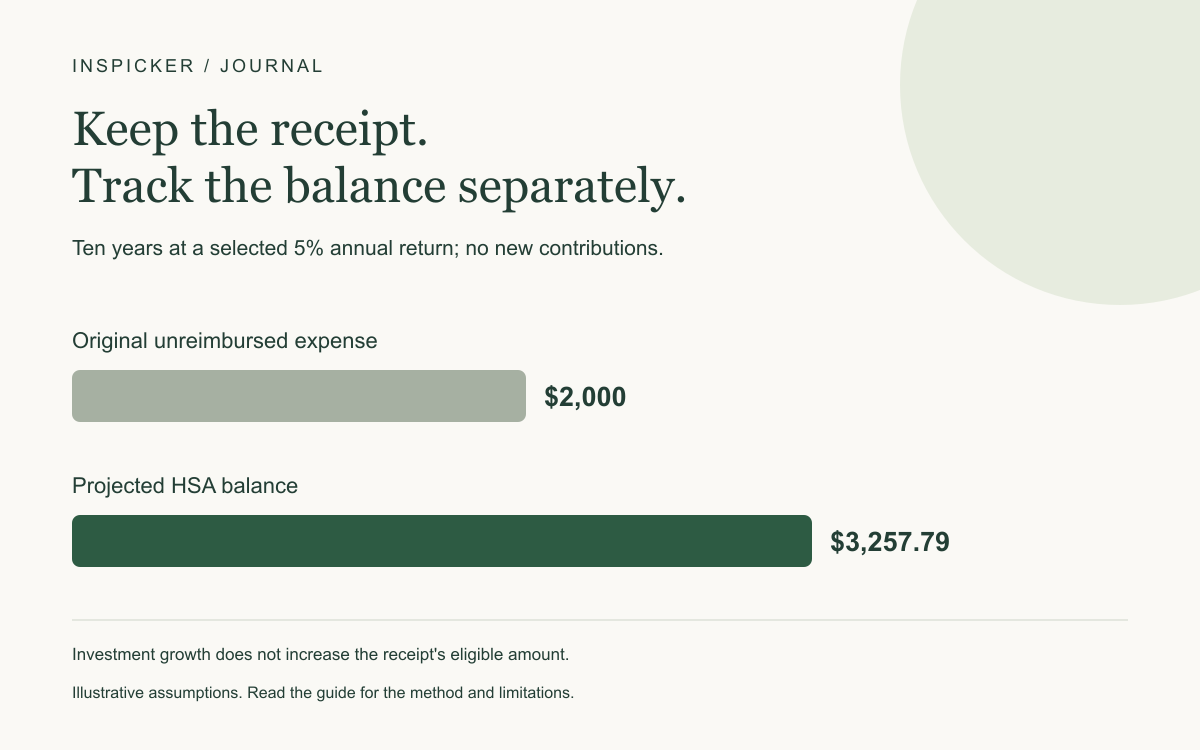
You may be able to reimburse an eligible medical expense from an HSA in a later year, but the receipt does not become more valuable just because investments grow. Keep the qualifying expense, its unreimbursed amount, and the account balance as separate records.
A hypothetical $2,000 eligible expense paid from ordinary cash can support at most that unreimbursed $2,000 amount in the example—not an inflation-adjusted or investment-grown version of the receipt. Whether delaying reimbursement is practical depends on available cash, documentation, investment risk, and the applicable rules.
Use the HSA calculator to explore its stated growth assumptions. It does not validate expenses, manage receipts, track reimbursements, or compare every cash-flow consequence of paying now versus reimbursing later.
The expense needs to qualify, not merely have a receipt
IRS Publication 969 explains qualified HSA distributions and recordkeeping. Relevant expenses generally must be incurred after the HSA is established, and records must support their qualified, unreimbursed status and that they were not taken as an itemized deduction.
Notice 2004-50, Q&A 39 addresses later-year reimbursement and states that there is no time limit for the distribution under the described conditions. Review the actual requirements rather than treating a saved invoice as automatic authorization.
This guide does not determine whether a specific treatment, family member, premium, or expense qualifies. Confirm that question before adding an amount to an eligible-expense ledger.
An account contribution and a reimbursement also answer different questions. The permitted amount contributed during a year is not simply reset by withdrawing money. See the employer-contribution-room worksheet for that separate issue.
Keep a ledger tied to supporting documents
A practical tracking record can include:
| Field | Why keep it |
|---|---|
| Unique expense reference | Connects every reimbursement to a specific expense |
| Service date and provider | Helps identify what occurred and when |
| Person receiving care | Supports reviewing the applicable eligibility rules |
| Amount personally paid | Separates an invoice total from the actual funded expense |
| Insurance adjustment or reimbursement | Prevents retaining an outdated expense amount |
| HSA reimbursement already taken | Shows which part has been used |
| Remaining unreimbursed amount | Identifies the balance still available for review |
| Document location | Makes the evidence retrievable later |
An invoice alone may not show the final patient responsibility or proof of payment. Retain the relevant payment evidence and insurance documentation alongside it, then reconcile the final amount.
For a partly reimbursed $2,000 eligible expense, a $750 reimbursement leaves $1,250 unreimbursed. A later $1,250 reimbursement brings the remaining amount to zero. Mark the expense accordingly instead of leaving the original $2,000 available indefinitely.
Use secure storage, backups, and access arrangements appropriate for sensitive medical and financial records. A filename and spreadsheet row are useful only if the supporting document can still be found and read when needed.
A receipt and an investment balance do not grow together
Assume an already funded HSA contains $2,000. Separately, the household pays a $2,000 qualifying expense from outside cash and keeps adequate records. For this illustration, nothing is contributed to or withdrawn from that selected HSA balance for ten years.
At a hypothetical constant 5% annual return, compounded annually:
$2,000 × 1.05¹⁰ = approximately $3,257.79.
| Measure after ten years under the stated assumptions | Amount |
|---|---|
| Projected HSA investment balance | $3,257.79 |
| Original expense still unreimbursed | $2,000.00 |
| Balance remaining after a $2,000 reimbursement | $1,257.79 |
The example assumes the expense remains eligible and unreimbursed under the applicable conditions. It is not a promise that the balance will grow, nor a determination of a particular taxpayer’s eligibility.
The original expense does not become a $3,257.79 reimbursement just because the account grew to that amount. Any remaining account money retains its own distribution requirements; it is not automatically unrestricted cash.
If you invest money needed for future expenses, losses are possible. A receipt does not guarantee that enough assets will remain available to reimburse it later.
Update the record when another source pays or an amount changes
Suppose the $2,000 in the example is not the final personal cost because an insurer later pays $400 attributable to it. The expense record needs review and adjustment; continuing to treat the full original amount as personally unreimbursed can be wrong.
Similarly, do not submit the same expense for reimbursement from multiple arrangements or reuse it after it has already been fully reimbursed. Track partial reimbursements rather than relying on memory across years.
The tax treatment of a distribution is not established by the HSA provider processing a transfer. The provider’s account records and your evidence of what the distribution funded are different records. Keep them reconciled.
The IRS’s Form 8889 instructions address reporting HSA distributions. Use the instructions applicable to the distribution year; do not assume a future reimbursement is reported as though it happened when the original expense was paid.
Paying outside the HSA ties up other household money
In the growth example, $2,000 remains inside the HSA because another $2,000 pays the provider. That outside cash has a cost and an alternative use. The table does not credit that cash to the household twice.
If paying out of pocket would require expensive card debt, drain essential bill money, or leave an inadequate accessible reserve, the investment-growth illustration does not resolve the choice. Compare the full household cash position.
Likewise, comparing “use the HSA now” with “invest the HSA and reimburse later” requires considering what happens to outside money in both paths. An account-only growth chart is not a complete after-tax strategy comparison.
The budget planner can help identify current cash available for medical costs, and the emergency-fund checklist helps distinguish money already committed elsewhere. Neither tool validates a tax-qualified reimbursement.
Use the growth tool without mistaking it for a receipt system
For the standalone growth example, the mathematical inputs are $2,000 starting balance, zero additional contributions, ten years, and a 5% annual return. InsPicker’s HSA model compounds annually and assumes annual contributions at the start of each year when contributions are entered.
It does not subtract a future $2,000 reimbursement automatically. The remaining $1,257.79 in the table is a separate subtraction after the projected growth.
The tool’s taxable-account comparison applies simplified tax assumptions. It does not determine state tax treatment, record eligible expenses, or model a complete spending-versus-investing strategy. A projected “advantage” is therefore not proof that delaying every reimbursement is best.
Keep the ledger and documentation outside the calculator. Review the current rules and actual account facts before taking a distribution.
Common questions about reimbursing HSA expenses later
Does a medical receipt earn interest?
No. The account investments may grow or lose value. The unreimbursed expense amount remains a separate record; it does not increase with investment returns in this example.
Can every old medical bill be reimbursed?
No. Eligibility, account establishment timing, other reimbursement, deduction treatment, and records matter. A receipt by itself does not establish all the conditions.
Does the HSA calculator track reimbursement eligibility?
No. It models growth under selected assumptions and does not manage expenses or receipts.
Is delaying reimbursement always better?
No. Cash needs, financing costs, investment risk, documentation, and the full tax and household circumstances affect the comparison.
Method: hypothetical already funded $2,000 HSA balance, annual compounding, no added contributions, and a separately documented $2,000 expense. No eligibility determination, future-return guarantee, or complete tax-strategy comparison is provided.
For education and planning. Check assumptions and product terms before making a financial decision.
Put the numbers to work ↗