Health plans / HSA
Does Your Employer’s HSA Contribution Reduce Your 2026 Limit?
Calculate HSA contribution room after employer deposits and prior contributions. Includes 2026 self-only and family examples and calculator limitations.
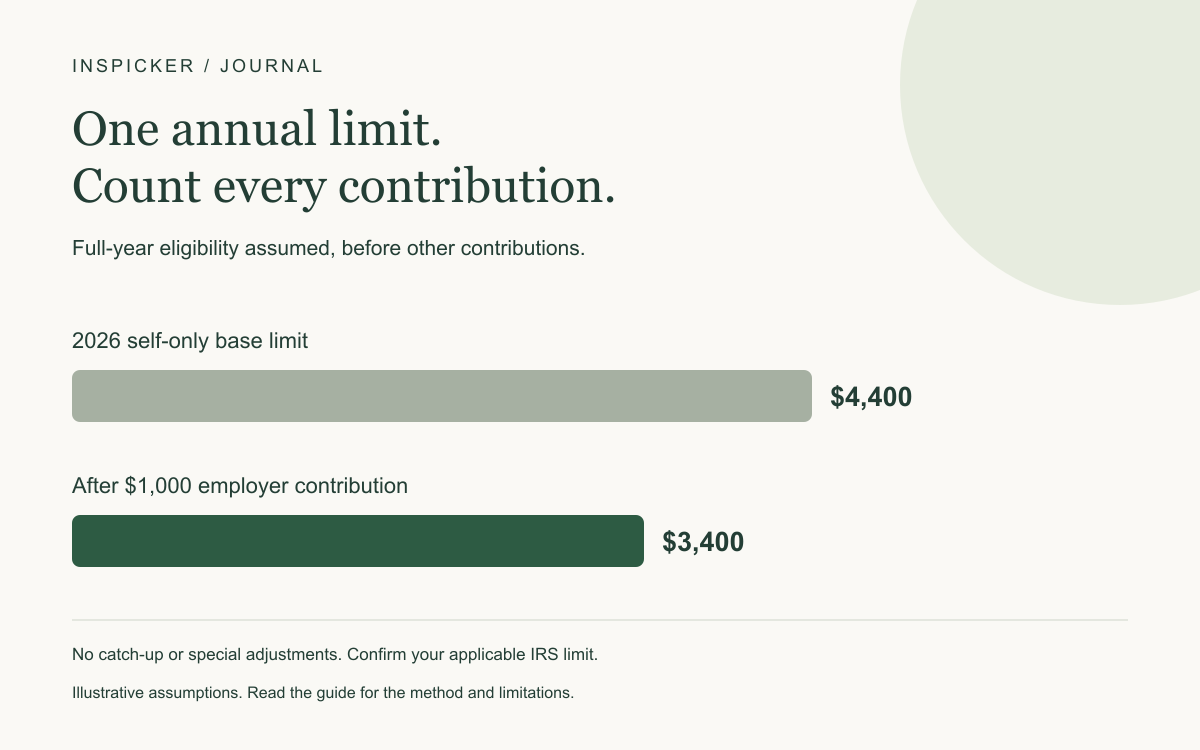
Employer HSA contributions generally use part of the same annual contribution limit as your own contributions. They are not automatically extra room on top of the limit.
For 2026, the base limits are $4,400 for self-only coverage and $8,750 for family coverage, subject to eligibility and applicable adjustments. Under a straightforward full-year self-only example with a $1,000 employer contribution, the remaining amount available for other contributions is $3,400 before subtracting any already made.
The HSA calculator illustrates hypothetical account growth and tax assumptions. It does not determine your personal legal contribution limit or validate employer deposits. Work out the permitted contribution separately before projecting growth.
Confirm eligibility before using the annual headline amount
The IRS contribution guidance in Publication 969 gives the 2026 base limits and explains that employer contributions reduce the remaining room. Eligibility timing, coverage changes, age-related additions, Medicare, and other circumstances can alter the calculation. Multiple HSAs do not create separate annual limits.
The examples below assume full-year eligibility, unchanged coverage, no catch-up contribution, and no special adjustments. If those assumptions do not fit, use the IRS instructions applicable to your circumstances before copying the arithmetic.
In particular, do not assume an account being open proves you can contribute the full annual amount. The account balance and the permitted annual contribution answer different questions.
This article’s date-specific figures were checked on October 15, 2026. For another tax year, verify that year’s official amounts rather than reusing these limits.
Self-only example: subtract the employer amount and prior deposits
Suppose the applicable limit is $4,400 and the employer will contribute exactly $1,000 for the year. The initial room for other contributions is:
$4,400 − $1,000 = $3,400.
Now suppose you have already contributed $2,000 of that amount. The remaining room is:
$4,400 − $1,000 − $2,000 = $1,400.
| Full-year self-only example | Amount |
|---|---|
| Applicable contribution limit assumed | $4,400 |
| Employer contribution for the year | −$1,000 |
| Your contributions already counted | −$2,000 |
| Remaining contribution room | $1,400 |
The employer amount here is the whole year’s expected contribution, including any already deposited. Do not subtract both the full-year amount and its year-to-date portion again.
If six payroll deposits remain, $1,400 divided by six is about $233.33. Five deposits of $233.33 followed by $233.35 would total exactly $1,400. Confirm the actual payroll schedule and permitted election increments rather than assuming payroll will make that final adjustment automatically.
A $1,400 remaining allowance is not a recommendation to contribute that amount regardless of cash needs. It is the arithmetic room under this selected set of assumptions.
Family example: coordinate the whole contribution picture
Use the selected $8,750 applicable family limit, an employer contribution of $1,500, and $3,000 already contributed from other sources:
$8,750 − $1,500 − $3,000 = $4,250 remaining.
| Full-year family example | Amount |
|---|---|
| Applicable contribution limit assumed | $8,750 |
| Employer contribution for the year | −$1,500 |
| Other contributions already counted | −$3,000 |
| Remaining contribution room | $4,250 |
If four equal deposits remain, the selected gap is $1,062.50 per deposit. That is much larger than spreading the same amount over a full year. Review progress before the final payroll periods rather than relying on an annual average after much of the year has passed.
For spouses with HSAs, coordinate the applicable family-limit rules rather than treating this table as an independent full family allowance for each account. Publication 969 explains the relevant rules and catch-up treatment. This simple example does not allocate a limit between spouses.
Keep a record of who made each contribution, which account received it, and which tax year it belongs to. A transfer of money already inside the HSA system should not be casually counted as new annual saving; confirm how the transaction is classified.
Your account balance is not your unused contribution room
An HSA can hold contributions from earlier years and investment gains. A $12,000 balance does not by itself tell you whether this year’s contribution limit has been used. Conversely, a low balance after spending does not mean the annual allowance has reset.
For example, suppose the self-only scenario has already received $3,000 in total contributions: $1,000 employer money and $2,000 of your own. If $2,000 is later withdrawn for expenses, the remaining contribution-room calculation in this straightforward example still starts with the $3,000 already contributed. It is not simply the $4,400 limit minus whatever balance remains on screen.
Maintain two separate records: annual contributions for the relevant limit calculation, and account activity for spending and investment tracking. Mixing them can lead to accidental excess funding or an inaccurate growth projection.
Do not count the same payroll contribution twice
A benefits portal may show both an employee payroll deduction and the total deposit sent to the account. Those can represent the same money moving through two stages.
For your worksheet, identify distinct sources and reconcile them to posted transactions. If the employer’s administrator uses labels that combine payroll deductions with employer-funded deposits, ask for a breakdown rather than adding every displayed total together.
Also distinguish an employer deposit from the tax benefit associated with an employee contribution. The employer’s $1,000 is a contribution. An estimated reduction in taxes is not another $1,000 deposited automatically into the HSA.
If the employer changes its annual amount or you change jobs, update the full-year projection. The room calculated using the old expected deposit may no longer be accurate. A new benefits portal does not erase contributions made earlier in the same year.
The growth tool is not a contribution-limit checker
InsPicker’s HSA tool accepts an annual contribution, starting balance, horizon, return, and selected tax rates. It models start-of-year contributions and a simplified taxable-account comparison. It does not ask all the questions needed to determine legal contribution eligibility.
It also does not separately identify employee and employer contributions. Applying one marginal-tax assumption to a combined amount does not reproduce a real payroll calculation. Use the projection to understand its stated scenario, not to calculate a deduction for an employer deposit.
The tool assumes no withdrawals during its growth horizon and does not model account fees or changes to future contribution limits. A fixed annual input repeated for many years is an assumption, not a statement that the 2026 limit will remain unchanged.
If your main decision is choosing a health plan, use the employer-HSA health-plan comparison instead. The value of an employer contribution in that plan comparison is a separate question from how much contribution room remains.
Common questions about employer HSA contributions
Can I contribute the full base limit plus employer money?
Not under the straightforward examples here. Employer contributions use part of the applicable limit, so subtract them before calculating additional room.
Does withdrawing money create new room?
Do not calculate room from the remaining balance. Track contributions for the year separately; spending the account down does not automatically undo the contributions already counted.
Does the calculator verify my eligibility?
No. It is a growth and tax-assumption illustration. Determine your applicable limit using current official guidance and your actual coverage and contribution history.
What if I changed coverage or started Medicare?
The simple full-year examples may not apply. Review the relevant IRS rules and your dates before funding the account.
Method: 2026 base limits from IRS Publication 969, with hypothetical employer and employee amounts and full-year eligibility assumptions. The examples omit catch-up and special-limit calculations. Confirm your own eligibility and contribution record before acting.
For education and planning. Check assumptions and product terms before making a financial decision.
Put the numbers to work ↗