Insurance / Life insurance
Is Employer Life Insurance Enough? Calculate the Coverage Gap
Compare employer life insurance with household needs using a checked example. Review current coverage, job-change scenarios, offsets, and benefit limitations.
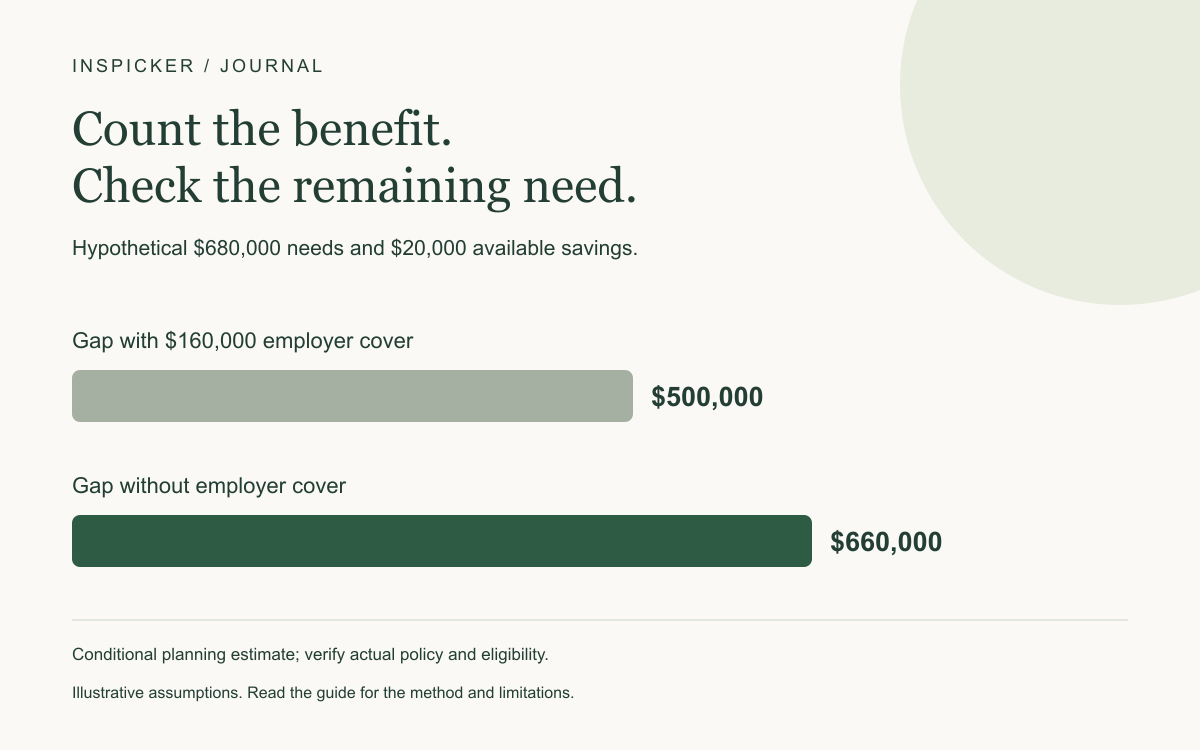
Employer life insurance is one resource to subtract from an estimated household protection need—not a substitute for calculating that need. A benefit described as one or two times salary can be useful, but the salary multiple alone does not show how much support dependents would require.
In the hypothetical example below, a household has $680,000 of modeled needs, $160,000 of current employer coverage, and $20,000 of available savings. The remaining gap is $500,000. If the employer coverage were no longer available and nothing replaced it, the modeled gap would rise to $660,000.
Use the life insurance calculator to organize a needs-and-offsets estimate. Then verify the actual benefit amount, covered person, eligibility, and policy conditions in the employer’s documents.
Read the benefit amount and conditions
An enrollment screen might display a basic benefit, optional coverage, a maximum, or an election awaiting approval. Confirm which amount is actually effective rather than adding every number shown on the screen.
The NAIC’s life-insurance consumer guide asks whether workplace coverage will be enough and encourages evaluating dependents’ financial needs. Start with your own benefit documents and household obligations rather than assuming a typical employer formula applies.
Review the insured person, effective amount, eligibility dates, salary definition if relevant, and any conditions affecting the benefit. Distinguish life coverage from a separate accidental-death benefit; do not assume an amount payable only under a particular event is interchangeable with general life coverage.
The selected $160,000 below is an invented effective coverage amount. It is not a statement that every employer provides twice an $80,000 salary or that every employee can obtain that amount without further requirements.
Build a household estimate before subtracting the benefit
Suppose the household selects $40,000 of annual support for ten years, excluding the mortgage payments funded separately in the next row. It assumes 3% annual inflation and a 3% nominal return on the support reserve.
Equal return and inflation produce a zero real discount rate in this model. Ten year-end support amounts therefore have a present value of $400,000 in today’s dollars.
| Selected need | Amount |
|---|---|
| Present value of ten years of support | $400,000 |
| Consumer debt | $15,000 |
| Final expenses | $15,000 |
| Separate mortgage payoff | $200,000 |
| Selected education allowance | $50,000 |
| Gross modeled need | $680,000 |
Every figure is hypothetical. The education amount is a chosen lump sum, not a tuition forecast. The final-expense figure is an assumption rather than a quoted funeral or medical bill.
The support amount excludes mortgage payments because the example separately funds a payoff. Property taxes, insurance, and maintenance can continue after payoff and should be included where relevant in the ongoing household budget.
For a fuller description of the components, see the DIME-method coverage example. For unpaid household work, see the caregiver replacement-cost guide.
Subtract resources genuinely available for these needs
The household has $160,000 of employer life coverage on the person whose loss is being modeled and $20,000 of liquid savings assigned to these obligations.
Modeled gap = $680,000 − $160,000 − $20,000 = $500,000.
| Current resource | Amount subtracted |
|---|---|
| Employer life benefit | $160,000 |
| Available liquid savings | $20,000 |
| Total offsets | $180,000 |
The result is not a policy recommendation or an insurance quote. It identifies a gap under the assumptions so you can review the obligations and available resources more carefully.
Do not subtract a retirement-account balance as though it were automatically accessible cash with no tax, beneficiary, or timing considerations. Likewise, home equity is not the same as money immediately available without a sale or borrowing decision.
Existing coverage on another household member may support a different scenario. Identify whose death triggers the benefit before applying it as an offset.
Model what happens if workplace coverage is unavailable
For a sensitivity check, remove the $160,000 employer benefit but leave needs and savings unchanged:
$680,000 − $20,000 = $660,000.
That is $160,000 above the current-case gap. It does not predict exactly when a particular benefit ends or say that no continuation option exists. It shows the amount of this estimate that depends on that benefit being available.
Ask the employer or insurer what happens when employment, hours, leave status, or another eligibility condition changes. If continuation, portability, or conversion is offered, obtain the applicable documents, deadlines, prices, and coverage terms. Do not assume the replacement has the same cost or features.
MetLife’s conversion guidance illustrates why continuation options and application deadlines need plan-specific review. Its program details are not universal rules for every employer or insurer.
If considering separate coverage, review the actual underwriting and effective-date requirements. Do not treat an application, tentative quote, or intended purchase as already effective coverage when calculating current offsets.
Avoid counting the same money or obligation twice
Employer coverage can be entered in the calculator’s existing-coverage total, along with other effective coverage on the same person if applicable. Do not also subtract the employer amount a second time manually from the result.
Similarly, subtract the $20,000 savings once. If the same savings are fully assigned to another simultaneous commitment, revisit whether they are available for this estimate.
On the needs side, do not fund the full mortgage balance as a lump sum and then include the same scheduled mortgage payments in the income-support stream without explaining the extra purpose. Decide whether the household intends to pay off the debt or maintain payments, then build a consistent budget.
Check coverage and needs periodically. A debt payoff, another dependent, changed care arrangements, or a new benefit can alter the calculation even when salary has not changed.
Reproduce the example and test different assumptions
For the support stream, enter $40,000 annual income as the selected support proxy, 100% replacement, ten years, 3% nominal return, and 3% inflation. This proxy is the household support amount chosen for modeling, not necessarily the insured person’s gross salary.
Enter $15,000 consumer debt, $15,000 final expenses, $200,000 mortgage balance, and an education component totaling $50,000. One child with a $50,000 selected allowance reproduces that component; it does not imply a standard cost per child.
Use $160,000 existing coverage and $20,000 liquid savings. Then change existing coverage to zero for the no-employer-benefit scenario.
The calculator does not read employer policies, verify eligibility, price additional insurance, model survivor benefits, or determine how quickly a claim will pay. Its output reflects the numerical inputs, not a review of coverage adequacy under a particular contract.
Adjust support duration and expense estimates before assuming the initial gap is the amount to purchase. Compare actual coverage options only after those definitions are clear.
Common questions about employer life insurance
Is twice my salary always enough?
No salary multiple guarantees adequacy. Compare the actual benefit with household obligations and resources. The example uses a needs calculation rather than treating the multiple as a target.
Should employer coverage count in existing insurance?
It can be a current offset when effective on the relevant insured person and applicable to the scenario. Enter it once and separately test what changes if it becomes unavailable.
Can I always keep workplace coverage after leaving?
Do not assume that. Check your plan’s options, eligibility, deadlines, terms, and cost with the employer or insurer.
Does a $500,000 calculated gap mean I should buy that exact amount?
It is a conditional planning estimate. Review assumptions, actual resources, policy terms, affordability, and available coverage before deciding.
Method: hypothetical needs-and-offsets estimate with zero real discount rate, a separately funded mortgage, and explicitly selected education and expense amounts. No insurer quote, benefit verification, or personalized coverage recommendation is provided.
For education and planning. Check assumptions and product terms before making a financial decision.
Put the numbers to work ↗