Health plans / HSA
HDHP vs. PPO: Compare a Quiet Year and a High-Cost Year
Compare health-plan costs at low, expected, and high medical spending. Include premiums, out-of-pocket limits, HSA funding, and early-year cash needs.
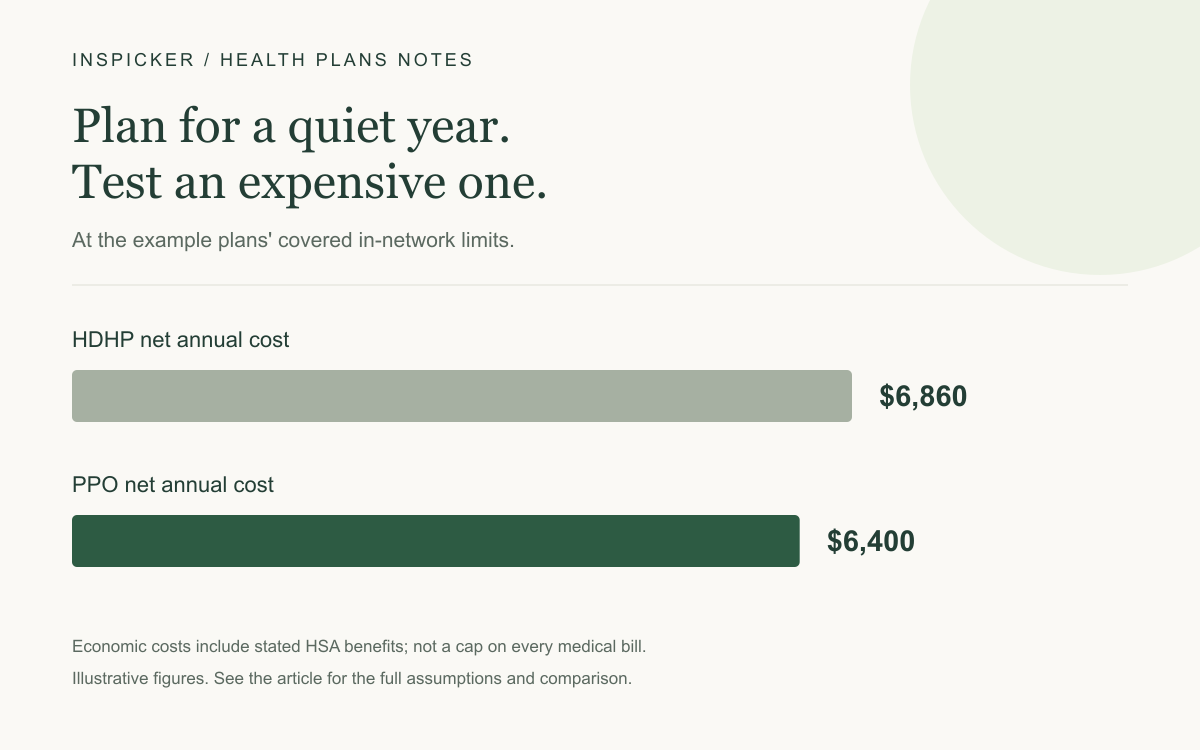
Compare a health plan in more than one kind of year: quiet, expected, and expensive. A plan that looks cheaper at ordinary medical spending may cost more when you reach its covered in-network out-of-pocket maximum.
The high-cost comparison should include annual employee premiums and the relevant medical limit, then account for employer funding and realistic tax benefits. Keep that economic result separate from the cash you may need before those benefits become available.
In our hypothetical employee-only plans, the HDHP costs $860 in a $500 medical-spending year, versus $2,900 for the lower-deductible PPO. At their covered in-network limits, the HDHP costs $6,860 after the assumed HSA benefits, versus $6,400 for the PPO.
Compare your health plans across several spending scenarios.
What does a worst-case health-plan estimate actually mean?
For this article, “worst case” means reaching the specified covered in-network medical out-of-pocket limit during one plan year. It is not a ceiling on every possible expense.
A first-pass gross budget is:
Annual employee premiums + covered in-network out-of-pocket maximum.
For an eligible HSA option, employer funding and the tax benefit of your own eligible contribution can reduce the economic cost. These benefits do not change the insurance contract's maximum or ensure all the money is available when a bill arrives.
Premiums and medical cost sharing are distinct. The HealthCare.gov total-cost explanation describes why both belong in an annual comparison.
Also remember that HDHP describes a deductible and benefit design, while PPO describes a provider-network arrangement. An HDHP can use a PPO network. Here, “HDHP vs. PPO” means an HSA-eligible high-deductible option compared with a lower-deductible PPO option.
Worked example: the cheaper plan changes with care use
These are fictional plans, not market averages. We assume full-year employee-only enrollment, matching covered services and allowed prices, full HSA eligibility, and a single deductible and medical maximum per plan.
| Feature | HSA-eligible HDHP | Lower-deductible PPO |
|---|---|---|
| Monthly employee premium | $150 | $200 |
| Annual premiums | $1,800 | $2,400 |
| Deductible | $3,000 | $1,000 |
| Employee coinsurance after deductible | 20% | 20% |
| Covered in-network maximum | $6,500 | $4,000 |
| Employer HSA funding | $1,000 | $0 |
| Personal HSA contribution | $2,000 | $0 |
| Assumed personal contribution tax benefit | $440 | $0 |
The $440 uses an assumed 22% federal marginal rate. We exclude state and payroll taxes, investment returns, premium tax treatment, and any PPO FSA benefit. These simplifications should not be treated as a personal tax estimate.
| Annual allowed charges | HDHP medical out-of-pocket amount | PPO medical out-of-pocket amount | HDHP net annual cost | PPO annual cost |
|---|---|---|---|---|
| $500 | $500 | $500 | $860 | $2,900 |
| $4,000 | $3,200 | $1,600 | $3,560 | $4,000 |
| $25,000 | $6,500 | $4,000 | $6,860 | $6,400 |
The HDHP has a $600 premium advantage, $1,000 in employer funding, and $440 of assumed personal contribution tax benefit. Those offsets outweigh its higher cost sharing in the first two scenarios. They do not outweigh the full $2,500 difference between the medical maximums.
Calculate the high-cost rows without double-counting the deductible
For the HDHP:
$1,800 premiums + $6,500 medical maximum − $1,000 employer funding − $440 tax benefit = $6,860.
For the PPO:
$2,400 premiums + $4,000 medical maximum = $6,400.
Do not add the deductible again after using the maximum that already contains qualifying deductible spending.
If you cannot make the $2,000 personal contribution, remove its $440 tax benefit. The HDHP's high-cost economic figure becomes $7,300, assuming the $1,000 employer funding still arrives. That is $900 more than the example PPO.
For the separate question of employer funding changing an ordinary-year result, read how employer HSA contributions change the comparison.
Use allowed medical charges, not your estimated bill
The calculator's spending input is the amount of covered care before insurance pays its share, using the insurer's allowed prices. Entering only what you expect to pay personally applies cost sharing twice and can make a high-deductible plan look artificially attractive.
An explanation of benefits can help separate allowed amounts from billed charges and patient responsibility. Use service-specific estimates where available.
A quiet year is not necessarily a year with zero allowed claims. However, services covered without deductible cost sharing should not be forced into the model as though you pay the entire allowed amount. Preventive care, prescription rules, and copays need separate attention.
The simple model treats medical spending through one deductible and coinsurance rate. It will not reproduce every real claim.
Annual economic cost is not the same as early-year cash needed
Before the HSA benefits, the example HDHP's premiums plus capped medical spending total $8,300. The PPO's equivalent figure is $6,400.
Employer HSA funding may arrive in installments. A tax benefit may be realized through lower withholding or later tax reporting rather than a deposit available for today's bill. Your personal HSA contribution is also your money; moving it into an HSA does not create an additional employer subsidy.
Ask what cash would actually be available if a large bill arrived early. Review your existing HSA balance, employer deposit schedule, accessible savings, and realistic payment timing.
Our emergency fund calculator can help assess a broader cash cushion. It should not be used to declare a medical expense affordable without considering the other essential bills that money must cover.
Five details can make the simplified maximum incomplete
- Out-of-network or noncovered care. Such charges may fall outside the in-network cap. Verify covered providers and services.
- Separate benefit rules. Prescription tiers, different deductibles, copays, and prior authorization can change the expected-year result.
- Family design. Individual embedded limits and aggregate family limits can produce different outcomes depending on which member receives care.
- Plan-year timing. Care spanning two plan years may involve two deductibles or maximums rather than one.
- Other benefits. Include relevant employer-funded accounts or FSA benefits on the comparison side where they actually apply.
The HealthCare.gov maximum definition describes important exclusions. Your plan's documents control the specific coverage.
HSA eligibility is also separate from the cost model. Other insurance, certain FSAs, Medicare enrollment, and partial-year eligibility can affect contributions. Confirm applicable rules in IRS Publication 969 and with your benefits administrator.
Run the comparison as a set of scenarios
Enter actual employee premiums, deductibles, employee coinsurance, and medical maximums from your plan summaries. Keep your own HSA contribution separate from the employer deposit.
Try a low-use estimate, an expected estimate based on likely services, and a sufficiently high spending level to reach the modeled caps. Then rerun with less personal HSA funding if your budget may limit contributions.
Do not interpret a single crossover value as a universal threshold. Different benefits and caps can create a changing advantage across the spending range.
Compare low- and high-cost years.
Common questions
Does the higher deductible automatically mean the worse high-cost plan?
No. Premium differences, the maximum, employer funding, and other applicable benefits can outweigh the deductible difference. Compare the full annual figures.
Is the out-of-pocket maximum the most I can spend on health care?
It covers specified qualifying expenses under the plan. Premiums and some other charges are outside that limit. Check exclusions and network rules.
Can I subtract my whole HSA contribution?
Not as a discount. Your personal contribution remains your asset until used; the modeled reduction is its applicable tax benefit. Employer funding is a separate benefit.
Which scenario should determine my choice?
Consider the expected cost, high-cost exposure, access to care, and the cash needed to manage bills. The cheapest expected scenario does not settle all of those questions.
Editorial note: Plans and figures are hypothetical. This single-year comparison uses simplified cost sharing and stated tax assumptions, not a quote or individualized insurance recommendation.
For education and planning. Check assumptions and product terms before making a financial decision.
Put the numbers to work ↗