Savings / Emergency fund
How Long Does an Emergency Fund Take at $500 a Month?
Calculate an emergency-fund timeline from current savings. Compare monthly deposits, coverage milestones, and the effect of a withdrawal on replenishment.
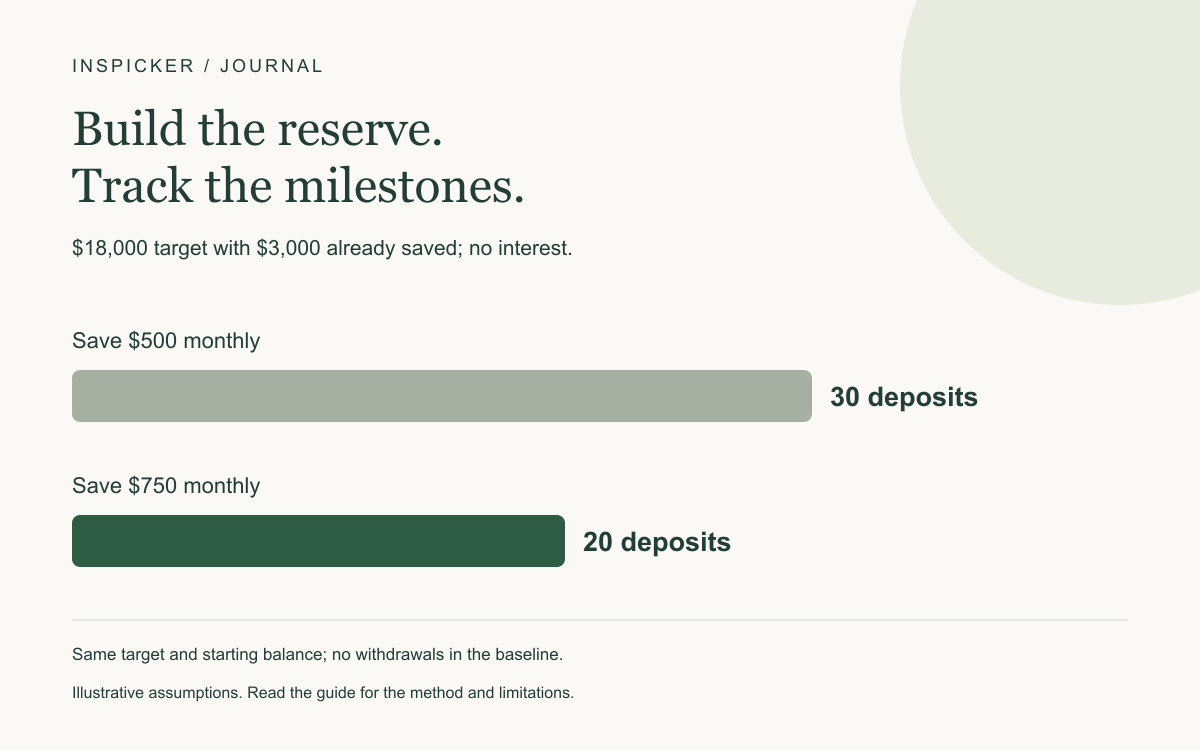
At $500 a month, building an $18,000 emergency fund from $3,000 takes 30 deposits, ignoring interest and withdrawals. The remaining gap is $15,000; dividing it by the monthly contribution gives the timeline.
That is a saving schedule, not a claim that every household needs $18,000 or can afford $500 monthly. Start with essential expenses and a reserve target suited to your circumstances, then choose a contribution that fits actual cash flow.
Use the emergency fund calculator to separate your target, current coverage, and time to completion. These are three different measures, and progress on one should not be confused with another.
Start with essential expenses, not a round account balance
This example assumes essential spending of $3,000 monthly and a selected target of six months. Multiplying them gives $18,000. A different essential budget or reserve choice would give a different target.
The CFPB’s emergency-fund guide explains the role of a dedicated cash reserve and notes that the appropriate amount depends on your situation. It also discusses practical saving methods and keeping the money accessible.
Identify what would need funding during an income interruption: essential housing, food, utilities, insurance, transport, care, and required debt payments. Review costs that could change during the emergency rather than simply copying a normal month of discretionary spending.
Our expense checklist helps define that input. The three-versus-six-month comparison addresses target selection; this guide focuses on the time needed to reach the target after choosing it.
With $3,000 already available exclusively for emergencies:
Remaining gap = $18,000 − $3,000 = $15,000.
The existing balance covers one month of the selected essential expenses. It is not six months of coverage merely because it is your full current savings balance.
Compare realistic monthly contributions
Ignoring interest, divide the gap by the contribution and round up to a whole deposit when needed.
| Monthly contribution | Deposits needed for the $15,000 gap | Approximate duration |
|---|---|---|
| $250 | 60 | 5 years |
| $500 | 30 | 2 years, 6 months |
| $750 | 20 | 1 year, 8 months |
| $1,000 | 15 | 1 year, 3 months |
The starting balance and target are identical across the rows. A faster date comes from contributing more, not from redefining what counts as emergency money.
If a contribution does not divide evenly into the gap, the final deposit can be smaller. For example, $700 monthly requires 22 deposits: 21 deposits supply $14,700, followed by $300 to close the remaining gap.
These timelines count deposits. If your first transfer occurs a month from now, the finish date differs from a plan with an immediate transfer. For an exact deadline, map the actual payment dates rather than assuming every schedule starts today.
Coverage improves before the fund is complete
A long finish date can make a plan feel unproductive. Track intermediate coverage as well as the final target.
With $3,000 starting savings and $500 deposited at each month-end:
| After deposits | Balance before any withdrawals or interest | Months of $3,000 expenses covered |
|---|---|---|
| Start | $3,000 | 1 |
| 6 | $6,000 | 2 |
| 12 | $9,000 | 3 |
| 18 | $12,000 | 4 |
| 24 | $15,000 | 5 |
| 30 | $18,000 | 6 |
At twelve deposits, the household has not completed its six-month target, but it has tripled its initial coverage. Neither “fully funded” nor “no progress” would describe it accurately.
Coverage is measured against the selected expense estimate. If essentials rise to $3,300, a $9,000 reserve covers about 2.73 months rather than three. Update both the target and the coverage calculation when the underlying budget changes.
A withdrawal changes the remaining schedule
Suppose the fund reaches $9,000 after twelve $500 deposits. Then an eligible household emergency requires a $2,000 withdrawal, leaving $7,000.
The gap is now $18,000 − $7,000 = $11,000. Continuing at $500 requires 22 more deposits, rather than the 18 that would have remained without the withdrawal.
That is four additional deposits under these assumptions. It does not mean the fund failed. The reserve supplied money for the event it was intended to cover; the next planning task is replenishment.
Avoid crediting the same money to a separate purchase goal. If the $9,000 also includes $4,000 committed to tuition or a car deposit, it is not all available for emergencies. Separate account labels or clear earmarks can prevent that double-counting.
Variable income needs a schedule you can maintain
A constant monthly contribution is a simplifying assumption. A household with irregular income might use a dependable base deposit plus occasional additions.
For example, $300 monthly contributes $3,600 annually. Two additional $1,200 deposits would add $2,400, bringing the year’s total to $6,000—the same annual amount as $500 every month. The path during the year differs, however: an emergency before the extra deposits arrives would encounter a smaller balance.
Do not count uncertain bonuses as though they are already available. Track the balance actually held and revise the next deposits when income arrives.
If the available monthly surplus is zero, a zero-interest model cannot produce a completion date. That is useful information about the current plan, not a reason to enter an unrealistic contribution. The budget planner can help identify whether the constraint is essential spending, other commitments, income, or timing.
Interest helps, but access still matters
The examples use zero yield so the saving commitment is easy to see. An interest-bearing account can reduce the needed contributions or shorten the timeline, but rates can change and taxes or fees can affect the retained amount.
Do not replace an emergency reserve’s liquidity requirement with an assumed smooth investment return. Money needed unexpectedly must be available when the event occurs, and market investments can lose value at that time.
The calculator allows a selected yield, but it does not model changing rates, taxes, fees, or emergency withdrawals. Re-enter the current balance after a withdrawal rather than assuming the old schedule remains accurate.
Reproduce the baseline before testing alternatives
Enter $3,000 essential monthly spending, $3,000 current savings, $500 monthly contributions, six target months, and 0% yield. The target should be $18,000, current coverage one month, and the gap $15,000.
Change only the contribution to $750 to reproduce the 20-deposit schedule. Then restore $500 and change current savings to $7,000 to reproduce the 22-deposit replenishment schedule.
Keeping one input change at a time makes the result easier to understand. If the target also changes, describe that as a new reserve goal rather than saying the same goal became faster to fund.
Common questions about emergency-fund timelines
How long does $500 a month take to build $18,000?
From zero, 36 deposits without interest. From the $3,000 starting balance in this example, 30 deposits. Starting savings matter.
Is six months always the right target?
No. This article uses six months to illustrate the timeline. Choose the reserve target after considering household expenses, income reliability, and other resources.
Does using the fund mean I am behind?
It means the remaining balance and replenishment schedule changed. In the worked example, a $2,000 withdrawal adds four $500 deposits, assuming nothing else changes.
Can I count money for a planned purchase as emergency savings?
Only if you are genuinely willing and able to redirect it. Do not allocate the same balance in full to two simultaneous commitments.
Method: hypothetical fixed essential spending, equal month-end deposits, no interest, and no withdrawals except in the explicitly labeled replenishment scenario. Actual expenses, rates, and saving patterns change timelines.
For education and planning. Check assumptions and product terms before making a financial decision.
Put the numbers to work ↗