Health plans / Coinsurance
Deductible and Coinsurance: Work Through a $5,000 Medical Bill
Calculate deductible, coinsurance, and an out-of-pocket cap with checked examples. Understand allowed costs, premiums, and the health-plan calculator's limits.
A 20% coinsurance rate does not necessarily mean you pay 20% of the entire medical bill. In a simple deductible-and-coinsurance plan, you first pay costs subject to the deductible, then your percentage of the remaining covered allowed amount, up to the applicable out-of-pocket limit.
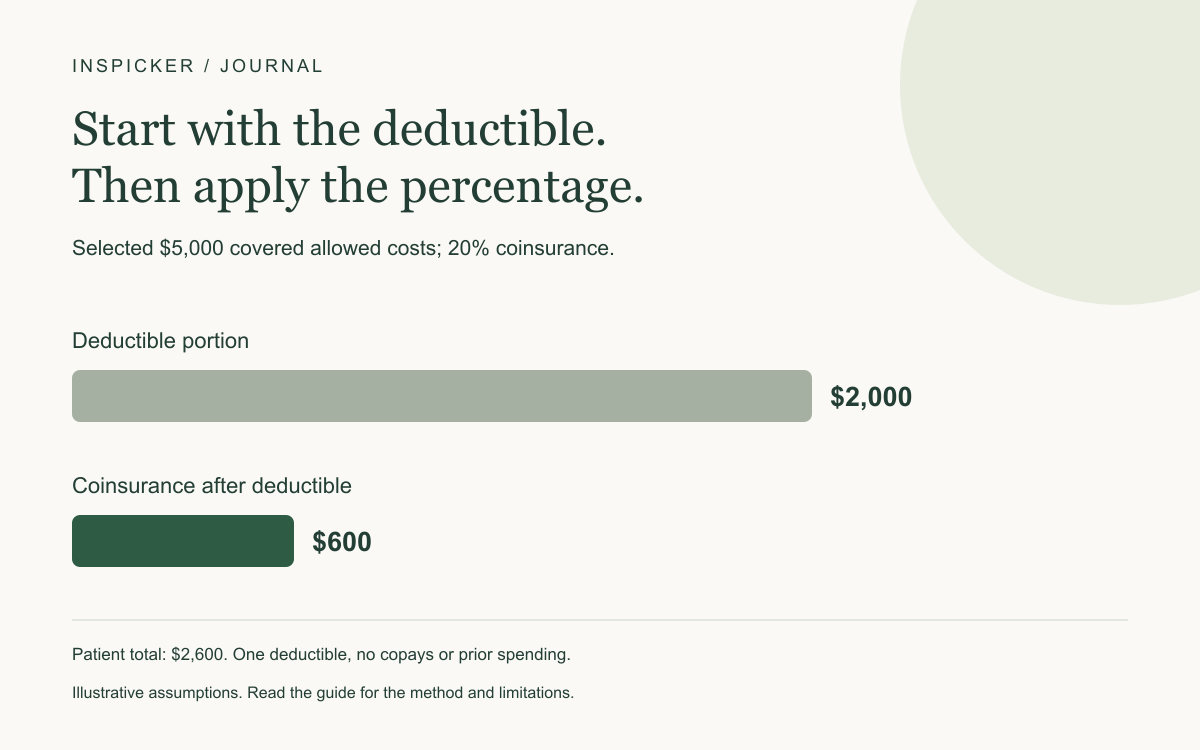
For a hypothetical $5,000 of covered allowed charges, a $2,000 deductible, and 20% coinsurance, the modeled patient share is $2,600: $2,000 plus 20% of the remaining $3,000. It is neither $1,000 nor $3,000.
Use the health-plan comparison calculator to compare annual scenarios. Its expected-spending input represents covered allowed costs in a simplified plan model, not an itemized provider invoice or a guaranteed estimate of benefits.
Begin with covered allowed costs, not automatically the sticker price
A provider’s billed charge and the amount recognized under the plan can differ. The HealthCare.gov coinsurance glossary bases its examples on the allowed amount and explains how the deductible affects the patient share.
For this article, every dollar of the selected spending is assumed to be covered, in-network, and subject to the same deductible and coinsurance. No preventive-care exemption, copayment, separate prescription schedule, or noncovered item is included.
Those assumptions simplify the calculation. Real benefits may apply different rules to different services, and the explanation of benefits should identify how a particular claim was processed.
Do not enter only the patient balance on an invoice as expected total medical spending. If the model is intended to calculate the patient share from total allowed costs, starting with an amount already reduced by insurance can understate the input.
The first $2,000 is not charged twice
Assume the plan year begins with no deductible spending accumulated. The selected deductible is $2,000.
For $1,000 of costs subject to that deductible, the simplified model assigns the full $1,000 to the patient. The spending has not yet reached the deductible.
For $5,000 of such costs, the first $2,000 satisfies the selected deductible. That leaves $3,000 to which the stated post-deductible coinsurance applies.
If some deductible has already been met, the claim-level calculation changes. This guide’s annual examples start at zero; do not apply a full fresh deductible to every separate bill.
The HealthCare.gov deductible definition is a useful starting point, but the plan’s actual benefits determine which services follow this sequence.
Apply 20% to the amount after the deductible
For the $5,000 annual allowed-cost scenario:
Patient share = $2,000 + [($5,000 − $2,000) × 20%] = $2,600.
The post-deductible patient amount is $600. The plan pays the remaining $2,400 of the selected allowed charges in this simplified example.
| Piece of the $5,000 allowed amount | Patient | Plan |
|---|---|---|
| First $2,000 subject to deductible | $2,000 | $0 |
| Remaining $3,000 at 20% patient coinsurance | $600 | $2,400 |
| Total | $2,600 | $2,400 |
Calculating 20% of the whole $5,000 gives $1,000 and ignores the deductible. Adding $2,000 to that $1,000 gives $3,000 and applies coinsurance to the deductible dollars again. Neither follows the sequence assumed here.
When comparing plans, keep the spending assumption consistent. A higher deductible can interact with a different premium, coinsurance rate, network, or employer contribution; the deductible alone does not establish which option costs less overall.
The selected out-of-pocket limit caps eligible cost sharing
Now add a hypothetical $6,000 out-of-pocket limit. At $25,000 of allowed costs, the uncapped formula would give:
$2,000 + [($25,000 − $2,000) × 20%] = $6,600.
The model caps eligible patient cost sharing at $6,000 instead.
| Annual covered allowed costs | Uncapped deductible-plus-coinsurance calculation | Modeled patient cost sharing |
|---|---|---|
| $1,000 | $1,000 | $1,000 |
| $5,000 | $2,600 | $2,600 |
| $25,000 | $6,600 | $6,000 |
Under this one-rate model, the cap is reached at $22,000 of allowed costs: the first $2,000 plus $20,000 after the deductible, whose 20% patient share is $4,000.
The selected deductible is already part of the $6,000 patient limit. Do not add another $2,000 on top and call the result an $8,000 cap.
The HealthCare.gov out-of-pocket-limit glossary explains important exclusions, including premiums and costs outside applicable covered in-network benefits. This guide’s cap is therefore not a promise that every possible health expense stops at $6,000.
Premiums belong beside the patient share, not inside this cap
Suppose the household’s premium is $250 monthly, or $3,000 annually. Add that separately to the modeled patient cost sharing:
| Allowed-cost scenario | Annual premiums | Patient cost sharing | Combined modeled annual cost |
|---|---|---|---|
| $1,000 | $3,000 | $1,000 | $4,000 |
| $5,000 | $3,000 | $2,600 | $5,600 |
| $25,000 | $3,000 | $6,000 | $9,000 |
These gross annual totals exclude HSA tax effects, employer funding, and noncovered expenses. They are selected planning scenarios, not real plan quotes.
For how employer money changes a comparison, see the employer-HSA contribution example. For a broader downside scenario, see the quiet-year and high-cost-year comparison.
Do not use a one-rate annual model as a claim adjudicator
To reproduce these calculations, enter the selected deductible, 20% coinsurance, $6,000 limit, $250 premium, and each annual expected-spend amount in the health-plan comparison. Set HSA contributions, assumed tax savings, and employer funding to zero for the gross totals shown here.
The tool does not model every copayment, separate drug deductible, service exemption, network rule, or family deductible arrangement. It also does not track an actual person’s year-to-date claims.
Family plans may have individual and family accumulators whose interactions cannot be captured by treating several people’s bills as one simple individual deductible. If those details matter, compare the plan documents and benefit examples rather than forcing them into one number.
Annual totals also hide timing. A $2,600 cost-sharing estimate can arrive unevenly, and a large early claim may require more cash before an employer HSA deposit is available. Review liquidity alongside the annual comparison.
Common questions about deductible and coinsurance math
Does 20% coinsurance apply to my entire bill?
Not necessarily. In the stated example, it applies to covered allowed costs after the deductible. Different services or plan terms may follow different rules.
Do I add the deductible on top of the out-of-pocket maximum?
Not for the eligible cost-sharing cap illustrated here. The deductible dollars count within the selected maximum rather than being a second amount above it.
Why can annual cost exceed the out-of-pocket limit?
Premiums are separate, and some expenses are excluded from that limit. The example’s $9,000 total includes $3,000 premiums plus $6,000 eligible cost sharing.
Will the calculator reproduce my explanation of benefits?
It is an annual planning model. Actual claims require the plan’s allowed amounts, service rules, accumulators, and processing details.
Method: hypothetical individual plan, all costs covered in-network under one deductible and coinsurance schedule, zero initial accumulators, and no HSA offsets. Actual plan terms and claims can differ.
For education and planning. Check assumptions and product terms before making a financial decision.
Put the numbers to work ↗