Health plans / HSA
HDHP vs. PPO: How Employer HSA Contributions Change the Math
Compare HDHP and PPO costs with employer HSA contributions. See a worked example, tax assumptions, and a checklist for choosing between your plans.
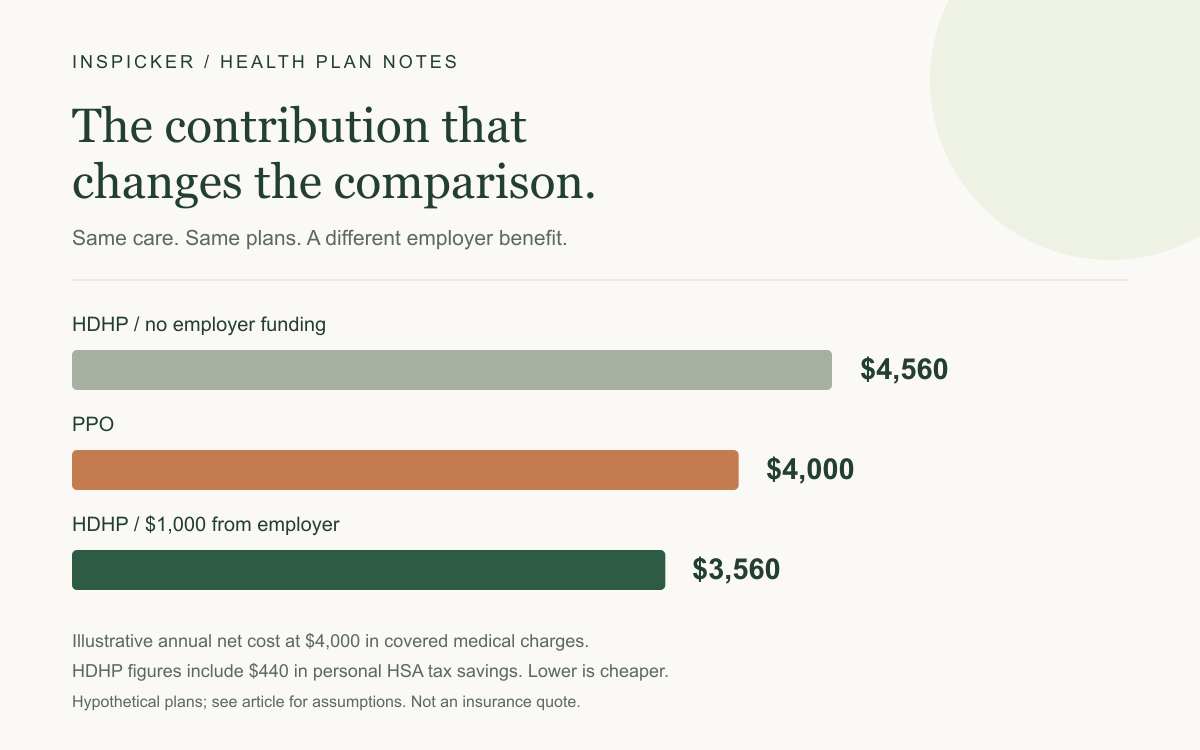
An employer HSA contribution can make a high-deductible health plan cheaper overall, even when its deductible looks less attractive. Compare annual premiums and your share of covered care, then account for employer funding and the tax benefit of your own eligible HSA contributions. The deductible alone cannot tell you which plan costs less.
In the hypothetical example below, a $1,000 employer contribution changes the HDHP from $560 more expensive to $440 less expensive than the PPO at the same level of medical spending. In a high-spending year, however, the PPO still comes out ahead. Your actual plan terms and ability to pay early bills matter as much as the annual result.
Open the HDHP vs. PPO calculator to follow along with your own benefits documents.
First, HDHP and PPO describe different things
An HDHP describes a plan's deductible and cost-sharing design. A PPO describes a provider-network arrangement. An HDHP can also use a PPO network. In everyday benefits conversations, “HDHP vs. PPO” usually means comparing an HSA-eligible high-deductible option with a lower-deductible PPO option offered by the same employer.
That is the comparison in this article. It does not mean all PPOs have lower deductibles or that all high-deductible plans qualify for HSA contributions. Confirm HSA eligibility with your benefits administrator. For the network distinction, see HealthCare.gov's PPO definition.
Start with each plan's Summary of Benefits and Coverage, your employee premium schedule, and the employer's HSA funding policy. Compare the same enrollment tier: employee-only against employee-only, or family against family.
Build the annual comparison from four parts
A useful first-pass calculation is:
Net annual economic cost = employee premiums + covered out-of-pocket costs − employer HSA funding − estimated tax savings on your own HSA contribution.
This is an economic comparison, not a prediction of every dollar leaving your checking account. An HSA deposit remains your asset until you spend it. Your own deposit is not itself a discount; only its estimated tax benefit reduces the cost in this model. An employer deposit is counted as a benefit even if part of it remains in the account at year-end.
For premiums, use what you pay, not the total premium including your employer's insurance subsidy. Convert payroll amounts carefully: $100 per paycheck means $2,600 a year with 26 paychecks, but $2,400 with 24.
For care, estimate the insurer's allowed charges and apply the plan's deductible, copays, coinsurance, and covered in-network out-of-pocket limit. Do not add the deductible on top of an out-of-pocket estimate that already includes it. HealthCare.gov explains why premiums and care costs belong in the same comparison.
For employer funding, use the amount you expect to receive under the actual policy. Keep that separate from any amount you contribute through payroll.
Worked example: a $1,000 contribution changes the winner
These are invented employee-only plans for illustration, not market averages, quotes, or recommendations. Both cover the same modeled in-network services at the same allowed prices. We assume full-year enrollment, full HSA eligibility, no other HSA contributions, and no separate prescription or copay rules.
| Input | HSA-eligible HDHP | Lower-deductible PPO |
|---|---|---|
| Employee monthly premium | $150 | $200 |
| Annual employee premiums | $1,800 | $2,400 |
| Deductible | $3,000 | $1,000 |
| Employee coinsurance after deductible | 20% | 20% |
| In-network out-of-pocket maximum | $6,500 | $4,000 |
| Employer HSA contribution | $1,000 | $0 |
| Your own HSA contribution | $2,000 | $0 |
| Assumed tax savings on your contribution | $440 | $0 |
The $440 is $2,000 × an assumed 22% federal marginal income-tax rate. We exclude payroll-tax savings, state taxes, investment returns, and any PPO FSA benefit. We also compare the quoted employee premiums without adjusting for their potential pretax treatment. Those choices simplify the example; they are not a personalized tax calculation.
At $4,000 of allowed medical charges, the cost sharing is:
- HDHP: $3,000 deductible + 20% of the remaining $1,000 = $3,200.
- PPO: $1,000 deductible + 20% of the remaining $3,000 = $1,600.
Now compare the annual results:
| Calculation | Net annual cost |
|---|---|
| HDHP without employer funding: $1,800 + $3,200 − $440 | $4,560 |
| PPO: $2,400 + $1,600 | $4,000 |
| HDHP with employer funding: $4,560 − $1,000 | $3,560 |
Ignoring the employer deposit would reverse the decision in this example. Without it, the PPO is $560 cheaper. With it, the HDHP is $440 cheaper.
Holding every other input fixed, employer funding of $560 produces a tie at this spending level. More funding favors the HDHP; less favors the PPO. That threshold changes when premiums, medical spending, your own contributions, or plan benefits change.
If you cannot make the assumed $2,000 personal HSA contribution, remove the $440 tax benefit. With the $1,000 employer deposit still available, both plans cost $4,000 in this particular scenario. Do not include savings from contributions you cannot afford to make.
Check a quiet year and an expensive year too
Repeating the same calculation at different spending levels gives a more useful picture than choosing one forecast and treating it as certain.
| Annual allowed charges | HDHP net cost, including employer funding | PPO net cost | Lower modeled cost |
|---|---|---|---|
| $500 | $860 | $2,900 | HDHP by $2,040 |
| $4,000 | $3,560 | $4,000 | HDHP by $440 |
| $25,000 | $6,860 | $6,400 | PPO by $460 |
At $25,000 of allowed charges, both example plans have reached their out-of-pocket maximums. The HDHP calculation becomes $1,800 + $6,500 − $1,000 − $440 = $6,860. The PPO calculation is $2,400 + $4,000 = $6,400.
These figures use the same $2,000 personal HSA contribution in every scenario, including the quiet year. Unspent HSA money is retained; the calculation does not assume you spend the whole contribution.
The high-cost row is only a ceiling for this simplified covered, in-network model. Premiums, noncovered services, and some out-of-network charges are outside the medical out-of-pocket cap. Check the exclusions in HealthCare.gov's out-of-pocket maximum definition.
How to enter your employer's offer in the calculator
Use the InsPicker health-plan comparison tool and replace the preset values with your benefits documents.
- Enter your monthly premium for each plan. Convert paycheck deductions to a monthly equivalent.
- Enter each deductible, your coinsurance percentage, and the in-network out-of-pocket maximum.
- Enter expected medical spending as allowed charges before insurance pays, not your estimated personal bill. Prior explanations of benefits can help.
- In the HSA contribution field, enter only your own planned contribution. Enter the employer deposit separately.
- Use a tax-rate assumption appropriate to your contribution method and situation. Try zero if you want to compare before your personal HSA tax benefit.
- Run low, expected, and high spending scenarios. Then rerun with a smaller personal contribution if cash flow is tight.
To reproduce the main example, enter $4,000 spending, a 22% tax rate, $2,000 personal HSA funding, and $1,000 employer funding, alongside the plan inputs in the table.
The calculator uses one deductible, one coinsurance rate, and one maximum per plan. It does not reproduce every copay, prescription tier, family embedded deductible, or service covered before the deductible. For example, do not treat fully covered preventive care as ordinary deductible spending. Use the result as a starting comparison, then check the actual services you expect.
Five checks before you enroll
1. When does the employer deposit arrive?
Ask whether funding arrives in January, in payroll installments, after a waiting period, or after completing an incentive requirement. A $1,000 annual benefit paid gradually does not make $1,000 available for an early bill. Count only funding you expect to receive, including any proration if you join or leave midyear.
2. Are you eligible to contribute to an HSA?
HSA eligibility depends on more than the plan label. Other coverage, including certain health FSAs, and Medicare enrollment can affect eligibility. Employer and employee contributions share the applicable annual limit; eligibility changes can affect that limit. Confirm the correct tax-year rules before contributing. IRS Publication 969 is the starting reference.
3. Can you handle the early-year cash requirement?
A plan may have the lower annual economic cost and still be difficult to use if a large bill arrives before your HSA is funded. Compare available cash, actual HSA balances, and a realistic payment schedule. Our emergency fund calculator can help you assess your broader cash cushion.
4. Are your providers and prescriptions covered?
Check the network for the specific plan, not just the insurer's name. Confirm your medications, pharmacy restrictions, specialist access, and planned facilities. A modest modeled saving may be outweighed by an uncovered service or a provider you cannot access.
5. Have you included comparable benefits on both sides?
If the PPO offers an employer-funded account or an FSA you would actually use, include its relevant benefit in your wider comparison. Likewise, do not add both a full employer deposit and a second “tax saving” on that same deposit. The example subtracts employer funding once.
Common questions
Should I subtract my entire personal HSA contribution?
No. Moving your money into an HSA does not make that amount an employer benefit. In this comparison, subtract the estimated tax saving on your eligible contribution, not the contribution itself. Track deposits separately when planning cash flow.
Is the employer contribution the same as a lower deductible?
No. It provides money in a separate account; it does not rewrite the insurance deductible. Funding timing and eligibility still matter. Your plan documents determine how claims are processed.
What happens to HSA money I do not spend?
It can carry forward, and the account remains yours when you change employers. Withdrawal tax treatment depends on how funds are used. See IRS Publication 969. If you are considering investing unused funds, the HSA growth calculator explores a separate, longer-term question.
Does employer HSA funding always make the HDHP better?
No. The expensive-year example shows the PPO winning despite a $1,000 employer contribution. Plan pricing, cost sharing, access to care, eligibility, and available cash can all change the decision.
What should I compare first?
Gather the two benefit summaries, employee premium deductions, employer funding terms, and your recent allowed claims. Then compare both plans using the same assumptions. A useful result tells you both the likely annual tradeoff and whether you could manage a more expensive year.
Editorial note: This article provides an educational comparison, not a recommendation for a specific insurance plan. Examples are hypothetical and use InsPicker's stated calculator method. Check your plan documents and applicable tax rules before enrolling.
For education and planning. Check assumptions and product terms before making a financial decision.
Put the numbers to work ↗