Debt / Debt payoff
Debt Snowball vs. Avalanche: Compare the Same Three Debts
Compare snowball and avalanche repayment with identical debts and budgets. See interest costs, payoff order, and how rolling payments keeps progress moving.
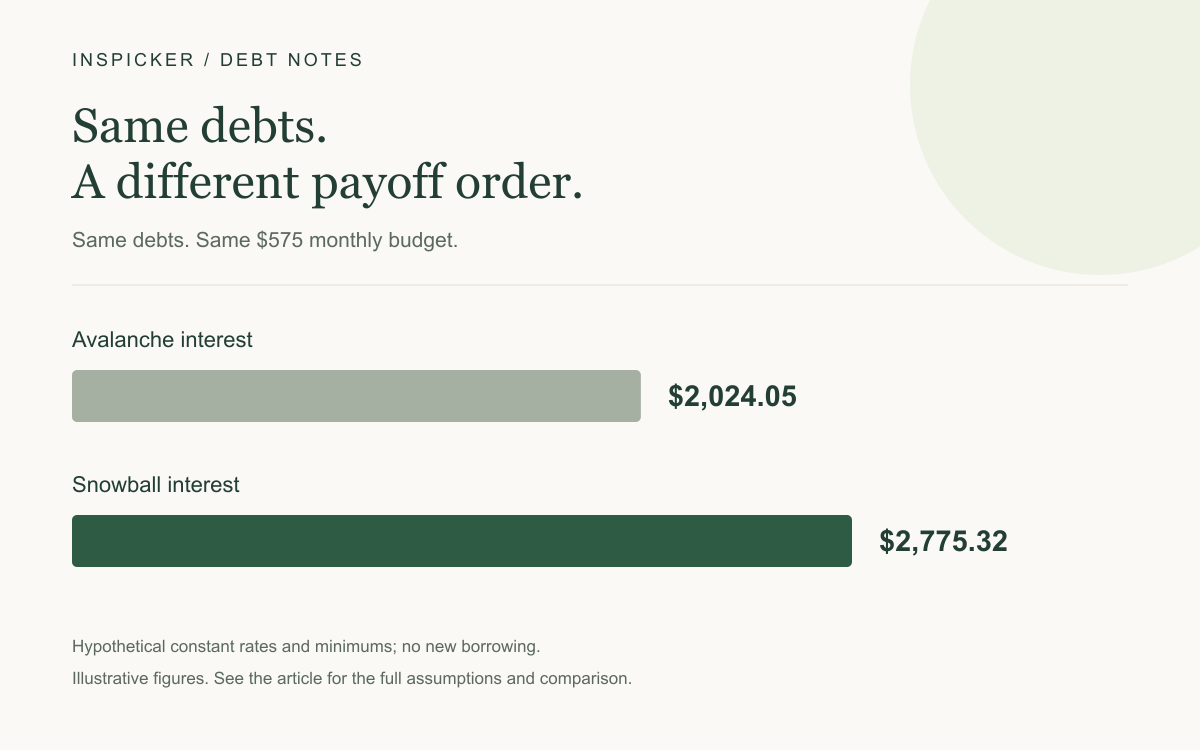
The debt avalanche sends extra money to the highest-rate debt; the debt snowball sends it to the smallest balance. Both require paying the other minimums and keeping the overall repayment budget moving toward debt.
With the same three hypothetical debts and a $575 monthly budget, our avalanche example clears all balances in 26 months and incurs $2,024.05 interest. The snowball clears them in 27 months with $2,775.32 interest, but eliminates the first account sooner.
This is a comparison of payment order under controlled assumptions. It does not say that every household's snowball costs that amount or every real debt can be treated as an ordinary interest balance.
Compare both methods with your debts.
Compare the same debts, rates, and budget
The CFPB's debt reduction guidance describes the highest-interest-rate and snowball approaches. To understand their tradeoff, hold the debt list and available cash constant.
Our fictional household has:
| Debt | Starting balance | Annual rate | Fixed monthly minimum used in the model |
|---|---|---|---|
| Card A | $6,000 | 24% | $180 |
| Card B | $1,500 | 12% | $45 |
| Auto loan | $5,000 | 7% | $150 |
| Total | $12,500 | — | $375 |
The household commits an additional $200 monthly, creating a total debt budget of $575.
We assume constant rates, fixed minimums, monthly interest before payments, no new borrowing, and no fees or penalties. Real credit-card minimums may decline; this model holds the starting minimums in the budget.
The final month's payment is reduced when less than $575 remains owed. Extra money can move to the next open debt within the same modeled month.
Where does the first extra $200 go?
Under avalanche, Card A is first because it has the highest rate. Under snowball, Card B is first because it has the smallest balance.
| First-month payment | Avalanche | Snowball |
|---|---|---|
| Card A | $380 | $180 |
| Card B | $45 | $245 |
| Auto loan | $150 | $150 |
| Total | $575 | $575 |
Card A's first monthly interest charge is $120. With avalanche, its $380 payment reduces principal by $260. With snowball, its $180 payment reduces principal by $60.
Card B's first interest charge is $15. Its snowball payment reduces principal by $230, while its avalanche minimum reduces principal by $30.
Both plans make progress. They concentrate that progress differently: one reduces more expensive debt, while the other closes the small balance faster.
Worked result: lower interest versus an earlier first payoff
| Measure | Avalanche | Snowball |
|---|---|---|
| Total monthly budget | $575 | $575 |
| First debt cleared | Card A, month 20 | Card B, month 7 |
| Second debt cleared | Card B, month 22 | Auto loan, month 18 |
| Final debt cleared | Auto loan, month 26 | Card A, month 27 |
| Total modeled interest | $2,024.05 | $2,775.32 |
| Total repayment | $14,524.05 | $15,275.32 |
Avalanche saves approximately $751.27 in this example and finishes one month earlier. Snowball gives the household its first fully cleared account in month seven rather than month twenty.
That first-payoff difference can matter to a person's experience of the plan. It does not change the modeled cost. Choose with both the financial result and your likelihood of following the commitment in view.
For ordinary debts with constant rates, no unusual constraints, and the same total payment budget, sending extra money toward the higher interest rate generally reduces the interest burden. Real obligations can introduce priorities beyond that simplified comparison.
If you want an introductory description of each method, see the debt strategy guide. Here, the focus is the controlled three-debt schedule and what you must maintain to reproduce it.
Keep the total budget after an account is cleared
The model keeps $575 available every month while debt remains. It does not reduce the budget when one minimum disappears.
For example, after Card B is cleared under the snowball, its $45 payment stays available for the remaining debts. The household does not simply resume paying $530 and call that the same schedule.
This rollover is part of both methods. Avalanche also redirects money when a targeted balance reaches zero. As interest costs fall and accounts close, more of the ongoing budget reaches principal on the remaining debt.
If your plan instead releases money for another goal, that may be a deliberate choice, but the payoff date should be recalculated. Do not expect the original schedule to survive a smaller debt budget unchanged.
Do not confuse changing the method with changing the payment
Comparing avalanche at $575 with snowball at $675 would mix two decisions. The larger budget could dominate the method difference.
Start with an equal-budget comparison, then separately test what a sustainable extra $50 or $100 changes. Our minimum-versus-fixed card payment article explains why keeping a payment steady can make a large difference.
Check the constraints the simple comparison leaves out
Past-due or secured obligations. Keeping necessary accounts current and addressing consequences such as loss of an essential asset can take priority over an abstract rate ranking.
Promotional rates. A debt currently at 0% may soon change rates. The basic comparison assumes each stated rate remains constant. Run a separate scenario for an expiry and check whether any promotion involves deferred interest.
Prepayment terms. Confirm whether extra payments reduce principal and whether an agreement imposes applicable penalties or other restrictions.
Minimum-payment changes. An issuer's minimum can differ from the fixed amount you entered. Meet actual requirements and update the budget when they change.
New borrowing. The schedule assumes no additional balances. If ongoing expenses keep creating debt, changing repayment order alone will not resolve the budget shortfall.
The budget planner can help establish the affordable payment. Retain realistic access to cash for essential expenses; see our emergency savings comparison.
How to compare your own payoff order
List each balance with its own rate and actual required minimum. Keep names distinct so you can track which account closes first. Enter an extra payment that is additional to those minimums.
Run both strategies and compare the interest, debt-free date, and payoff order. Then check whether the fixed-budget assumption matches your intention after an account is closed.
To reproduce the worked example, enter the three table rows and $200 extra. The starting minimums sum to $375; adding the extra produces $575.
The calculator does not model future rate changes, tax differences, penalties, new balances, or every lender's allocation rules. If a budget does not clear the debts within the model's limit, treat that as a reason to revisit the plan rather than as a completed payoff.
Compare snowball and avalanche.
Common questions
Does avalanche always close the first account sooner?
No. In this example it closes the first account later while saving interest overall. Cost and first-account timing are different measures.
Should I stop paying other debts while targeting one?
Both methods assume all required minimums are paid. The target determines where the extra money goes, not which obligations you may ignore.
Can I switch methods?
You can revise a repayment plan, but rerun the schedule with current balances and rates. The old forecast no longer describes the full path if the payment order changes.
What if the smallest balance also has the highest rate?
The initial target can be the same. The methods may diverge later if the remaining balances and rate rankings differ.
Why do the listed minimums stay constant in the example?
That allows a clear, fixed-budget comparison. Your issuer's actual requirement may change; keep your intended total commitment separate from the minimums currently due.
Editorial note: Debts and figures are hypothetical. Monthly simulation uses constant rates and payments with no new borrowing; actual agreements and circumstances govern repayment obligations.
For education and planning. Check assumptions and product terms before making a financial decision.
Put the numbers to work ↗