Savings / Budgeting
How to Apply a 50/30/20 Budget to Take-Home Pay
Build a 50/30/20 budget using take-home pay. Compare a worked allocation, classify debt payments, and adjust when essential costs exceed the benchmark.
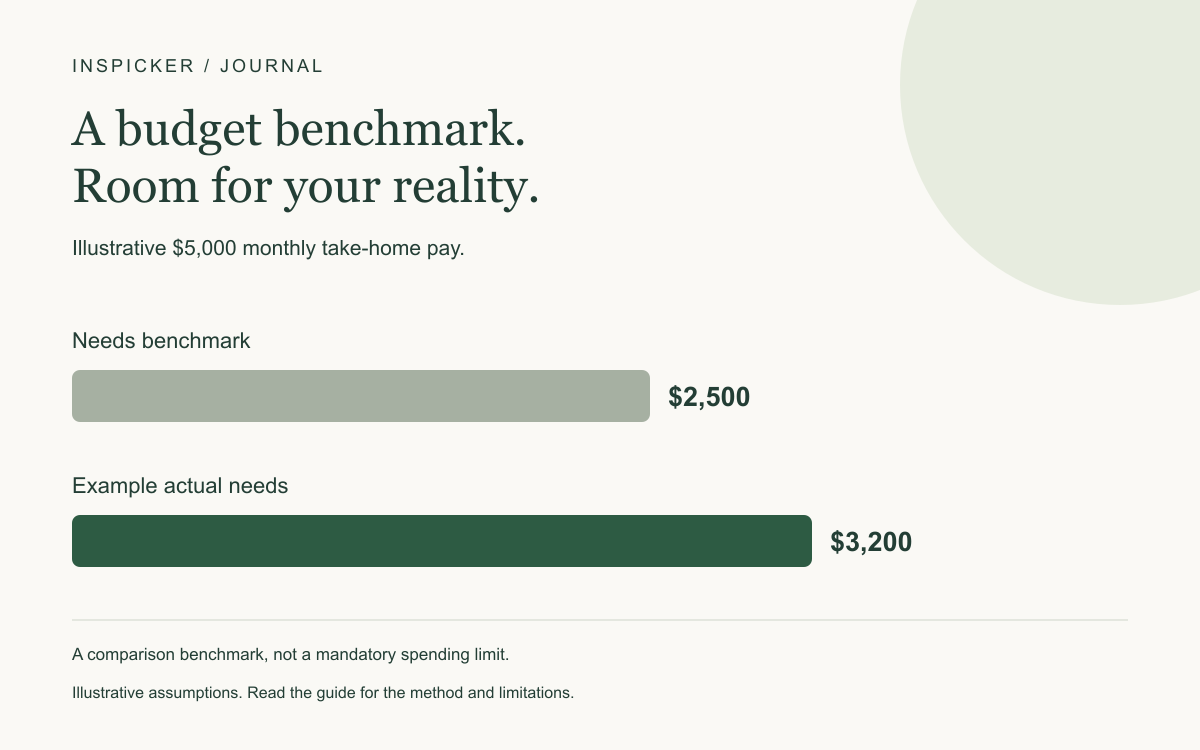
Apply a 50/30/20 budget to take-home pay, then compare the benchmark with the bills you actually have. The framework allocates 50% to needs, 30% to wants, and 20% to savings and debt reduction, but it is a starting comparison rather than a mandatory spending limit.
For $5,000 of monthly take-home pay, those amounts are $2,500, $1,500, and $1,000. A balanced real budget may use different percentages because housing, care, debt obligations, and income vary.
The most useful outcome is a complete allocation you can maintain, with a clear view of what must change if expenses exceed income.
Build your monthly budget using the money available after payroll deductions.
Use the amount available, not gross salary
Take-home pay generally means what reaches you after taxes and payroll deductions. A gross annual salary is not the same pool of spendable monthly money.
If you are paid twice a month, two normal net paychecks form a monthly baseline. If you are paid every two weeks, an annualized average and the amount actually arriving in an ordinary month can differ.
For cash-flow planning, keep the payment dates visible. A monthly average is not a guarantee that every bill can be paid before the next paycheck.
The Consumer.gov budgeting guide explains comparing income and expenses, including situations where pay is not received every month.
Avoid counting payroll deductions twice
Suppose $5,000 reaches your checking account after a $400 retirement contribution has already been withheld. That $400 is not still part of the checking-account budget.
You may track it separately when measuring total saving. Do not subtract it again from the $5,000 as though the same cash remains available and needs to be transferred.
Health premiums and other deductions need the same consistent treatment. Write down whether each figure is before or after a deduction.
Use clear rules for needs, wants, and saving
The CFPB's spending-rule worksheet presents the familiar take-home-pay framework. Different budgeting approaches classify debt payments differently.
For consistency with InsPicker's planner, this article puts required minimum debt payments with needs, and extra debt repayment with saving. That is an explicit classification convention, not a claim that every version of 50/30/20 uses it.
| Category | Examples to review | Important distinction |
|---|---|---|
| Needs | Essential housing, food, utilities, necessary transport, required debt payments | Essential does not mean the current price cannot ever change |
| Wants | Optional dining, entertainment, upgrades, nonessential subscriptions | Classify what is optional for your household |
| Saving and extra debt | Goal deposits, emergency saving, additional principal repayment | Separate these from amounts already deducted from payroll |
Avoid assigning the same installment to both needs and saving. Also separate planned annual bills from entirely new savings: putting money aside for next year's required insurance bill can be a way to fund an essential expense.
For a detailed review of unavoidable costs, use the emergency-fund expense checklist.
Worked example: a balanced budget outside the benchmark
With $5,000 monthly take-home income:
| Allocation | 50/30/20 comparison | Household's actual plan |
|---|---|---|
| Needs | $2,500 | $3,200 |
| Wants | $1,500 | $900 |
| Saving and extra debt | $1,000 | $900 |
| Total allocated | $5,000 | $5,000 |
| Unassigned balance | $0 | $0 |
Actual needs are 64%, wants 18%, and saving 18% of take-home income.
The household is not running a deficit merely because needs exceed 50%. It has offset the $700 difference by allocating $600 less to wants and $100 less to saving than the benchmark.
That does not prove the budget is ideal. The household still needs to decide whether $900 of saving serves its goals and whether the essential-cost level is sustainable. But the arithmetic is balanced.
This distinction prevents two common errors: calling every percentage difference a cash shortfall, and assuming a budget is healthy simply because the total matches income.
What should change when needs exceed 50%?
First verify the classification and the numbers. Check for double-counted debt payments, payroll deductions, or annual expenses.
Then identify realistic choices. Some discretionary spending can change quickly. Housing, essential care, or required installments may take longer to alter or may be difficult to reduce at all.
If the budget still does not cover obligations, reducing saving on paper is not necessarily a complete solution. Consider the underlying income, essential commitments, and available options. A framework cannot create cash that is not there.
Do not assume everyone can solve a large fixed-cost problem by eliminating a small subscription. Compare the dollar amounts and timing.
For variable income, set an amount you can reasonably support from normal receipts. Plan separately how you will allocate additional income when it actually arrives.
Include bills that do not arrive monthly
A $1,200 annual bill can require $100 of monthly earmarking. Assign that amount to the relevant category rather than allowing the bill to become a surprise.
Seasonal utility changes, planned medical costs, repairs, gifts, and travel can also affect the budget. Some are essential, others discretionary; their irregular timing does not make them nonexistent.
Do not confuse a sinking fund for a known bill with an emergency reserve for unexpected needs. If both use one account, keep the earmarks clear.
Our savings goal calculator can convert a specific deadline into a monthly contribution. Make sure the contribution then fits inside the budget rather than adding a second unaccounted commitment.
Review the budget against actual spending
Compare the planned allocation with what happened. A balanced plan with missing categories can still produce repeated overdrafts or fresh card debt.
If you consistently spend $1,100 on wants while budgeting $900, identify the difference and decide how to change the plan or behavior. Do not count the same $200 as saving simply because the original spreadsheet allocated it there.
The minimum-versus-fixed card payment article explains why an ongoing payment commitment needs a reliable budget.
How to reproduce the example
Enter $5,000 income, $3,200 needs, $900 wants, and $900 saving. The planner shows no money remaining and compares those amounts with the $2,500 / $1,500 / $1,000 benchmark.
A positive remaining amount is unassigned money, not an extra category already funded. A negative amount means the allocations exceed the entered income.
The planner does not connect to bank accounts, calculate taxes, or verify that every expense has been included. It is a monthly allocation comparison. You remain responsible for category definitions and bill timing.
Compare your actual budget with 50/30/20.
Common questions
Is 50/30/20 a rule I must follow?
It is a planning framework. Use it to ask questions about your allocations, then adapt to obligations, income, and goals.
Does 20% saving include required debt payments?
Different methods classify them differently. InsPicker puts required minimums in needs and extra debt repayment in saving. Keep one convention throughout the comparison.
Should I use gross income?
This article uses take-home pay so the allocations relate to available cash. Using gross salary without accounting for deductions can overstate what you can spend.
Is a balanced budget enough?
It is a necessary arithmetic check, but it does not establish that the categories are complete, the timing works, or the saving goals are sufficient.
Editorial note: All dollar figures are hypothetical. The planner's category convention is stated explicitly; percentages are a benchmark rather than individualized financial instructions.
For education and planning. Check assumptions and product terms before making a financial decision.
Put the numbers to work ↗