Loan comparisons / Debt
36 vs. 60-Month Personal Loan: Monthly Payment and Total Cost
Compare a $15,000 personal loan over 36 and 60 months at 12%. See checked payments, total interest, budget trade-offs, fees, and calculator assumptions.
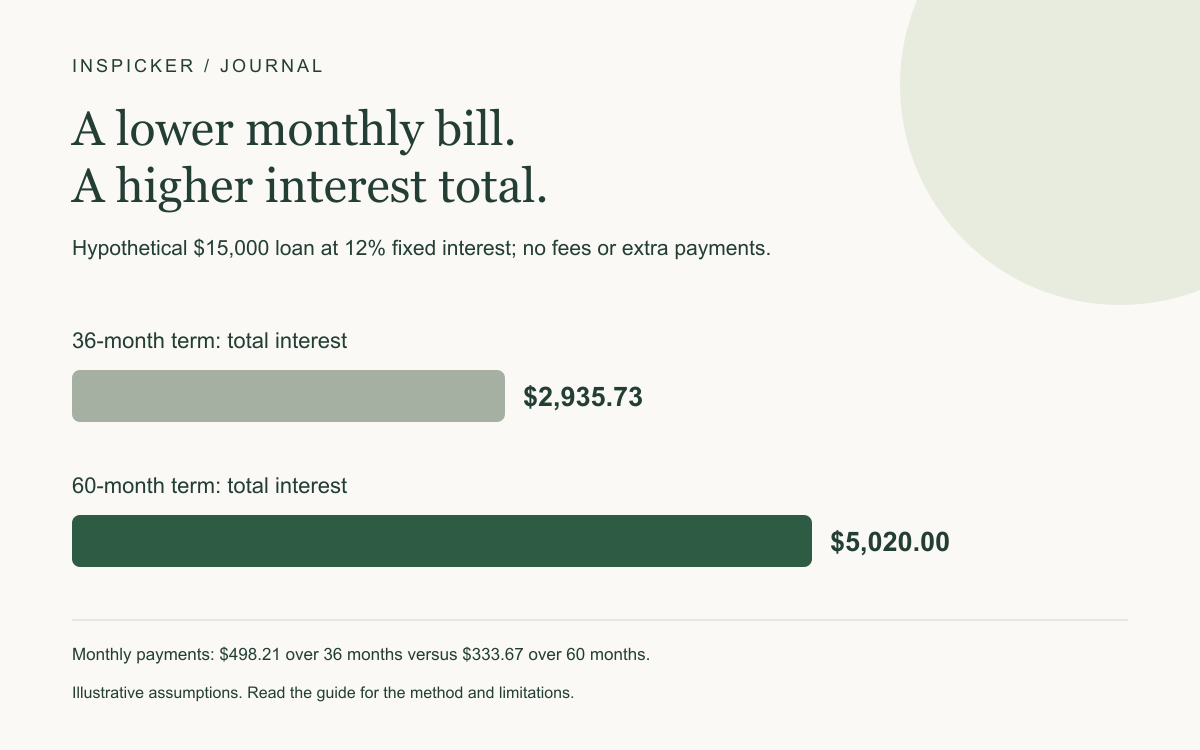
For a hypothetical $15,000 personal loan at a fixed 12% contract interest rate with no fees, a 36-month term costs about $498.21 per month; a 60-month term costs about $333.67. The longer term lowers the modeled monthly commitment by $164.55 but adds $2,084.28 in total interest if both loans are repaid on their original schedules.
The decision therefore has two separate questions: which payment fits your cash flow, and how much borrowing cost are you accepting over the full term?
Use the loan comparison calculator to compare the same borrowing amount across different terms. The figures below are original hypothetical examples, not current lender offers or an approval estimate.
Hold the loan amount and rate constant first
To isolate the effect of repayment length, this example changes only the number of payments:
| Selected input | Shorter loan | Longer loan |
|---|---|---|
| Principal borrowed | $15,000 | $15,000 |
| Fixed contract interest rate | 12% | 12% |
| Term | 36 months | 60 months |
| Separately paid upfront fee | $0 | $0 |
| Extra payments | None | None |
Both loans advance the same amount, use monthly amortization, and are paid on schedule. There is no insurance premium, late fee, payment holiday, or balloon payment in the example.
The CFPB’s personal installment loan overview describes borrowing a lump sum and repaying it through installments over a specified period. Actual offers can have different rates and terms, so confirm whether the rate is fixed before using a fixed-rate comparison.
If a lender quotes a different rate for each term, enter each actual contract rate in its own offer. Do not assume a five-year loan will have the same rate as a three-year loan. The same-rate illustration helps explain the mechanism; it is not a pricing forecast.
36 versus 60 months: payment, interest, and total paid
Using the selected inputs gives:
| Modeled result | 36 months | 60 months |
|---|---|---|
| Monthly payment | $498.21 | $333.67 |
| Total interest | $2,935.73 | $5,020.00 |
| Interest plus upfront fee | $2,935.73 | $5,020.00 |
| Total paid, including principal | $17,935.73 | $20,020.00 |
| Scheduled repayment period | 3 years | 5 years |
The five-year term reduces the monthly payment by approximately $164.55 while increasing full-term interest by $2,084.28. Differences are calculated from unrounded model results and then rounded to cents. Subtracting the displayed rounded figures can therefore differ by one cent.
Total paid includes the original $15,000 being returned. Interest is the amount above that principal in this no-fee scenario. Keeping these figures separate prevents mistaking the whole repayment total for the cost of borrowing.
Lenders usually collect payments rounded to cents, and the final payment may be adjusted. This calculator retains full precision internally, so multiplying a displayed monthly payment by the term may not exactly reproduce its displayed total.
Why does the lower payment cost more overall?
At a selected nominal annual rate of 12%, the simplified monthly rate is 1%. Both schedules start with the same principal, so their first modeled month includes $150 of interest.
With the three-year schedule, the first unrounded payment allocates about $348.21 to principal after interest. With the five-year schedule, it allocates about $183.67. The longer schedule initially reduces the debt more slowly and leaves a balance accruing interest for more months.
The monthly amortization formula is:
Payment = principal × monthly rate ÷ [1 − (1 + monthly rate) raised to the negative number of payments].
The model then calculates total interest as the unrounded payment multiplied by the payment count, minus original principal. At 0% interest, the formula becomes principal divided by payments, and both schedules have zero interest if there are no fees.
The extra two years do not mean the interest simply rises in direct proportion to the term. Each payment changes the outstanding balance, so use an amortization calculation rather than multiplying an annual percentage by the original principal for every year.
Check payment affordability before choosing a term
Lower full-term interest is useful only alongside a payment you can keep making. Use your actual take-home income, essential expenses, other required payments, and realistic saving commitments in the budget planner.
Suppose a hypothetical household has $450 per month available for this new loan after its other selected commitments. The three-year payment of $498.21 exceeds that allowance by about $48.21. The five-year payment of $333.67 leaves about $116.33 of it unused.
That comparison does not establish lender eligibility or prove the loan is affordable. The $450 allowance is a chosen household budget figure, not an underwriting threshold, and irregular expenses may still change the position.
Possible responses include reducing the amount borrowed, reconsidering the purchase, finding another offer, or selecting a longer term while accepting its additional cost. Avoid treating a smaller payment as permission to increase the loan amount without rebuilding the entire comparison.
For existing card debt being replaced by a loan, also check the debt-consolidation fee guide. A consolidation decision requires comparing the debts being replaced and the new terms, rather than comparing two new loan payments alone.
Fees and early repayment can change the result
The CFPB’s installment-loan fee guidance explains that charges can add to borrowing costs and recommends reviewing lender disclosures. Read the actual fee and repayment terms before relying on a quote.
In InsPicker’s comparison, the upfront fee is paid separately in cash. For example, a $300 cash fee on the 36-month loan leaves its modeled payment unchanged but raises interest-plus-fee cost to $3,235.73 and total cash paid to $18,235.73.
If the fee is financed, the note principal changes. If it is withheld, the proceeds available for your purpose change. Neither arrangement is represented by simply adding a cash fee while leaving all other inputs untouched. Our interest rate versus APR guide explains why the contract rate and fee-inclusive APR should not be entered interchangeably.
Paying a five-year loan off early may reduce interest relative to its original schedule, depending on how the loan calculates interest and applies payments. Check any prepayment charge and the lender’s instructions. This term comparison assumes no extra payments; it does not calculate an accelerated payoff or guarantee that paying extra on one offer reproduces another offer’s cost.
Reproduce the comparison in the calculator
- Set amount borrowed to $15,000.
- For Offer A, enter 12% interest, 36 months, and $0 upfront fee.
- For Offer B, enter 12% interest, 60 months, and $0 upfront fee.
- Compare monthly payment, interest, interest plus fee, and total paid.
- Replace the hypothetical inputs with the actual terms of offers financing the same borrowing need.
The calculator assumes fixed rates, monthly amortization, full scheduled repayment, and a separately paid cash fee. It excludes taxes, optional products, late payments, irregular payment dates, financed or withheld fees, and early repayment. Its result is a comparison under the inputs you choose, not a recommendation or loan quote.
Common questions
Is a 36-month personal loan better than a 60-month loan?
At the same principal and positive fixed rate with no fees, the shorter schedule has a higher payment and lower total interest. Whether it suits you also depends on your budget and the actual offer terms. Compare both the monthly obligation and the full cost.
How much does a $15,000 loan cost over five years?
At the selected 12% contract rate and no fees, this monthly model produces a payment of about $333.67, total interest of $5,020.00, and total repayment of $20,020.00. A different rate, fee arrangement, or schedule changes those results.
Does the smaller monthly payment mean I save $164.55 every month?
It reduces the scheduled monthly obligation by that modeled amount while both loans are active. It does not reduce the loan’s full-term cost in this example. The longer loan also continues for 24 months after the shorter schedule ends.
Can I compare APR instead of the contract interest rate?
This calculator expects the contract interest rate and a separately entered upfront cash fee. Fee-inclusive APR may already reflect charges. Using it as the rate and adding those charges again can overstate modeled cost. Read the lender’s disclosures and use the appropriate inputs.
Method: original hypothetical examples checked against InsPicker’s loan-comparison calculation. Sources reviewed October 16, 2026. No current market-rate, lender-availability, or approval claims are made.
For education and planning. Check assumptions and product terms before making a financial decision.
Put the numbers to work ↗