Debt / Debt consolidation
Is a Debt Consolidation Loan Worth It After Origination Fees?
Compare consolidation loan fees, monthly payments, and total repayment with checked examples. Learn how financed and withheld fees change the decision.
A consolidation loan is worthwhile on cost only when its interest and fees are lower than the remaining cost of your current repayment plan. A lower advertised rate or a smaller monthly payment does not answer that question by itself.
An origination fee can reduce the saving, increase the amount you owe, or leave you with too little cash to settle the old balances. Its treatment matters: a fee paid separately, added to principal, or withheld from proceeds creates a different cash flow.
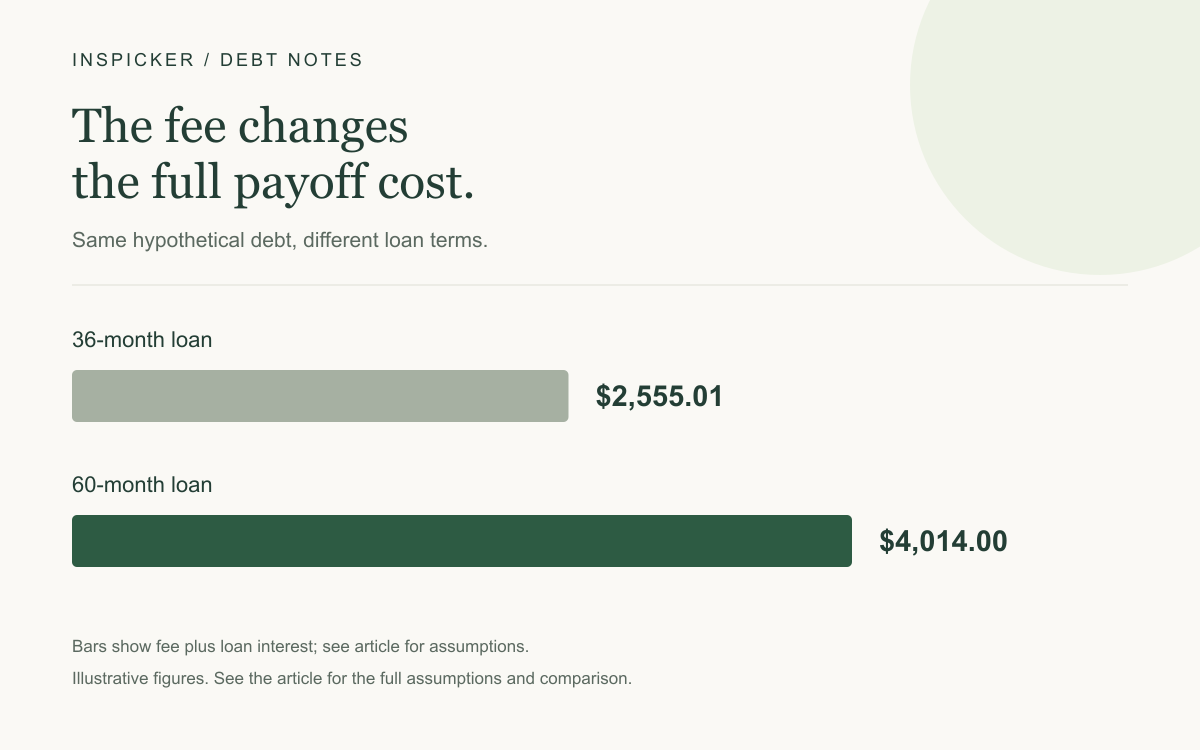
Our hypothetical example compares $10,000 of existing debt with a $400 monthly payment. A three-year consolidation offer at 12% with a financed 5% fee saves $1,446.12. Extending the same offer to five years lowers the payment further but costs $12.88 more than continuing the old plan.
Compare your consolidation offer before judging it by the payment alone.
First, identify what the fee is based on
A fee quoted as a percentage of the loan amount requires you to identify that amount. A 5% fee on $10,000 is $500, but a fee on a larger face amount produces a larger dollar charge.
Ask the lender for four numbers: the contractual loan principal, the fee in dollars, the cash paid to you or your creditors, and the total scheduled repayment. Those numbers should reconcile with the disclosure.
For the worked example, we assume $10,000 of old balances is refinanced and the lender adds a $500 fee to principal. The new amount financed is $10,500. This is the fee convention used by our consolidation tool; actual offers may use another convention.
Worked example: the term can reverse the result
Assume the existing $10,000 debt carries a constant 24% annual rate and you pay $400 each month. Our model applies monthly interest before the payment and reduces the final payment to what remains owed. It assumes no new borrowing, penalties, annual charges, or changes in rates.
The existing plan clears in 36 modeled months and incurs $4,001.13 in interest. The total repayment is $14,001.13.
Now compare two hypothetical fixed-rate offers. Both use a 12% annual contractual interest rate and a $500 fee added to principal. The rate is an interest input, not a statement that the disclosed APR is 12% after fees.
| Measure | Existing plan | 36-month consolidation | 60-month consolidation |
|---|---|---|---|
| Starting amount owed | $10,000 | $10,500 | $10,500 |
| Monthly payment | $400 | $348.75 | $233.57 |
| Modeled payoff term | 36 months | 36 months | 60 months |
| Interest after today | $4,001.13 | $2,055.01 | $3,514.00 |
| Origination fee | None | $500 | $500 |
| Interest plus fee | $4,001.13 | $2,555.01 | $4,014.00 |
| Total repayment | $14,001.13 | $12,555.01 | $14,014.00 |
The three-year loan provides about $51.25 of monthly payment relief and saves $1,446.12 overall. The five-year loan provides about $166.43 of monthly relief, but stretches the repayment and costs slightly more.
Dollar differences are calculated from unrounded model outputs. Small displayed rounding differences do not indicate extra fees.
The CFPB's consolidation guidance cautions that a lower payment may reflect a longer term and higher overall costs. This example puts that tradeoff into a reproducible comparison.
Compare the offer with and without the fee
At the same 12% rate over 36 months, financing $10,000 with no origination fee would require about $332.14 a month and cost $1,957.15 in interest.
Adding the $500 fee raises the modeled payment to $348.75 and increases financing costs to $2,555.01. The fee therefore raises total cost by $597.86, including interest charged on the extra principal.
The fee is not always the entire cost difference between a fee-bearing and fee-free offer. If the amount borrowed grows, interest on that additional borrowing matters too.
What if the lender deducts the fee from the proceeds?
Suppose a lender offers a $10,000 face amount and withholds 5% before disbursement. You receive $9,500, while your creditors still need $10,000. You have a $500 funding gap unless you supply the difference.
If the same fee is calculated on the face amount and you need exactly $10,000 of net proceeds, the calculation is:
Required face amount = needed proceeds ÷ (1 − withheld fee rate).
$10,000 ÷ 0.95 is approximately $10,526.32, with a fee of approximately $526.32. The lender's rounding and contractual fee calculation control the actual amounts.
This is not the same structure as adding 5% of $10,000 to principal. The basic consolidation tool does not automatically convert a withheld-fee offer. Use the actual loan principal and net proceeds when reviewing such a quote, and check the disclosure.
Avoid double-counting fees when using APR
APR is a broader borrowing-cost measure than the contractual interest rate. A fee included in APR should not then be added to an APR-based amortization as though it were an entirely separate, excluded cost.
Our example calculates loan payments from the contractual interest rate and financed principal, then identifies the fee when comparing total cost. Entering a disclosed APR that already incorporates the fee into that same calculation can distort the result.
For quote comparisons, review the lender's disclosed APR, amount financed, finance charge, payment schedule, and total of payments. Ask which rate produces the scheduled payment. Our loan comparison calculator provides another way to compare ordinary fixed-rate quotes with explicitly stated fees.
A cheaper offer still needs a workable payment plan
Check three practical conditions before treating the new offer as useful:
- The proceeds settle the intended balances. Confirm creditor payoff amounts, transfer timing, and any residual interest.
- The payment fits normal cash flow. Compare it with required bills and other debt payments. A lower rate does not help if the payment is repeatedly missed.
- The old balances do not grow again. Identify what created the shortfall and how the budget changes after consolidation.
A single-payment loan can simplify administration, but it does not erase debt. Keep a record of which accounts were paid and verify the final balances. Do not stop required payments on the old accounts merely because a new loan has been approved.
The budget planner can help you test the monthly commitment. If you can afford to maintain the original payment, ask whether the new agreement permits extra principal payments without a penalty; the quoted-term comparison does not model every accelerated schedule.
For several debts with different rates, a blended-rate approximation may miss the true payoff path. The debt payoff calculator compares individual balances directly.
How to enter the example
Use $10,000 current debt, 24% current rate, $400 current payment, 12% new interest rate, a 36-month term, and a 5% financed fee. Then change only the new term to 60 months.
Compare total saving and payment relief separately. The calculator uses constant rates and monthly accrual; it does not model withheld proceeds, variable teaser rates, penalties, new spending, or individualized tax treatment.
Check your fee-adjusted consolidation costs.
Common questions
Is a 5% origination fee automatically too high?
No. Compare its dollar cost and treatment with the remaining interest you would otherwise pay. The three-year example saves money despite the fee; the five-year example does not.
Should I choose the smallest payment?
Only after understanding the term and full cost. A smaller payment can improve cash flow while increasing total repayment. Those are different benefits and should be assessed separately.
Is the fee added to the debt or paid in cash?
It depends on the agreement. Identify the principal, fee, proceeds, and repayment schedule before using a simplified calculator.
What if I consolidate only some debts?
Compare that portion with its own current repayment path, then include the payments and costs of debts left behind. Do not present partial consolidation as eliminating every balance.
Editorial note: All offers and figures are hypothetical. Examples use monthly accrual and stated fee conventions; your lender's disclosures determine actual costs.
For education and planning. Check assumptions and product terms before making a financial decision.
Put the numbers to work ↗