Mortgage / Extra principal
What Happens When You Pay $100 Extra on Mortgage Principal?
See how $100 of extra monthly mortgage principal changes payoff time and interest. Includes checked assumptions, payment instructions, and liquidity checks.
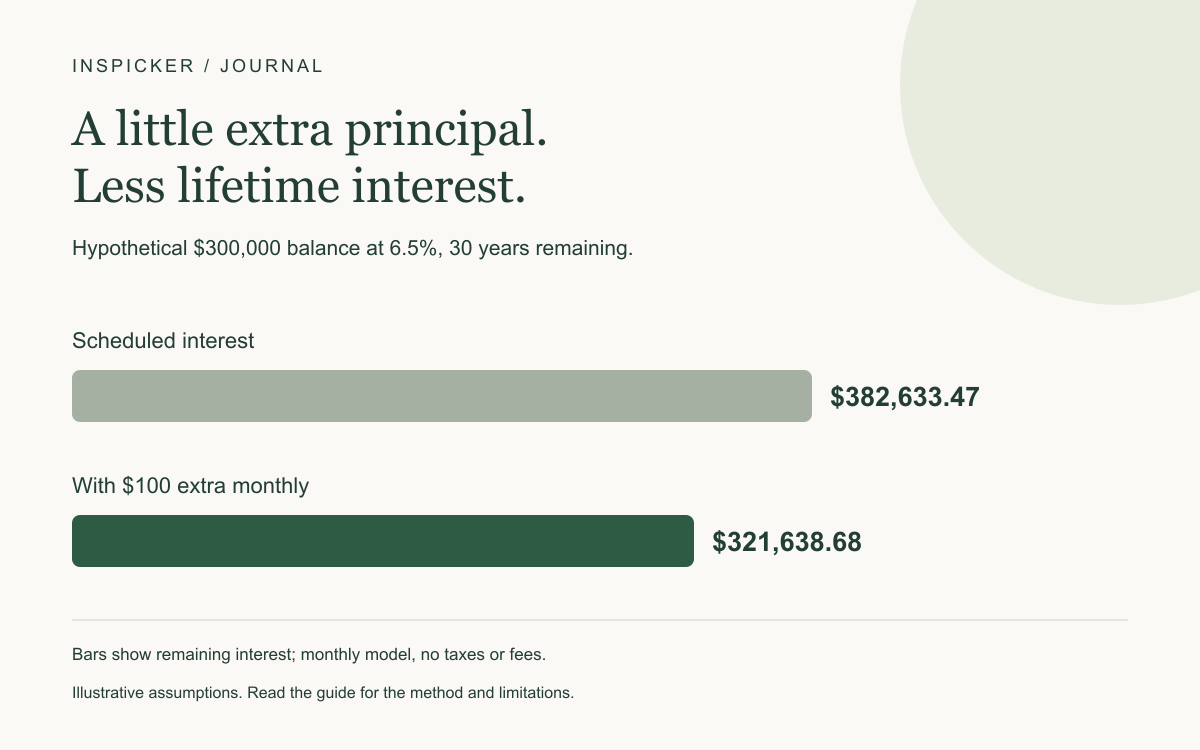
Paying $100 extra toward mortgage principal can shorten repayment and reduce interest, provided the servicer applies it correctly and you keep making the required payments. The size of the benefit depends on the balance, rate, remaining term, and when the extra payments begin.
For our hypothetical $300,000 balance at 6.5% with 30 years remaining, adding $100 every month reduces the modeled payoff from 360 to 312 months. That is four years earlier, with approximately $60,994.79 less remaining interest.
This does not mean every mortgage saves that amount, and it does not automatically reduce the required monthly installment.
Compare your extra principal payments.
What does the first extra $100 change?
The example uses a fixed annual rate, monthly interest accrual, and a fully amortizing principal-and-interest payment. It excludes escrow, mortgage insurance, transaction charges, tax effects, and prepayment penalties.
The scheduled monthly principal-and-interest amount is approximately $1,896.20. In the first modeled month:
| Item | Scheduled payment | With $100 extra |
|---|---|---|
| Interest on $300,000 | $1,625 | $1,625 |
| Amount paid | $1,896.20 | $1,996.20 |
| Principal removed | About $271.20 | About $371.20 |
The extra $100 reduces the balance beyond the normal principal reduction. In the following month, that $100 alone avoids about $0.54 of interest under the monthly model.
The early change looks small. Its effect accumulates as the lower balance incurs less interest and more of later payments reaches principal.
The CFPB's mortgage-servicing guidance explains the importance of checking whether extra payments are permitted and applied to principal.
Worked example: four years earlier, not $100 off the bill
Hold the original balance, rate, and remaining term constant. The homeowner begins the extra payments immediately and continues them every month until payoff.
| Measure | Scheduled payments | Scheduled payment plus $100 |
|---|---|---|
| Starting balance | $300,000 | $300,000 |
| Annual fixed rate | 6.5% | 6.5% |
| Initial monthly principal and interest | $1,896.20 | $1,996.20 |
| Modeled payoff | 360 months | 312 months |
| Remaining interest | $382,633.47 | $321,638.68 |
| Time saved | — | 48 months |
| Interest saved | — | $60,994.79 |
The simulation uses unrounded payments internally and reduces the final installment to the balance actually owed. Actual loan servicing and cent rounding may produce slightly different results.
These are future costs from the modeled starting point. Interest paid before today is not recovered by sending extra principal now.
The savings also do not appear as a $60,994.79 deposit into your account. They represent interest that would otherwise have been paid over the longer schedule.
Starting later changes the result
An extra payment avoids interest only after it reduces principal. Delaying the extra payments gives them less time to affect the schedule.
For a loan already partway through its term, enter today's balance and remaining months. Do not combine the original loan amount with the current remaining term unless that describes the actual contract.
Make sure the extra money reaches principal
Review the servicer's instructions for an additional principal payment. An undirected extra transfer may not be handled the way you assume.
Make the required installment on time, identify the extra principal amount, and check the next statement to confirm the principal balance changed as intended. Do not treat a principal-only transfer as automatically replacing a required scheduled payment.
Check applicable prepayment terms. The CFPB's prepayment-penalty explanation is a starting reference, but your agreement determines what applies.
A lender's online interface may distinguish a regular installment, future installment, and additional principal. If the labels are unclear, get the application instructions before relying on the payoff forecast.
Extra principal, recasting, and refinancing are different
Extra principal generally reduces what remains owed. Under an ordinary fixed-payment amortization schedule, it can shorten the time needed to clear the loan without changing the required payment.
A recast, where available under the loan's rules, recalculates the required installment after a principal reduction. Refinancing replaces the loan with another agreement and may involve new costs and terms.
Do not assume the extra-payment calculator models a recast or produces a new lower required payment. Its accelerated schedule maintains the original scheduled payment plus the selected extra amount.
If the goal is payment relief, review the actual options and associated fees. Our refinance break-even article shows why a lower required payment can still increase total costs.
Keep the interest benefit alongside the cash commitment
The extra $100 is money no longer available for other uses. Before committing it, consider essential bills, accessible savings, and other debt costs.
Reducing a mortgage balance can build equity, but equity is not the same as readily available cash. Accessing it later may require selling, borrowing, qualifying for new financing, and paying associated costs.
The emergency savings comparison can help you assess your cash cushion. The debt payoff calculator can help compare priorities across several balances.
Tax circumstances may change the effective cost of mortgage interest. Do not label the example's 6.5% avoided-interest rate as a universal after-tax return or compare it with a guaranteed investment outcome.
If $100 is affordable only some months, make a plan that reflects that. The fixed-extra simulation assumes the additional payment happens every month. It does not model skipped or changing extras.
How to enter your own loan
Use today's outstanding balance, contractual annual rate, and remaining months. Enter $100 as the extra monthly amount and zero as a lump sum to reproduce the example.
Check the principal-and-interest payment against your statement. Your total payment may also include escrow or other charges that are not part of amortization.
Then compare a smaller extra amount and a larger one if both are realistic. Keep the starting loan inputs unchanged so you can identify what the extra payment itself changes.
Model $100 of extra monthly principal.
For a compact introduction to lump sums versus monthly extras, see the extra mortgage payment guide. This article focuses on the fixed $100 commitment and its practical application.
Common questions
Does paying extra lower next month's required payment?
Not automatically. The ordinary fixed-payment schedule can finish earlier while the required installment stays the same. A recast or another contractual change is separate.
Is $100 extra always worth doing?
It reduces interest under the stated positive-rate model, but the household decision also involves cash access, other obligations, and loan terms.
Can I stop the extra payments later?
Review the agreement. The forecast assumes they continue; rerun the schedule with current inputs if your plan changes.
Should I use the original 30-year term?
Only if 30 years actually remain. A correct remaining term and current balance are necessary for a meaningful comparison.
Editorial note: Figures use a hypothetical fixed-rate mortgage and monthly amortization. Taxes, insurance, penalties, servicing differences, and changing payments are excluded.
For education and planning. Check assumptions and product terms before making a financial decision.
Put the numbers to work ↗