Mortgage / Refinancing
No-Closing-Cost Refinance: Is the Higher Rate Worth It?
Compare a higher-rate refinance with no net upfront cost against paying cash for a lower rate. Includes five-year costs, payment break-even, and financed-fee limits.
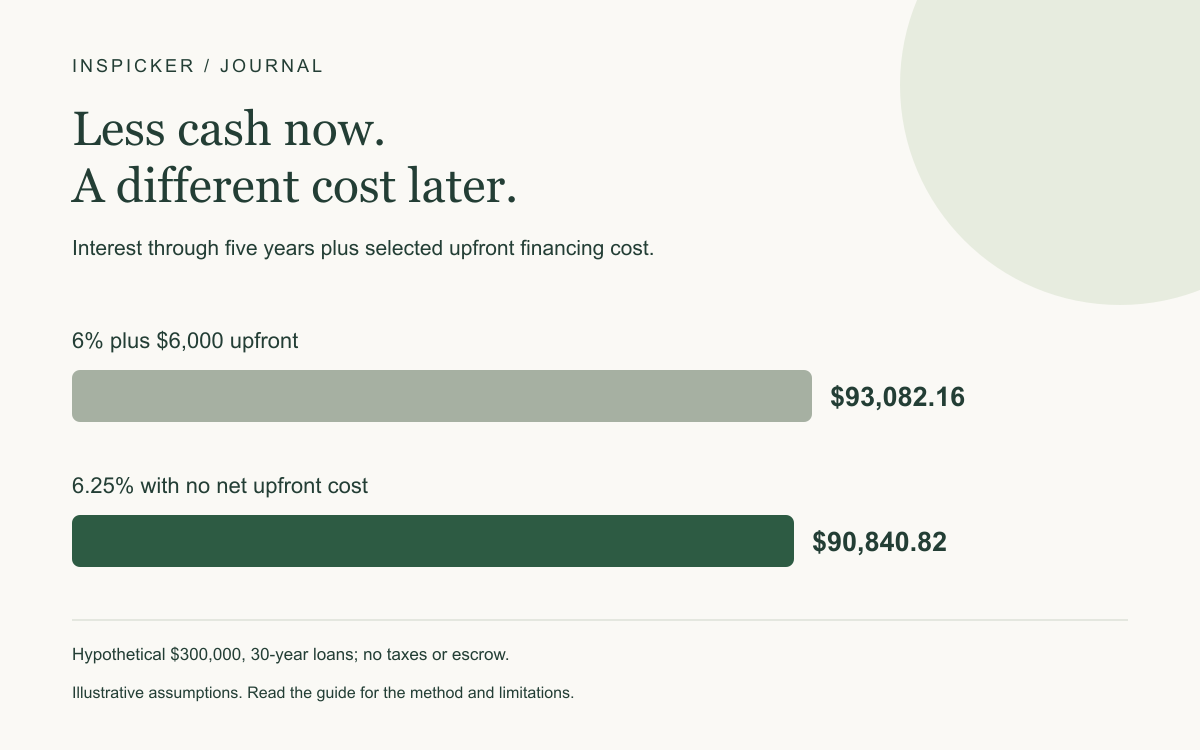
A no-closing-cost refinance can replace an upfront payment with a higher rate or a larger loan. It does not necessarily remove the economic cost. Compare the amount borrowed, rate, term, credits, and the time you expect to keep the mortgage.
In this hypothetical comparison, a $300,000, 30-year loan at 6% with $6,000 paid upfront has a payment of approximately $1,798.65. An otherwise comparable 6.25% loan with zero net upfront financing cost has a payment of approximately $1,847.15. The lower-rate option needs a longer holding period to recover its upfront cost.
Use the mortgage refinance calculator to compare an existing loan with a selected replacement. The side-by-side offer comparison below is separate arithmetic; the tool does not automatically compare every combination of lender credits and financed fees.
Ask where the closing cost went
The CFPB’s no-closing-cost explanation describes two arrangements: a higher rate with a credit covering costs, or costs added to the loan amount. They affect the comparison differently.
With a rate-based credit, the borrower can have less cash due but pay a higher ongoing rate. With financed costs, the loan starts larger, which can increase payments and reduce equity. Do not treat these as the same offer just because both reduce cash needed now.
Also distinguish financing costs from prepaid items and escrow funding. Ask for itemized documents showing exactly which charges a credit covers and which amounts remain due. “No closing costs” is not enough detail to build a comparison.
These examples contain invented offers, not current quotes or a lender recommendation. They exclude taxes, insurance, escrow, prepayment penalties, and the opportunity cost of cash.
Hold the principal and term constant first
| Input | Lower-rate offer | Higher-rate offer |
|---|---|---|
| Principal | $300,000 | $300,000 |
| Fixed annual rate | 6% | 6.25% |
| Term | 360 months | 360 months |
| Net upfront financing cost paid in cash | $6,000 | $0 |
| Monthly principal and interest | $1,798.65 | $1,847.15 |
The higher-rate offer costs approximately $48.50 more per month, using unrounded payments internally. The selected $6,000 cash cost is not added to principal in the lower-rate path.
If both mortgages run to scheduled payoff, interest plus the selected upfront cost is approximately $353,514.57 for the lower-rate offer and $364,974.58 for the higher-rate offer. The lower-rate path costs about $11,460.01 less over that full horizon.
That lifetime difference does not establish which is cheaper if the mortgage ends in five years. Fees are paid early, while the rate difference affects future payments and principal reduction over time.
A simple payment-based calculation gives about 124 months
Divide the extra upfront cost by the monthly payment difference:
$6,000 ÷ $48.5000… = approximately 123.71 months.
On a simple cumulative-payment basis, that is about 124 monthly payment periods, or a little over ten years. Before that point, the lower installments have not offset all the extra cash paid upfront.
This is not a complete economic break-even calculation. It ignores the remaining balance difference and the timing value of money. It also assumes the same rate and installment continue and no extra payments occur.
Do not use “I will own the house for ten years” as an automatic substitute for the loan holding period. You might replace the mortgage earlier, or keep it longer than originally expected. Avoid assuming another refinance will certainly become available.
For the broader distinction between cash flow and borrowing cost, see the refinance break-even guide.
Compare payments plus the remaining payoff balance
For a five-year exit, count the first 60 payments, add the remaining principal, subtract the original $300,000 principal, and add the cash financing cost. This gives interest paid through the exit plus the chosen upfront cost, without counting repaid principal as an expense.
| Five-year comparison | Lower rate plus cash cost | Higher rate, zero net upfront cost |
|---|---|---|
| Interest through 60 payments plus upfront financing cost | $93,082.16 | $90,840.82 |
Under those assumptions, the higher-rate offer is approximately $2,241.34 cheaper at five years, even though its installment is larger and its full-term interest cost is higher.
This exit-date comparison does not include a future sale fee, refinance fee, tax effect, or investment return on cash retained. Such items need consistent treatment if they differ between paths.
The result demonstrates why a lower rate, a lower payment, and a lower cost over your actual horizon are related but different questions. Keep the holding-period assumption beside the comparison rather than hiding it in a lifetime total.
Adding costs to principal needs a different comparison
If $6,000 of costs are added to a $300,000 payoff amount, the new balance would be $306,000 before any other adjustments. That is not the same principal as either offer above.
The refinance calculator uses the entered balance for both its current and replacement schedules. Its closing-cost field is included in the cost comparison but does not independently raise the replacement principal. It therefore does not directly reproduce every financed-cost offer.
Do not simply set the whole comparison balance to $306,000: that would also change the modeled current loan. Use a separate amortization calculation or lender schedules to compare unequal principals correctly.
Likewise, do not add a $6,000 cash cost and also add the same $6,000 to principal unless both are truly paid. That would count one charge twice.
Ask for the amount financed, the actual payoff being replaced, net credits, and cash due. Reconcile those figures before treating a quote as comparable with another.
Use the refinance tool to compare keeping versus replacing
Enter the actual remaining balance, existing rate, and months left on the current mortgage. Then enter the proposed rate, new term, and relevant cash closing costs.
Repeat with the alternative offer while keeping the current-loan inputs unchanged. Compare payment relief, term extension, and interest cost. Do not mistake each offer’s comparison with the old loan for a complete direct comparison between the two offers at an early exit.
A longer replacement term can lower the payment while extending borrowing. A lender credit does not remove that separate term question. The budget planner can help assess monthly affordability, while the financing comparison addresses cost.
Common questions about no-closing-cost refinancing
Does no closing cost mean the loan is free to originate?
No. Identify whether a credit, higher rate, larger balance, or another arrangement covers the cost. Review the actual itemization.
Which selected offer is cheaper after five years?
The 6.25% offer is about $2,241.34 cheaper in the stated five-year interest-plus-cost comparison. At full scheduled payoff, the 6% offer with the cash cost is cheaper.
Is 124 months the exact economic break-even?
No. It is the payment-only estimate. Remaining principal, cash timing, and other differences require a fuller analysis.
Does the calculator automatically finance closing costs?
No. Its cost field does not separately increase only the new principal. An offer with unequal loan balances needs an adjusted comparison.
Method: hypothetical fixed-rate monthly amortization, equal principal and term, scheduled payments, and an upfront cash cost on one offer. No taxes, escrow, penalties, reinvestment return, or future transaction costs are included.
For education and planning. Check assumptions and product terms before making a financial decision.
Put the numbers to work ↗