Debt / Loan comparisons
Why Debt Consolidation Can Lower Your Payment and Cost More
Compare a $10,000 balance over 36 and 60 months. See how a lower consolidation payment can mean more interest, then account for fees and payoff terms.
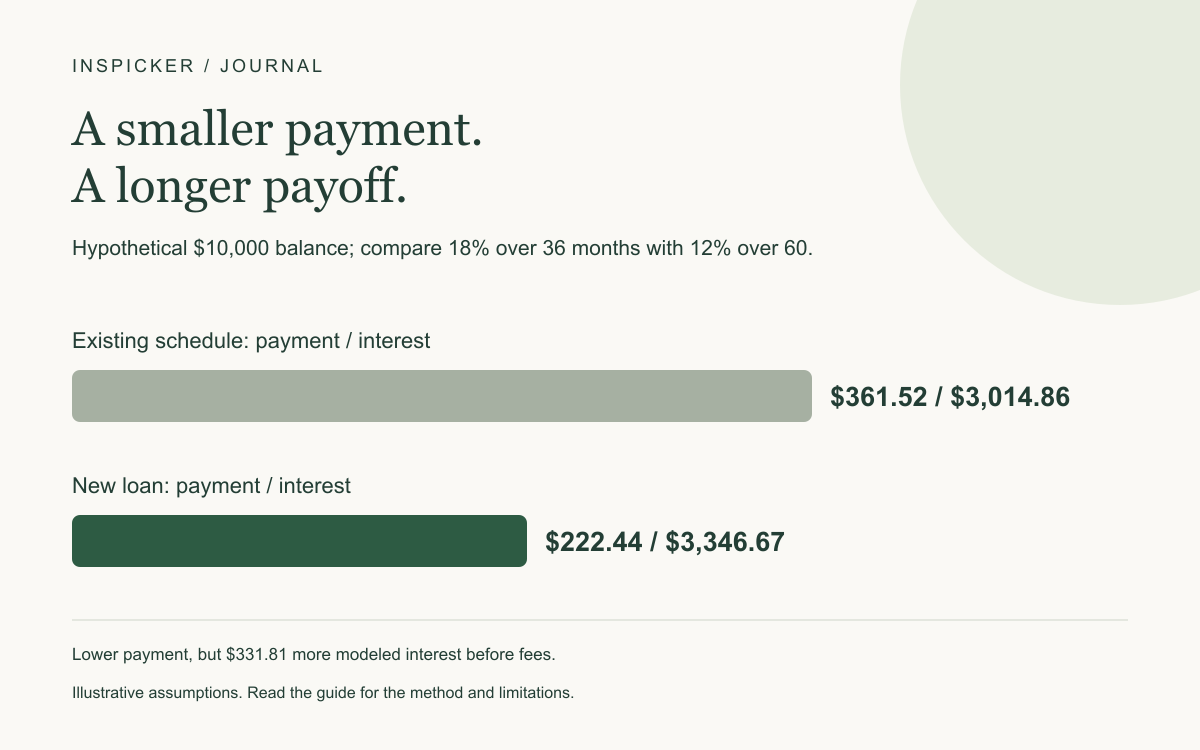
A debt consolidation loan can lower your monthly payment and still cost more overall. The payment may fall because the new loan stretches repayment over more months, adds fees, or both. Compare the full payoff schedules and total borrowing costs before deciding.
In a simplified example, a $10,000 balance at 18% paid over 36 months costs about $361.52 per month and $3,014.85 in interest. A new $10,000 loan at 12% over 60 months costs about $222.44 per month, but $3,346.63 in interest before fees. The new payment is lower by about $139.08 while modeled interest is higher by $331.78.
Use InsPicker’s debt consolidation calculator to compare assumptions. The example is hypothetical: it holds a constant rate on each path, adds no new charges, and does not represent a lender offer.
A lower payment can come from a longer term
Assume a single $10,000 balance is being repaid with fixed monthly payments. Compare the existing schedule with a hypothetical new loan:
| Selected assumption | Existing debt | Consolidation loan |
|---|---|---|
| Starting principal | $10,000 | $10,000 |
| Annual contract rate | 18% | 12% |
| Term | 36 months | 60 months |
| Separate fee | $0 | $0 |
| Extra borrowing | None | None |
| Approximate monthly payment | $361.52 | $222.44 |
| Approximate interest over term | $3,014.85 | $3,346.63 |
| Approximate total repaid | $13,014.85 | $13,346.63 |
The new loan’s rate is lower, but its term is two years longer. In this model, that combination reduces the monthly payment while increasing interest by about $331.78. The first payment difference is roughly $139.08; that monthly relief is not the same as total savings.
The CFPB describes this same consideration: a consolidation loan might offer a lower rate, while a lower monthly payment may reflect a longer repayment period. Fees and the full repayment term belong in the comparison too. See its debt consolidation guidance.
Track three different questions
Before treating an offer as a saving, answer these separately:
- Can I afford the required payment? Include rent or mortgage, utilities, insurance, food, transport, and other minimum debt payments in your budget plan.
- How much will this schedule cost? Add all scheduled interest and applicable fees, then compare equivalent starting balances and include the entire term.
- What happens after the old cards are paid? If new balances accumulate on the cards while the consolidation loan remains, total debt can rise instead of fall.
The CFPB warns that moving debts into one loan does not automatically resolve the spending or cash-flow pattern that created them. Continue paying creditors as agreed until the new loan has actually paid them, and verify each account’s resulting balance. Do not assume that receiving loan proceeds itself clears every debt.
If the monthly payment is the immediate problem, a lower required amount may help cash flow, but check whether the offer is fixed or promotional and what happens when a teaser rate ends. Read the written terms instead of relying on an advertised payment alone.
Include fees and the actual amount needed to pay creditors
A quote may include an origination fee, documentation charge, optional insurance, or another cost. The CFPB advises reviewing the loan disclosures for fees. Its overview of personal installment loan fees lists several charges that may affect the total.
This calculator models its origination fee as added to the new loan balance. If the hypothetical 12% loan above has a $500 fee added to principal, it finances $10,500. Over 60 months, the payment becomes approximately $233.55 and interest approximately $3,513.96. Add the $500 fee and the modeled borrowing cost is approximately $4,013.96, before any other charges.
That fee treatment is only one structure. If a lender deducts its fee from proceeds, you may receive less cash than the amount owed to creditors. If you finance the fee, the principal grows. Confirm the net proceeds, all-in amount financed, and payoff amount due for each existing account.
A current statement balance may not equal the payoff amount on a specified date, particularly when interest accrues between the statement and payment. Request payoff figures where applicable, then verify the destination accounts are paid as intended.
A consolidation loan does not make old credit unavailable
After a transfer or payoff, avoid using the cleared cards to recreate balances unless the new spending fits a repayment plan. Otherwise, the household can end up with both the consolidation payment and new revolving debt.
If the current payments are unaffordable, contact the creditors and ask about hardship options before missing payments. A nonprofit credit counselor may help review a budget and available repayment plans. Debt settlement is different from consolidation; companies promising to eliminate debt may have risks and costs of their own. The CFPB explains these distinctions in its guide to credit counseling, consolidation, and settlement.
Compare the example in the debt consolidation calculator
Enter $10,000 of existing debt, an 18% current rate, and a 36-month payoff. Then compare a new loan at 12% for 60 months with a zero origination fee. Record payment, interest, fee, and total loan cost.
Next, change the new loan fee to $500 and confirm how the modeled payment and total cost change. The tool approximates multiple debts as one balance at a weighted-average current APR and a fixed payment. Real cards can have different minimums, changing balances, and different daily or monthly interest methods. It assumes the consolidation fee is financed, uses fixed rates and payments, and does not model promotional rates, new purchases, missed payments, or a creditor’s exact payoff quote. See the origination fee worked example for another comparison.
Common questions
Does a lower monthly consolidation payment mean I save money?
No. The payment may be lower because the loan term is longer, even when the total interest and fees increase. Compare both the monthly amount and full scheduled cost.
Is a lower interest rate always cheaper?
Not necessarily. A lower rate can be offset by a longer term, fees, or a larger financed balance. Use the actual written terms and compare the total amount repaid.
Should I close the credit cards after consolidating?
That depends on the account terms and your circumstances. The calculation does not answer credit-score or account-management questions. Avoid adding new balances that you cannot repay while the loan is still outstanding.
What if I cannot afford the consolidation payment?
Do not rely on a payment estimate that exceeds your available budget. Contact current creditors promptly to ask about options and consider speaking with a nonprofit credit counselor. A new loan is not the only way to address unaffordable payments.
Method: original fixed-rate amortization examples checked with InsPicker’s loan calculations. Sources reviewed November 5, 2026. This comparison is educational and does not guarantee savings or lender approval.
For education and planning. Check assumptions and product terms before making a financial decision.
Put the numbers to work ↗