Debt / Balance transfers
3% vs. 5% Balance Transfer Fees: When the Longer Offer Wins
Compare a lower transfer fee with a longer 0% offer using the same balance and payment. See when post-promotion interest changes which offer costs less.
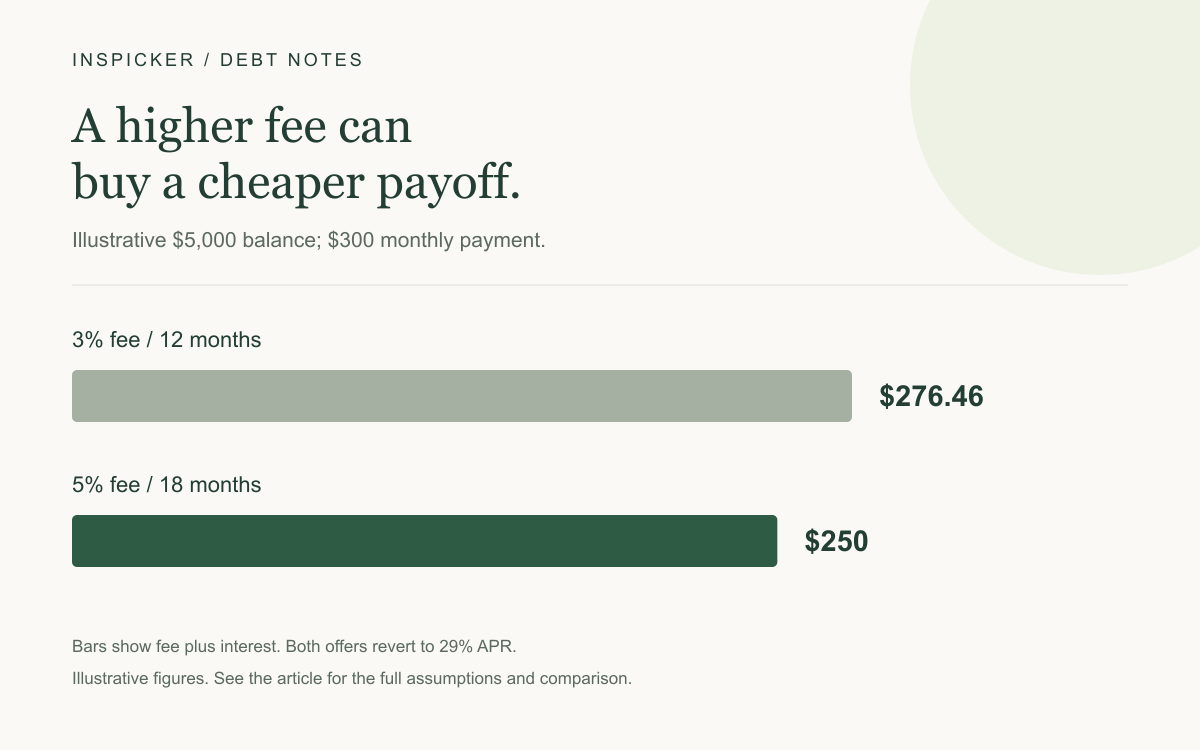
A 3% balance transfer fee is not always cheaper overall than a 5% fee. If the higher fee buys a longer 0% period, it can avoid enough later interest to win. Compare the entire payoff schedule using the same balance and monthly payment.
In our hypothetical $5,000 example, a 3% fee with 12 months at 0% costs $276.46 in fee and interest at $300 monthly payments. A 5% fee with 18 months at 0% costs $250. The more expensive upfront fee produces the cheaper payoff.
At $500 monthly payments, both offers clear during their promotions. The 3% fee then wins by $100. Your repayment budget can change the better offer.
Use the balance transfer calculator to test each offer separately.
Compare fees, duration, and follow-on APR together
A percentage fee should first be converted to dollars. On $5,000, 3% is $150, while 5% is $250. The upfront difference is $100.
The CFPB confirms that fees may apply even to zero-percent transfer offers. The percentage alone does not show total repayment cost.
For the comparison, list the amount approved for transfer, fee and minimum dollar charge, promotional APR, expiry, follow-on APR, and any additional unavoidable charges. An annual fee can alter the apparent saving.
Here are the fictional offers used throughout the article:
| Term | Offer A | Offer B |
|---|---|---|
| Debt transferred | $5,000 | $5,000 |
| Transfer fee | 3%, or $150 | 5%, or $250 |
| Starting balance including fee | $5,150 | $5,250 |
| Promotional APR | 0% | 0% |
| Promotional duration | 12 modeled months | 18 modeled months |
| Follow-on APR | 29% | 29% |
| Initial payment comparison | $300 monthly | $300 monthly |
We assume the fee is added to the balance and receives the promotional rate, there are no new purchases or other charges, and the full debt can be transferred. Monthly interest accrues before each payment. Real billing dates and daily interest can produce different totals.
At $300 per month, the longer offer wins
With Offer A, twelve $300 payments remove $3,600 from $5,150. That leaves $1,550 when the assumed promotion ends.
In the first following month, 29% annual interest divided by twelve adds approximately $37.46 before the next payment. Subsequent interest falls as the balance is repaid. Across the remaining schedule, post-promotion interest totals approximately $126.46.
Offer A's total financing cost is therefore $150 + $126.46 = $276.46.
With Offer B, seventeen $300 payments leave $150. A final $150 payment in month 18 clears the $5,250 balance within the promotion. The total financing cost is the $250 fee, with no interest in this model.
| Result at $300 monthly | Offer A: 3% / 12 months | Offer B: 5% / 18 months |
|---|---|---|
| Balance after month 12 | $1,550 | $1,650 |
| Payoff month | 18 | 18 |
| Transfer fee | $150 | $250 |
| Later interest | $126.46 | $0 |
| Total fee and interest | $276.46 | $250 |
| Total repayment | $5,276.46 | $5,250 |
Both finish in the same modeled month, but Offer B costs $26.46 less. The additional $100 fee avoided about $126.46 of later interest.
This is a narrow margin. A different payment date, fee treatment, or additional charge could change it. Do not treat the illustration as proof that every longer offer is better.
At $500 per month, the lower fee wins
At a $500 payment, Offer A clears its $5,150 starting balance in 11 months. Offer B also clears in 11 months, with a larger final payment.
Both complete during their respective 0% periods:
| Result at $500 monthly | Offer A | Offer B |
|---|---|---|
| Payoff time | 11 months | 11 months |
| Interest under the stated assumptions | $0 | $0 |
| Fee and total financing cost | $150 | $250 |
The longer promotion is unused repayment time in this scenario. Offer A's lower fee saves $100.
A useful comparison tests the amount you realistically expect to pay and a lower fallback amount. If your budget can sustain $500 only briefly, do not choose an offer based on making that payment every month.
For judging either offer against staying on the original card, read is a balance transfer fee worth it?. This article compares two transfer offers with each other.
Calculate the payment needed to avoid later interest
For a true 0% offer, divide the balance including its fee by the payment opportunities before the actual promotional expiry.
| Target | Offer A | Offer B |
|---|---|---|
| Starting balance including fee | $5,150 | $5,250 |
| Assumed available payments | 12 | 18 |
| Rounded-up monthly target | $429.17 | $291.67 |
The target is rounded upward so ordinary cent rounding does not leave a small final balance. It assumes every listed payment happens in time and no additional charges are added.
A shorter available window raises the target. If Offer A effectively allows only eleven payments before expiry, $5,150 divided by eleven requires $468.19 per payment when rounded up.
This division does not apply unchanged to a nonzero promotional rate, separate fee APR, multiple balance categories, or deferred-interest structure.
Read dates and restrictions before counting months
A promotion may be measured from account opening, not from the day your transfer finally posts. The deadline to request a transfer may also differ from the interest-rate expiry. Identify both dates.
Confirm the approved transfer limit and whether the fee counts against available credit. If only part of your debt moves, include the balance left on the old card and its ongoing payment.
Continue meeting obligations on the existing account until the transfer is confirmed. Processing time and residual interest can leave a small balance behind.
Do not assume the transfer's promotional rate applies to new purchases. Carrying the transferred balance can also affect purchase grace periods; see the CFPB's purchase-interest explanation.
A true 0% promotion is different from deferred interest, which can involve retroactive charges if its conditions are not met. The CFPB's promotional-financing guide explains that distinction. Our comparison models true promotional APRs, not deferred interest.
Compare each offer using the same payment
Run the calculator with your old balance and APR, then enter Offer A's fee, duration, promotional rate, and follow-on APR. Record transfer cost and payoff timing.
Rerun with Offer B while keeping the balance and monthly payment unchanged. Compare the transfer costs directly; the “saving versus staying” figure uses a third alternative and should not be mistaken for a direct offer-to-offer comparison.
Repeat with a lower affordable payment. If the result changes, the decision is particularly sensitive to your budget.
The tool uses a percentage fee added to principal and monthly accrual. It excludes minimum dollar fees, annual charges, processing delays, new spending, and separate fee-rate treatment. Adjust for those actual terms.
Compare both transfer offers. Use the budget planner to assess the payment commitment.
Common questions
Is a longer 0% period always worth a higher fee?
No. It helps only if it changes the interest or repayment outcome enough to justify the extra cost. A rapid payoff can make the additional months irrelevant.
Does paying the fee reduce the old debt?
No. Under our assumptions it adds to the new balance. Include it in the promotional payoff target.
What if both offers run past their promotions?
Calculate the follow-on interest for both schedules. Comparing fees alone is even less reliable when neither offer finishes at 0%.
Should I assume I will transfer again later?
Do not make the decision depend on an unapproved future offer. Price the current schedule using its known follow-on APR and your realistic payment.
Editorial note: These offers are fictional. Monthly calculations illustrate how fees, duration, and payments interact; they do not guarantee actual issuer costs or approval.
For education and planning. Check assumptions and product terms before making a financial decision.
Put the numbers to work ↗